
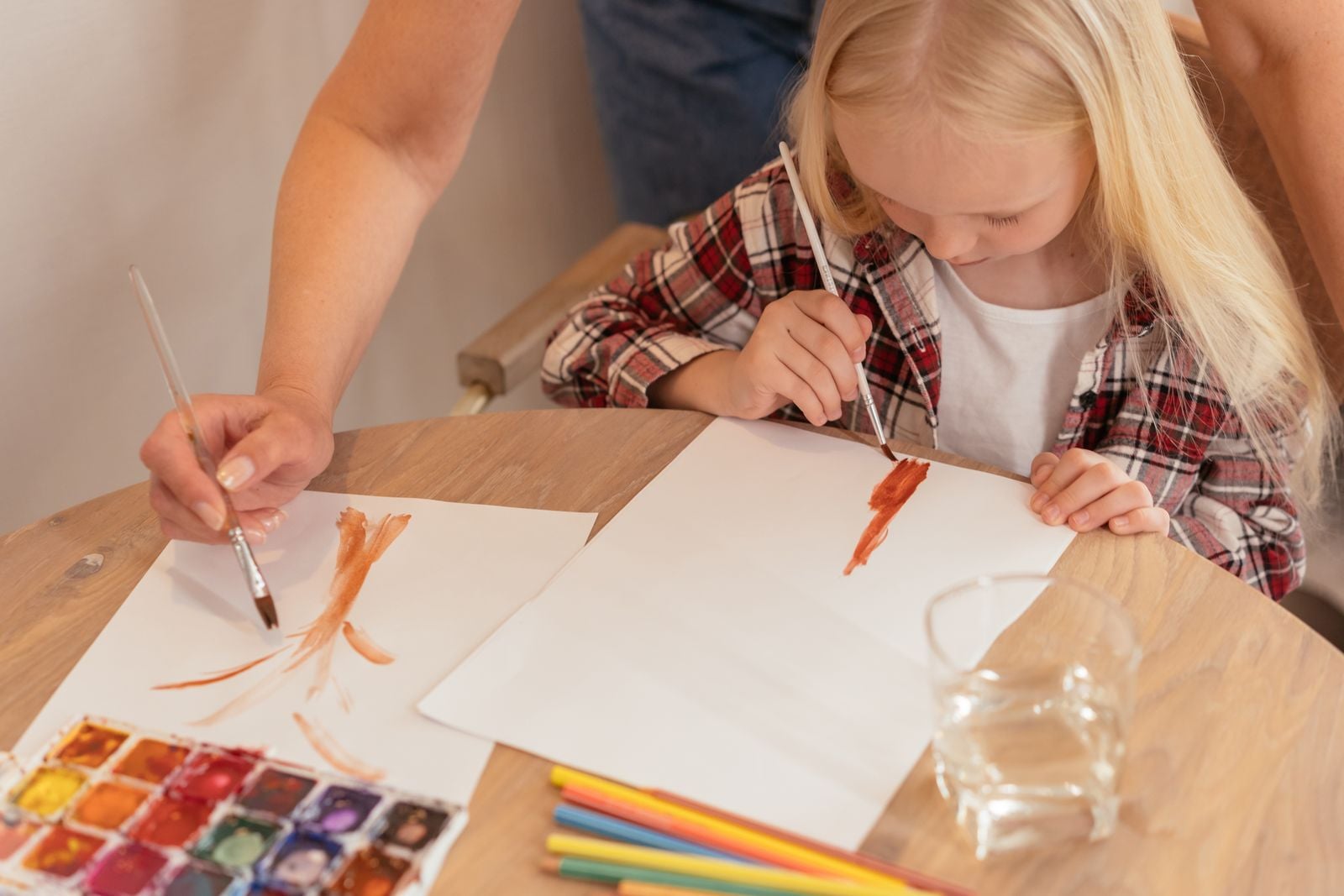

Wax crayon on paper, then a wash of watercolour on top, and the paint flees the waxed lines like water off a duck’s back. The pigment pools in the untouched fibres of the paper and beads up on the crayon marks, leaving the drawing floating in a field of colour. The reason is molecular: the paraffin in a standard crayon is a long-chain hydrocarbon, and long-chain hydrocarbons don’t want anything to do with water. The same chemistry that makes lotus leaves shed rain is doing quiet work on a kitchen table covered in newspaper.
Crayola’s basic recipe is paraffin wax and colour pigment, pressed into a stick. Paraffin is a mix of saturated hydrocarbons — carbon atoms strung in chains, each surrounded by hydrogens, with no charged spots anywhere along the molecule. Water, by contrast, is a small bent molecule with a strong positive end and a strong negative end. Water molecules cling to each other because those opposite charges pull. They cling to paper fibres for the same reason. On a bar of paraffin, there is nothing to cling to.
What “hydrophobic” actually means on the page
The word gets used loosely. It doesn’t mean the wax is pushing the water away — nothing is actively repelling anything. It means the water molecules would rather stick to each other than spread out across a surface that offers them no grip. So they contract. A droplet on paraffin pulls itself into a bead because the surface tension at the water-air interface is stronger than any attraction to the wax below.
Contact angle is how chemists measure this. Drop a bead of water on a surface and look at it from the side. If the water spreads flat, the contact angle is low and the surface is hydrophilic. If the water sits up in a dome, the angle is high and the surface is hydrophobic. Paraffin sits comfortably above 100 degrees. Researchers modifying cellulose fibres with hydrophobic coatings have achieved contact angles above 130 degrees, which is roughly what a crayon line manages on decent paper.
A child painting over a wax drawing is running the same experiment. Every stroke of the brush pushes water across a landscape that is chemically two things at once: bare paper, thirsty and full of hydroxyl groups that grab water molecules, and waxed paper, slick and indifferent. The pigment travels with the water, so wherever the water goes, the colour goes.
Why the pigment beads instead of vanishing
The pigment doesn’t disappear from the waxed area. It rides along on the surface of the water bead until the bead shrinks, and then it settles wherever the water was last touching. On heavy wax coverage, you often see tiny freckles of colour trapped in the low spots of the crayon — places where the wax didn’t fully fill the paper’s tooth. The paper’s texture matters as much as the wax.
This is why the effect works better on cold-press watercolour paper than on printer paper. Cold-press has visible grain — little valleys the crayon skips over on a light pass. Water sinks into those valleys and stains them. Printer paper is smoother and thinner, so the wax fills it more completely and the water has fewer places to hide.
The technique has a name in the art world: wax resist. Children discover it accidentally. Industrial chemists have been chasing the same molecular behaviour for decades to build surfaces that harvest water from fog or shed it entirely, using arrays of hydrophobic bumps modelled on beetle backs and lotus leaves.
The candle in the drawer is the same molecule
Household paraffin is paraffin. The wax in an unscented candle, the wax coating on a wheel of imported cheese, the wax on the underside of a surfboard, the wax in a crayon — all long-chain alkanes, mostly between about 20 and 40 carbons long. Rain doesn’t soak into a candle for the same reason paint doesn’t soak into the crayon line. There is no chemical handhold.
Candle soot, made by holding glass over a candle flame, is being studied as a coating in its own right. Researchers have used dispersed candle soot particles to build superhydrophobic surfaces that resist water jets and stay stable at high temperatures. The soot is mostly carbon nanoparticles with a rough, fractal structure, and roughness is the second half of the water-repellent story. A flat waxed surface beads water. A rough waxed surface beads it harder, because air gets trapped in the gaps under the droplet, and water can’t sit on air.
Why kids find this magic on the first try
The moment of surprise is not small. A child scribbles with a white crayon on white paper — invisible ink, effectively — and then washes blue over the top. The scribble emerges. It looks like the paper was remembering something.
Children’s brains are particularly attuned to this kind of causal surprise. In early childhood, neural connections are forming rapidly, and process-based art activities land in that window — they give the brain a stack of small, sensory mysteries to work on.
Wax resist is one of the tidier mysteries. There is a clean rule (wax stays, water goes) and a clean visible outcome. The child doesn’t need vocabulary for hydrophobicity to notice that this material behaves differently from that material. The knowledge lands in the hands first.
What the paper is doing under the paint
Paper is mostly cellulose — long chains of glucose units, studded with hydroxyl groups. Those hydroxyls are the reason paper accepts watercolour at all. They form hydrogen bonds with water molecules, pulling the water into the fibre matrix and holding the pigment there as the water evaporates.
Coating cellulose to make it water-resistant is a serious industrial project. Food packaging companies have spent years replacing plastic linings with biodegradable options, and paraffin wax is one of the oldest solutions on the list. Research on biodegradable polymers for sustainable applications has shown that hydrophobic surface modification of cellulose remains central to packaging development, because keeping water out of paper is genuinely difficult once you’re competing with plastic.
A crayon does exactly this, poorly and locally. The paraffin fills the surface fibres of the paper along the line of the stroke, sealing off the hydroxyls from any incoming water. Everywhere the crayon didn’t touch, the paper stays thirsty.
The pressure of the crayon matters
A light scribble leaves gaps. A hard, waxy line seals the paper completely. This is why children who press hard get a stronger resist effect — they’re laying down more paraffin per square millimetre, filling more of the paper’s tooth, blocking more of the water’s grip points.
Older children figure this out through trial. A white crayon pressed lightly on white paper gives a ghostly, patchy image under a wash. Pressed hard, it gives a bright, sharp reveal. The technique rewards commitment to the mark.
Oil pastel behaves similarly but not identically. Oil pastels use non-drying oils and softer binders instead of pure paraffin, so they smudge more and resist less consistently. Beeswax crayons — the kind sold for Waldorf classrooms — have a different molecular makeup again, a mix of long-chain esters and fatty acids rather than pure hydrocarbons, and they resist water slightly less aggressively but blend more smoothly.
Where the technique came from
Wax resist as a decorative technique has ancient roots. Batik, the Indonesian textile art, uses hot wax drawn onto cloth, then dyed. Where the wax sits, the dye can’t reach. The cloth is boiled to remove the wax at the end, leaving a pattern that can be layered and re-waxed to build up multiple colours.
The crayon-and-watercolour version is much younger. Wax crayons became widely available in the early twentieth century, and the resist trick appeared in classroom art curricula in the following decades as an entry-level version of batik that didn’t require heat, dye baths, or supervision beyond the usual. The chemistry is identical. The wax is different, the substrate is different, but the principle — hydrophobic mask, hydrophilic ground, water-based colour — has not changed.
Lacquer traditions in East Asia used a related logic. Ming and Qing dynasty furniture makers built waterproof lacquer layers using tree sap and organic fillers, and researchers have shown that traditional recipes using fish glue as a reinforcing filler produced coatings with genuinely impressive water resistance, still intact on furniture centuries later. Different molecules, same problem: keep the water out.
What happens when the wax fails
Push a child’s wax resist far enough and it breaks. Very wet washes, sitting on the crayon for a long time, will eventually seep in at the edges — not through the wax but around it, wicking through the paper fibres from the wet zone into the dry. The water finds the cellulose under the crayon and stains the paper from below.
Warm the wax and it stops working entirely. Paraffin’s melting point sits between 46 and 68 degrees Celsius depending on the exact blend. A hairdryer aimed at a wax drawing melts the paraffin into the paper, and the resist collapses. This is the trick behind crayon-melt art: heat turns the wax from a barrier into a soaking stain.
Chemists working on flexible electronics have exploited the same reversibility in reverse — building stretchable water-repellent coatings that keep their hydrophobic properties even under mechanical strain, useful for wearable sensors. The molecules that repel water on a child’s drawing are the same class of molecules being engineered into next-generation electronics.
A kitchen table full of physical chemistry
Wax resist is one of a small handful of art activities that lets a child touch a real physical principle directly. Cornstarch and water is another — squeeze the slurry and it turns into a solid, relax the hand and it drips, a shear-thickening fluid that only exists while it’s being touched. Salt painting works because sodium chloride pulls water into itself as the paint dries. Bubble prints work because surfactants lower water’s surface tension.
None of these need adult explanation to work. A child can do wax resist for years and simply know, in their hands, that crayon repels paint. The chemistry lives in the muscle memory before it lives in the vocabulary. For more entry points into this kind of hands-on colour play, watercolour activities for kids is a good place to look.
The blue pools around the waxed lines. The pigment settles into the paper’s grain where the fibres are thirsty. The bead of water on the crayon shrinks as it evaporates, leaving a fine ring of colour where it last sat. A four-year-old with a paintbrush is running, without knowing it, one of the oldest experiments in surface chemistry — the same one being run right now, in cleaner labs with better instruments, on the way to the next generation of self-cleaning glass.