

I watched something shift in my mom last Saturday and it stopped me mid-step.
She was sitting cross-legged in the grass with Ellie, sorting through a basket of leaves they’d collected from the backyard. No timer running. No next activity lined up. Just my mom, turning each leaf over slowly, listening to my five-year-old explain which ones were “the crinkly kind” and which were “still a little bit alive.”
My mom never did this with me.
Not because she didn’t love me — she did, fiercely. But when I was Ellie’s age, she was running a household on a razor-thin budget, cooking everything from scratch, managing three kids and the low hum of anxiety I only now, as a mother myself, recognize for what it was. She didn’t have the bandwidth to sit with leaves. She was too deep in the machinery of keeping us all going.
And honestly? That’s the thing about grandparents that I keep turning over in my mind. The ones who truly build deep, lasting bonds with their grandchildren are offering something that we, as parents, structurally cannot give — not because we’re failing, but because our role is fundamentally different. We are in the thick of it. We are managing bedtimes and meal prep and the mental load that never fully powers down. Grandparents, when they show up well, get to arrive without all that weight.
And that changes everything.
Love that comes without a to-do list
Have you ever noticed how a grandparent can make a child feel like the most important person in the room just by paying attention? Not redirecting, not multitasking, not mentally running through the grocery list while nodding along — just genuinely present?
That kind of attention is rare. And kids can feel the difference.
When Milo — my two-year-old — is with my parents, he crawls into my dad’s lap and just stays there. No agenda. My dad isn’t checking the time or wondering when nap should start. He’s just holding my boy. And Milo melts into it in a way that’s different from how he melts into me. With me, there’s always a subtle undercurrent of “what’s next.” With my dad, there’s just now.
I don’t say this to romanticize it or to suggest that parents aren’t giving enough. We are giving everything. But the role of a grandparent carries a quality that parenting can’t replicate: presence without responsibility for the outcome. They can love without managing. They can show up without running the show. That distinction matters more than we might think.
The attachment village we were always meant to have
Here’s something that really reframed the way I think about this. Developmental psychologist Dr. Gordon Neufeld, who co-authored Hold On to Your Kids with Dr. Gabor Maté, talks about how for centuries, children were deeply attached not just to their parents but to grandparents, extended family, and other trusted adults in what he calls the “attachment village.” He describes this as “cascading care” — the idea that we’re all meant to be embedded in layers of connection, where being cared for by someone empowers us to care for the ones who depend on us.
Related Stories from The Artful Parent
- We chose the wrong dog for our family and spent three years learning why breed matters more than most people admit — here’s what I wish someone had told us before we fell in love at the shelter
- I’m 35 and I just realized my parents weren’t the moral anchors I built my entire value system around — they were just two people who got really good at performing certainty while making it up as they went along
- Psychology says parents who lose the respect of their adult children don’t lose it because they were imperfect, they lose it because they were unreachable—too defensive to reflect, too prideful to apologize, and too afraid of shame to become the parent their adult child still wanted to trust
That idea hit me hard, because it names the thing so many of us feel but can’t quite articulate. We weren’t designed to do this alone. And grandparents aren’t just bonus babysitters or occasional visitors — they’re part of the architecture of a child’s emotional world.
When my parents visit and Ellie runs straight to my mom with her latest nature collection or her newest made-up story, I can physically feel something release in my chest. Not because I’m off duty, exactly. More because I can see my daughter being held by someone else’s love, and it reminds me that she has roots that extend beyond just me and Matt.
What unhurried really looks like
I think one of the most underestimated gifts a grandparent can offer is simply time that doesn’t feel like it’s going anywhere.
As parents, even our most intentional moments have edges. We know the bath still needs to happen, the lunches need packing, the laundry is growing sentient in the hallway. Our attention has limits because our responsibilities don’t.
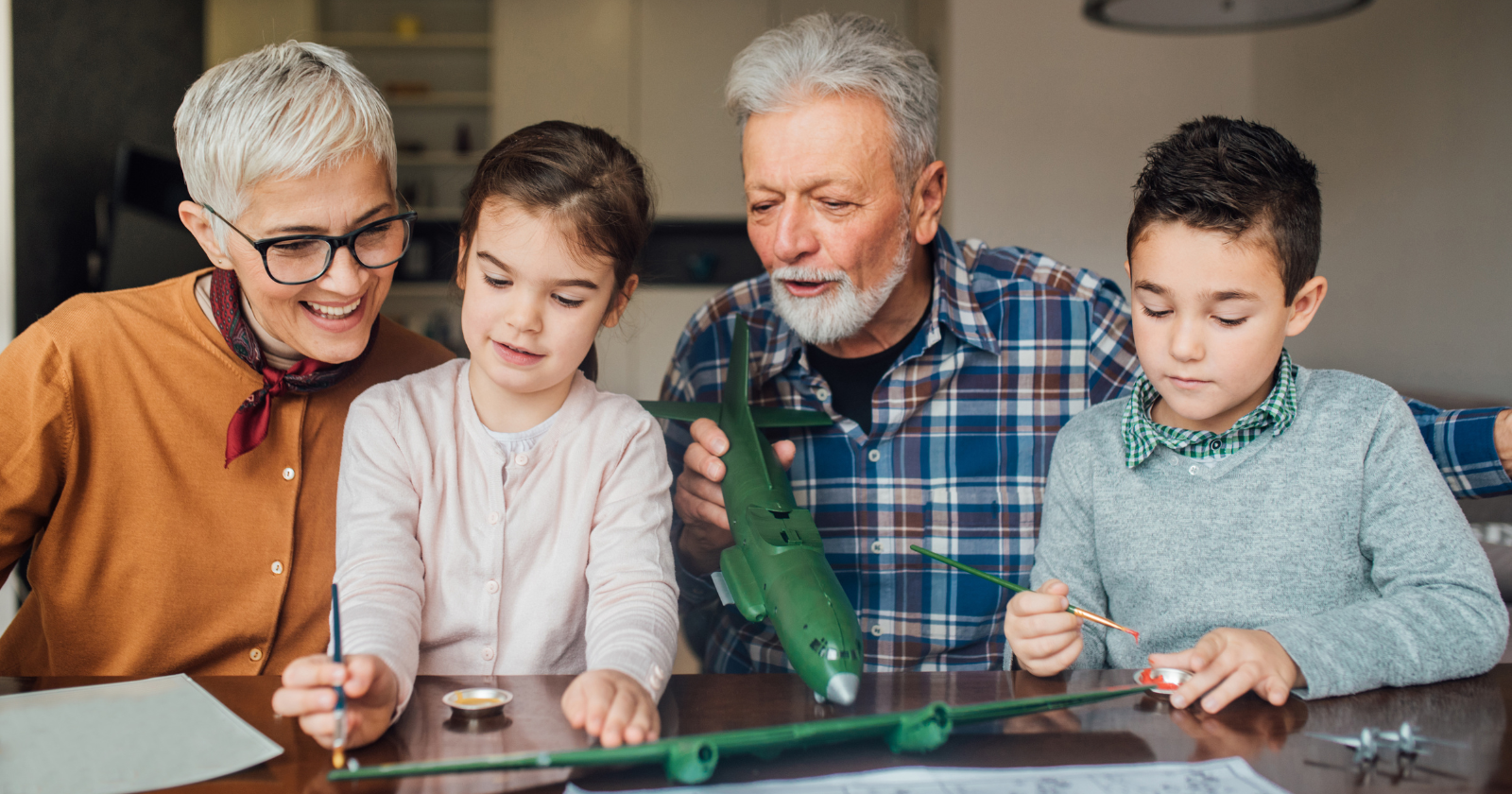
Grandparents who are truly present with their grandkids operate in a different gear. They read the book a third time because the child wants to, not because it fits the schedule. They let the walk take twice as long because there are puddles to splash in. They sit on the floor and build the block tower again and again without checking a clock.
That kind of unhurried presence teaches a child something language can’t. It says: you are worth slowing down for. You are not an interruption. You are the point.
When the relationship isn’t easy
I want to be honest about something, because I think it matters.
My relationship with my parents hasn’t always been smooth around parenting. I grew up in a fairly traditional Midwest home where my dad worked long hours and showed love through providing rather than talking, and where family dinners happened nightly but conversations stayed surface-level. When I started making different choices — co-sleeping, extended breastfeeding, cloth diapers, gentle discipline — my parents didn’t exactly throw a parade. “Hippie parenting” is the phrase that’s come up more than once.
So when I talk about grandparents building bonds, I’m not pretending it happens automatically or that it’s always comfortable. Sometimes it takes years of quiet negotiation. Sometimes it takes biting your tongue when they hand your kid a juice box you’d rather not have in the house, or when they default to “stop crying” when you’ve been working hard to teach your children that big feelings are welcome.
But here’s what I’ve learned: grandparents don’t have to parent the way you parent in order to love your child deeply. The bond they’re building operates on different terms. And sometimes the slightly different rules at Grandma’s house are actually part of what makes the relationship special — it’s a separate world with its own rhythms, and kids are smart enough to hold both.
My parents are slowly coming around. And honestly, watching them soften — watching my dad get on the floor with Milo, watching my mom follow Ellie’s lead instead of directing — has been one of the most healing things about this whole journey. They’re re-learning, and they’re doing it because they love my kids enough to try.
Why it matters for the child
This isn’t just about warm feelings. Research backs up what many of us sense intuitively. As noted in a Psychology Today review of the research, grandparent involvement during childhood — defined by both contact frequency and emotional closeness — is positively linked to emotional development, cognitive functioning, and social adjustment that lasts well into adulthood. Children who are close to a grandparent tend to show fewer behavioral and emotional difficulties, and the lessons they learn from that relationship — about values, patience, family identity — stick with them long after childhood ends.
I think about that when I watch Ellie and my mom together. Ellie is learning something in those quiet leaf-sorting moments that I can’t teach her, because I’m her mom and my job is different. She’s learning that she can be deeply known and loved by someone whose only agenda is her.
That’s not a small thing. In a world that will eventually ask her to perform, achieve, and prove herself — having a person in her corner whose love has nothing to do with any of that is a kind of armor.
It goes both ways
Something I didn’t expect when I became a parent was how much watching my kids with their grandparents would change my relationship with my own parents.
I spent years processing the patterns I inherited — the people-pleasing, the perfectionism, the conversations that stayed safe instead of real. I’ve done the therapy. I’ve done the journaling. But nothing cracked open my understanding of my parents quite like seeing them love my children.
Because when I watch my mom with Ellie, I see the tenderness she always had but didn’t always know how to show under the pressure of daily parenting. When I watch my dad hold Milo with zero agenda, I see the man who was always there but never quite knew how to say it. As Brené Brown wrote in Daring Greatly, who we are and how we engage with the world are stronger predictors of how our children will do than what we know about parenting. I think the same is true for grandparents. It’s not technique. It’s presence.
Grandparenting gives people a second pass at something that went by too fast the first time. And for those of us parenting right now, watching that unfold can be quietly transformative — not because it erases the hard stuff, but because it adds a layer of understanding that wasn’t there before.
In closing
Matt and I talk about this sometimes, usually during our evening check-in after the kids are in bed. How lucky our kids are to have people in their lives who love them with that specific unhurried quality — the kind that only comes from a person who has finally run out of reasons to be anywhere else.
Not every family has this. I know that. And not every grandparent is safe or healthy to have around. This isn’t about forcing a bond that isn’t there or glossing over real harm.
But where the relationship does exist — even imperfectly, even with tension around the edges — it’s worth protecting. Worth nurturing. Worth making space for, even when it’s inconvenient or complicated.
Because what grandparents offer, at their best, is something no parenting book or carefully curated routine can replace: the experience of being loved by someone whose only job is to show up. No schedule. No agenda. Just a person on the floor, sorting leaves, listening to every word.
And if you’re a grandparent reading this, or becoming one, know that the small things are the big things. The extra story. The slow walk. The unhurried lap. Your grandchild will carry those moments further than you can imagine.
