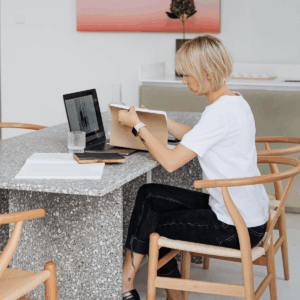
The other day I was sitting in a coffee shop during my kid-free writing hours, and I watched something I couldn’t stop thinking about. A woman finished her latte, stood up, and in one smooth motion pushed her chair neatly back under the table before heading for the door. The man at the next table did the opposite—stood up, left his chair jutting into the walkway, coat draped over the back, crumbs everywhere. Gone.
Such a tiny difference. Two seconds, tops. But it got me wondering: does that little gesture actually say something real about who a person is?
Turns out, it might. Psychology suggests that the small, almost invisible things we do—especially when nobody’s watching—can reveal a surprising amount about our personality. And if you’re someone who tucks that chair back in? The research points to some pretty admirable traits hiding behind that simple habit.
As a former kindergarten teacher, I spent seven years watching kids’ micro-behaviors tell me everything I needed to know about them long before any report card did. The child who put the cap back on the glue stick. The one who stacked the chairs without being asked. Those tiny acts always pointed to something deeper. So let’s talk about what the research actually says—and why this two-second habit might be a window into nine distinct personality traits.
It starts with how you see other people
When someone pushes their chair back in, they’re doing something psychologists call being “socially mindful”—essentially, they’re thinking about how their actions affect the people around them, even in small, low-cost ways. Research from Leiden University, led by psychologist Niels van Doesum, explored this concept across 31 countries with over 8,000 participants. Their findings, published in PNAS, showed that people who demonstrate social mindfulness in minor situations—like preserving choices for others—tend to do so consistently across many different contexts.
It’s the same impulse that makes someone hold a door, step aside on a crowded sidewalk, or leave the last slice for someone else. The chair thing is just one more expression of that awareness.
I see it with my daughter Ellie, who’s five. She’s started pushing her chair in at the dinner table without being asked, and she’s the same kid who always checks if her little brother got a turn with the toy she just put down. These things come from the same place—an almost instinctive consideration for others.
And that consideration bleeds naturally into genuine empathy. At its heart, pushing in your chair is about thinking ahead for someone else. Maybe it’s the next person who needs that spot. Maybe it’s the server carrying a heavy tray through a tight space. Maybe it’s the toddler who’ll run face-first into a chair leg that’s sticking out. (Ask me how I know—Milo has found every stray chair leg in every restaurant we’ve been to.)
Psychologists call this “perspective-taking”—the ability to step outside your own experience and imagine how your actions affect someone else’s comfort or safety. Most people who push in their chairs do it automatically, without conscious deliberation. That’s what makes it meaningful. It’s not performative kindness. It’s the real, baked-in kind.
The personality trait that ties it all together
In personality psychology, there’s a well-known framework called the Big Five—five broad traits that shape how we move through the world. One of those traits is conscientiousness, and it’s strongly linked to habits like tucking in your chair.
As Simply Psychology explains, conscientiousness describes people who are organized, dependable, and thoughtful about how their actions ripple outward. It’s the trait most consistently linked to success in work, relationships, and long-term goals. And here’s the thing—it doesn’t just show up in dramatic, high-stakes moments. It shows up in the mundane ones. The chair. The dish put in the sink instead of left on the counter. The email replied to on time.
Related Stories from The Artful Parent
- Psychology explains people who look significantly younger than their actual age in their 60s aren’t just genetically lucky — they display these 9 behavioral patterns that most people abandon sometime in their 40s without even noticing
- Most people don’t realize that childless adults over 65 are the fastest-growing demographic in assisted living facilities, not because they’re sicker or more fragile, but because they reach the threshold of needing daily help without a built-in person who feels obligated to provide it at home
- Psychology says the reason many people can’t articulate their loneliness isn’t a lack of emotional vocabulary. It’s that the specific loneliness they feel — being surrounded by people who love them in theory but have replaced genuine presence with logistical check-ins — doesn’t have a word yet, and you can’t ask for help with something you can’t name
What makes this trait so interesting is how many smaller qualities branch off from it. Attention to detail, for one. Have you ever noticed that the people who push in their chairs also tend to be the ones who notice when something’s off? A picture hung crooked. A friend’s tone that sounds a little tired. A door left slightly ajar. Their brains are wired to register details that others breeze right past, and they act on what they see.
I think back to my teaching days and remember this so clearly. The kids who put their chairs up at the end of the day were almost always the same ones who’d come tell me that the class hamster’s water bottle was empty or that another student had been sitting alone at lunch. Paying attention is a trait that extends well beyond furniture.
Then there’s the need for completion and closure. For some people, leaving a chair pulled out feels like a sentence without a period. There’s something unfinished about it. These are the folks who close cabinet doors, tie off loose ends on projects before starting new ones, and don’t leave the house without making the bed. It’s not perfectionism, necessarily—it’s more of an internal rhythm that says, “Okay, this part is done. Now I can move forward.”
My mantra around our house is “progress, not perfection,” but I’ll admit there’s something satisfying about completing a small loop—clearing your plate, wiping the counter, pushing in the chair. It tells your brain the scene is set for whatever comes next.
Self-discipline without the fanfare
Nobody’s standing there giving you a gold star for pushing your chair in. There’s no penalty for leaving it out. So why bother?
Because people who do it are exercising a kind of low-key self-discipline—pausing between impulse (get up and go) and action (leave the space tidy first). That brief moment of control matters more than it looks.
- Research suggests the reason some people can live the same day on repeat for years without distress while others feel like they’re suffocating isn’t personality. It’s whether the routine was chosen deliberately or inherited by default, because the brain processes voluntary repetition as ritual and involuntary repetition as captivity. - Global English Editing
- Life isn’t a series of random events but a chess game where every move matters - Global English Editing
- Nobody tells you that the real threat to a long relationship isn’t the dramatic betrayal. It’s the Wednesday afternoon coffee where someone at work asks how you’re really doing and you actually answer honestly for the first time in months. - Global English Editing
This is backed by experts like social psychologist Roy F. Baumeister, whose decades of research have shown that self-control functions like a muscle. People who practice small acts of discipline in everyday life tend to perform better in bigger areas too—work, relationships, health. Even something as minor as improving your posture throughout the day has been shown in his studies to strengthen overall self-regulation. The chair is just another small rep for that willpower muscle.
And this connects to something deeper: internal standards. No one is going to call you out for leaving a chair pulled away from the table. There’s no posted sign. No fine. No social consequence. Which is exactly what makes pushing it in so revealing. People who do it aren’t responding to external pressure—they’re acting on a personal code, even for the small stuff, and they follow it whether or not anyone is watching.
I think this is what I want to teach my kids more than anything: not to be “good” because someone’s watching, but to care about doing the right thing because of who they are on the inside. Ellie’s getting there. Milo? Well, he’s two. He’s currently more interested in climbing the chair than pushing it in. But we’re working on it.
A “we” mentality in a “me” world
Here’s a trait that doesn’t get talked about enough: respect for the commons. People who push their chairs in tend to view public and shared spaces as belonging to everyone, not just themselves.
They’re the ones who wipe down gym equipment, return the shopping cart, and pick up trash they didn’t drop. They operate from a “we” mentality rather than a “me” mentality. And that kind of community-mindedness creates a ripple effect—research on conscientious behaviors has shown that habits like tidying up, maintaining shared environments, and following through on responsibilities tend to cluster together. If someone does one of these things, they’re usually doing many of them.
Matt, my husband, is this person through and through. The man pushes in every chair at every restaurant, returns every cart at the grocery store, and picks up stray nails on the sidewalk because “someone might step on that.” It’s just how he’s wired, and honestly, it’s one of the things I love most about him.
And one of the most telling things about people like this is that they do it everywhere. At a restaurant. At a friend’s house. In a waiting room. At a coffee shop on a random Tuesday. It doesn’t matter who’s around or what the setting is—the behavior stays the same.
That kind of consistency signals something deeper than good manners. It signals reliability. These are people whose values don’t shift depending on the audience. They show up the same way whether they’re at a formal dinner or eating cereal at their own kitchen table. And in a world where people can be one thing online and another in person, one thing at work and another at home, that kind of steadiness is actually pretty rare. It builds trust fast, and it’s the kind of trait that makes people feel safe around you.
What two seconds can tell you
Look, I’m not saying that every person who forgets to push in their chair is somehow lacking in character. We’re all distracted, rushed, and running on too little sleep sometimes. (Believe me, with a two-year-old and a five-year-old, I get it. Some days it’s scrambled eggs for dinner and calling it a win.)
But the pattern matters. When someone consistently takes that extra two seconds to leave a space a little better than they found it, it tells you something real about how they move through the world. They notice. They care. They follow through—even in the moments nobody’s tracking.
Social mindfulness. Conscientiousness. Empathy. Self-discipline. Attention to detail. A need for closure. Internal standards. Respect for shared spaces. Reliability. Nine traits, all bundled up in one tiny, forgettable gesture that most people never think twice about.
And the beautiful thing is, it’s a habit anyone can build. You don’t need a personality overhaul. Just start small. Push in the chair. Return the cart. Wipe the counter. These little acts become part of who you are over time, and they shape how other people experience you.
Next time you stand up from a table, take that extra beat. It costs you nothing. But what it says about you? That’s worth a lot.