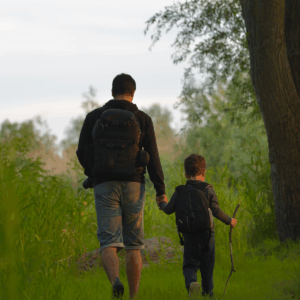

Six years ago, I stood in my empty house after helping my younger son pack the last box into his moving truck.
Both my boys were heading west—one to Seattle, the other to San Francisco—and I remember feeling proud. They were chasing big opportunities, better jobs, the kind of careers that weren’t available in our sleepy Midwest town.
What took me six years to realize was that opportunity might not have been the only thing they were chasing. They might have also been running from something. From me.
It’s a hard pill to swallow at sixty-something, but if there’s one thing I’ve learned about personal growth, it’s that the truth doesn’t care about your age or your ego. And sometimes the most important realizations come wrapped in the kind of discomfort that makes you want to look away.
When distance becomes a pattern
At first, I told myself all the right stories. My older son got that tech job offer—how could he turn it down? My younger one followed a year later for graduate school. These were logical moves, smart moves. The kind any father would encourage.
But patterns have a way of revealing themselves if you’re willing to look. Weekly calls became monthly. Visits home got shorter. Holidays became negotiations rather than assumptions.
I’d mention this to friends and they’d nod knowingly. “Kids today,” they’d say. “Always so busy.” And I’d nod along because it was easier than examining what might really be happening.
The thing about emotional distance is that it often starts long before the physical distance. And if I’m being honest—really honest—I can trace it back to those teenage years when work became my excuse for everything.
When “I’m building a future for this family” became my answer to missed games, shortened conversations, and the slow drift that happens when you stop paying attention.
The conversation that changed everything
Last year, during what was supposed to be a casual phone call with my older son, he mentioned something that stopped me cold. W
e were talking about his career—he’d just made a major pivot into a completely different field—and he said, “Dad, I spent ten years in a career you thought was perfect for me. I need to figure out what I actually want.”
Related Stories from The Artful Parent
- Psychology says the boomer parent who keeps bringing up how things were harder in their day isn’t dismissing your struggles. They’re trying to hand you the only coping tool they were ever given, and they genuinely don’t understand why you keep handing it back.
- I’m 74 and I’ve accepted that my children love me but don’t actually miss me—and understanding the difference between those two things has been the most clarifying and painful lesson of my seventies
- Quote of the day by Maya Angelou: I sustain myself with the love of family—and psychology says this one sentence reveals why boomers who built their identity around family often struggle most when adult children need space
There it was. Not accusatory, not angry, just… true.
I’d pushed him toward finance because it “made sense.” Good money, stability, the whole package. What I’d never asked was whether it made sense to him. And more importantly, I’d never really apologized for those years of pressure, of subtle disapproval when he expressed interest in other paths, of my certainty that I knew better.
That night, I couldn’t sleep. I kept thinking about all the times I’d been so sure I was right. All the advice I’d given that was really just my fears dressed up as wisdom.
The weight of unfinished business
After I retired, I went through a rough patch. Depression hit hard, and I found myself with all this time and no idea what to do with it. I’ve written about finding meaning in retirement before, but what I didn’t share then was how much of that emptiness was connected to my relationship with my sons.
You see, when your kids live across the country, you can’t just pop over for dinner to make things right. You can’t have those organic moments of connection that happen when you’re geographically close. Every interaction requires planning, intention, effort.
And when there’s unfinished business between you—years of being the dad who was physically present but emotionally checked out, years of assuming you knew best without really listening—that distance feels insurmountable.
- The subtle gap between accepting free products and selling editorial trust - The Blog Herald
- Psychology says the most fulfilled retiree is not the one with the busiest schedule—it’s the person who has finally made peace with doing absolutely nothing without feeling guilty about it - Global English Editing
- Research suggests the most emotionally intelligent people in most rooms aren’t the ones who speak wisely about feelings, they’re the ones who learned to read micro-expressions before they could read books, because their childhood required them to predict a parent’s mood before it arrived, and that skill looks like empathy but was built from fear - Global English Editing
Learning to apologize (really apologize)
Here’s something they don’t tell you about apologizing to your adult children: generic apologies don’t work. “I’m sorry if I wasn’t perfect” isn’t an apology. It’s a deflection.
Real apologies require specificity. They require you to name what you did wrong and acknowledge the impact it had.
So I started making a list. Not for them, but for me. All the specific things I wished I’d done differently.
The time I missed my younger son’s championship game for a meeting that, in retrospect, meant nothing. The years I spent pushing my older son toward a career that made me feel successful by proxy. The teenage years when I pulled back right when they probably needed me most.
Then, slowly, carefully, I started having real conversations with them. Not all at once—that would have been overwhelming for everyone. But piece by piece, I started owning my mistakes.
“I’m sorry I pushed you toward finance without really listening to what you wanted.”
“I’m sorry I wasn’t there for your championship game. I made the wrong choice.”
“I’m sorry I checked out during your teenage years. Work felt easier to navigate than parenting teenagers, and I took the easy path.”
What surprised me most
What surprised me wasn’t their willingness to forgive—my boys have generous hearts. What surprised me was how much they’d been waiting for these conversations. How much they needed to hear that their feelings and experiences were valid.
My younger son told me he’d spent years wondering if he was being too sensitive about the missed games and events. My older son admitted he’d felt like a disappointment for wanting to leave finance.
These conversations didn’t magically erase the distance between us, but they did something important: they acknowledged it. They named it. They made it something we could work with rather than around.
Building something new
The truth is, I can’t change the past. I can’t go back and be the dad who was emotionally present during those crucial teenage years. I can’t undo the pressure I put on my older son or the events I missed for my younger one.
But here’s what I’ve learned: adult relationships with your children aren’t just extensions of their childhood relationships with you. They’re something new, something you build together.
These days, our phone calls are different. Longer. Deeper. We talk about real things, not just weather and work. When they visit, we make time for actual conversations, not just the logistics of family gatherings.
And slowly, I’m learning to be curious about who they actually are, not who I assumed they’d become.
Closing thoughts
If your adult children live far away, it might be worth asking yourself an uncomfortable question: are they just chasing opportunity, or are they also creating distance?
And if it’s the latter—even partially—what are you willing to do about it?
Because here’s the thing: it’s never too late to become the parent your adult children need. It just might look different than you expected. It might require more humility than you’re comfortable with. It might mean admitting you were wrong about things you were certain you were right about.
But if my experience is anything to go by, it’s worth it. Every uncomfortable conversation, every specific apology, every moment of choosing curiosity over certainty—it all adds up to something.
Not a perfect relationship, but a real one. And at this stage of life, isn’t that what we’re really after?