
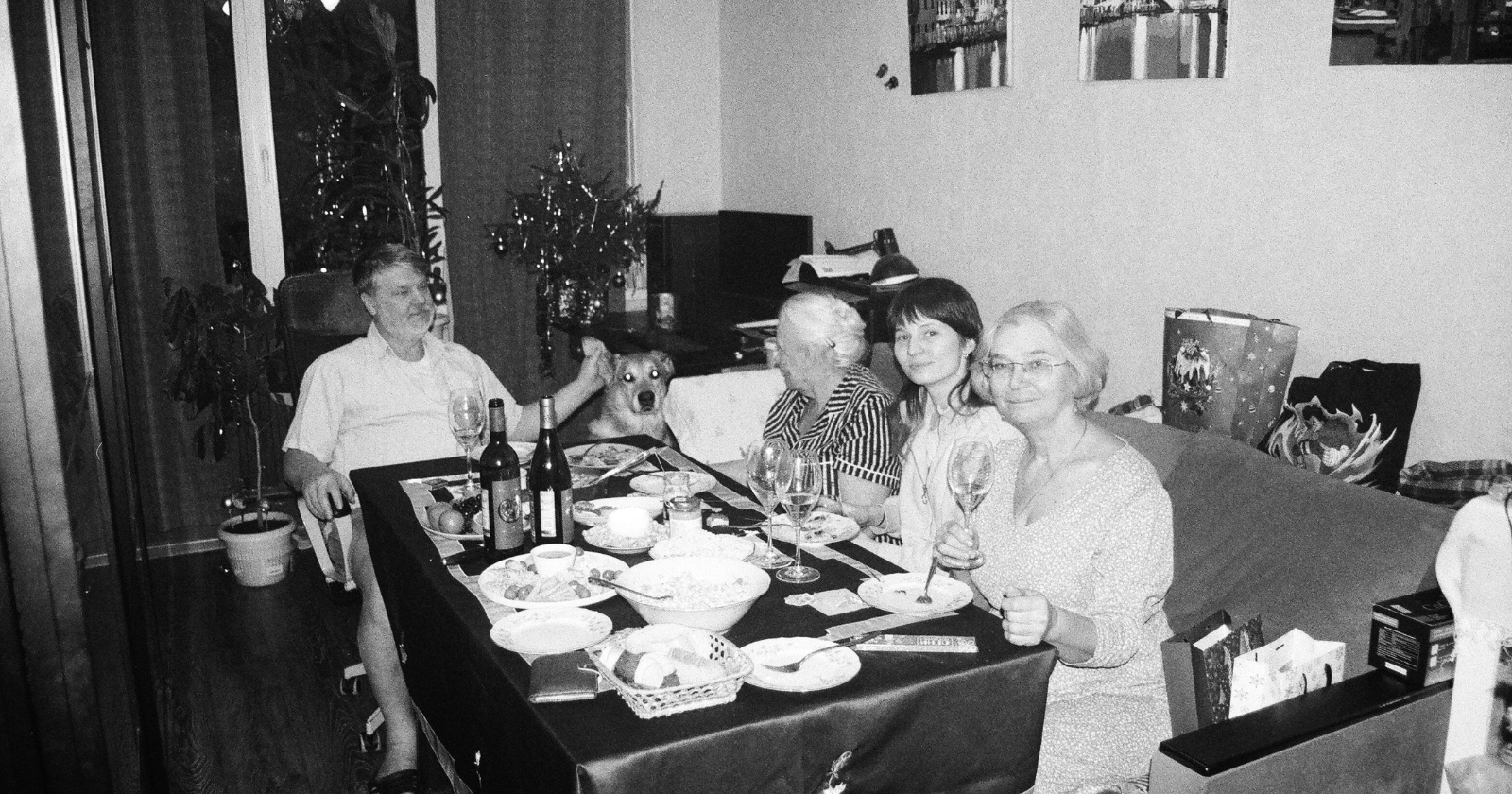
There was a table in our house growing up that seated six.
My mother at one end, my father at the other, four children in between.
Six o’clock, every evening, without negotiation.
There was no television on in the background.
There was no radio.
There were certainly no phones, because this was 1975 and the phone was a heavy black thing attached to the wall in the hallway that nobody used at mealtimes.
There was food, and there were people, and there was silence that nobody particularly felt the need to fill.
And out of that silence, somehow, came conversation.
Real conversation.
The kind where you found out what your father actually thought about something, or where your brother said a thing that surprised you, or where the meal went twenty minutes longer than planned because nobody had noticed the time.
I’ve been thinking about that table a lot lately.
Related Stories from The Artful Parent
- Psychology says the children most shaped by toxic parenting rarely come from homes that looked broken, they come from homes that looked completely fine, and they spend their adult lives trying to explain a wound that has no obvious source
- There’s a specific kind of exhaustion that comes not from doing too much but from spending decades performing a version of yourself that was designed to make other people comfortable, until one morning you can’t remember what your face does when nobody is watching
- Behavioral scientists found that adults who describe themselves as ‘not creative’ almost always trace it back to a single moment in childhood when someone evaluated what they made instead of asking what it meant
Specifically, I’ve been thinking about what was actually happening there that we didn’t have a name for.
What boredom used to produce
The word boredom has a bad reputation now.
We treat it as a problem to be solved, a gap to be filled, an indication that something has gone wrong with the evening.
But boredom at that dinner table in 1975 wasn’t a failure of entertainment.
It was the condition that made everything else possible.
When there’s nothing else available, you turn to the people in front of you.
- The movable type story and what it still means for creators building on borrowed ground - The Blog Herald
- The case for selling your own ad space as a blogger - The Blog Herald
- Psychology says the reason creative people struggle more than most with ordinary daily routines isn’t lack of discipline — it’s that their nervous system processes interruption as a genuine threat to the fragile mental state that makes the work possible - The Blog Herald
Not because you’ve decided to be present or because someone has suggested a conversation starter from a card deck bought online.
Because there is genuinely nothing else there.
That’s a different thing.
That’s conversation arriving not as a project but as the only available option, and it produces a completely different quality of attention.
My father wasn’t a talkative man by nature.
He came home tired, ate his dinner, and went back to whatever needed doing.
But at that table, with nowhere else to direct himself, he talked.
Not about feelings, not in any language I’d recognise from a therapy book.
But about what had happened that day, what he remembered from when he was young, what he thought about something in the news.
Small things.
Real things.
The kind of things that, accumulated over years, are how you actually get to know someone.
What the silence was doing
I’ve sat with a lot of people through difficult moments over the years, first in HR and more recently just as someone who has gotten older and has friends who are going through things.
One of the things I’ve learned is that silence isn’t empty.
It has weight and texture and it often contains more than the words that eventually come out of it.
The silence at that dinner table wasn’t awkward in the way we seem to experience silence now.
It was just the space between one thing and the next.
And in that space, thoughts formed.
Observations surfaced.
Someone said something that had been sitting at the back of their mind.
We don’t give silence that chance anymore.
The moment a gap appears in a conversation, someone reaches for their phone.
Not out of rudeness, mostly.
Just out of habit, and because the phone is there, and because we have trained ourselves to treat any moment of stillness as something to be managed rather than inhabited.
I do it too, more than I’d like.
The dinner table as the family’s nervous system
I worked in HR for thirty years and I spent a lot of that time thinking about what makes groups of people function well together.
The answer, almost always, came down to one thing: regular, reliable, low-stakes contact.
Not the big meetings.
Not the annual reviews or the team-building days.
The ordinary, repeated moments of being in the same room and talking about nothing particularly important.
That’s where trust gets built.
That’s where people learn how each other thinks, what each other cares about, where the pressure points are.
The family dinner table was doing exactly that.
Every evening, reliably, the family sat down together and became a group rather than a collection of individuals who happened to share a house.
Nobody called it connection.
Nobody had a strategy for it.
It just happened, night after night, because the structure was there and the structure made space for it.
What we replaced it with
I’m not going to pretend I was perfect at this with my own boys.
Work was demanding for a long stretch of their childhoods and I wasn’t always home at six.
There were evenings I came in late and the family had already eaten, and I told myself that was just how it was.
I got that wrong.
I know that now because my sons have told me, in their different ways, that the evenings I was there mattered more than I realised at the time.
Not because I was performing fatherhood particularly well on any given night.
Just because I was there, at the table, present and accounted for.
When I became a grandfather I made myself a quiet rule about mealtimes.
The phone stays out of the room.
Not as a statement, not because I’m making a point to anyone.
Just because I know what happens when it’s there and I know what’s possible when it isn’t.
The grandchildren talk more without it.
I talk more without it.
We find out things about each other that wouldn’t have surfaced otherwise.
It’s not magic.
It’s just what happens when you take away the alternative.
What the 1975 dinner table actually gave us
My parents didn’t know they were doing something important.
They were doing what their parents had done, what everyone in the street was doing, what the rhythm of that era more or less required.
Six o’clock, sit down, eat together.
But the thing it gave us, without anyone naming it or intending it, was fluency in each other.
I knew how my father’s face looked when he was tired versus when he was quietly pleased about something.
I knew which topics made my mother go still in a way that meant the conversation was over.
I knew my siblings in the way you only know people you’ve eaten hundreds of meals with, in the small details that don’t get shared in any other context.
That’s not nothing.
That’s actually quite a lot.
What I’d say to a parent reading this now
I’m not suggesting you need to recreate 1975.
I’m not nostalgic for the things that were genuinely hard about that era, and there were plenty.
But I do think there’s something worth recovering in the basic architecture of the thing.
A table.
People around it.
Food.
And nothing else.
Not every night, not perfectly, not with any grand intention about what it’s supposed to produce.
Just regularly enough that the people at that table start to become real to each other in the small, specific, accumulated way that actually matters.
The boredom will do the rest.
It always did.