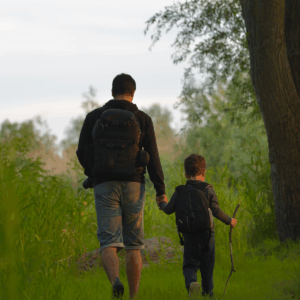

When I was eight years old I left the house after breakfast and came back for lunch.
Nobody knew exactly where I was.
Nobody needed to.
I was somewhere in the neighbourhood, doing whatever eight-year-olds do when nobody is watching them or organising them or asking them how they feel about what they’re doing.
Building something, probably.
Breaking something, possibly.
Sorting out some dispute with the kids on the next street according to rules we made up on the spot and revised whenever they stopped working.
That was a Tuesday.
That was just what childhood looked like.
I’ve been thinking about that a lot since I read the research suggesting that the number of uninterrupted hours a child now spends outside without an adult directing their attention has dropped by 50% compared to two generations ago.
50 percent.
Related Stories from The Artful Parent
- Psychology says the children most shaped by toxic parenting rarely come from homes that looked broken, they come from homes that looked completely fine, and they spend their adult lives trying to explain a wound that has no obvious source
- There’s a specific kind of exhaustion that comes not from doing too much but from spending decades performing a version of yourself that was designed to make other people comfortable, until one morning you can’t remember what your face does when nobody is watching
- Behavioral scientists found that adults who describe themselves as ‘not creative’ almost always trace it back to a single moment in childhood when someone evaluated what they made instead of asking what it meant
I’ve sat with that figure for a while because it’s the kind of statistic that sounds dramatic until you look at a typical child’s week and realise it’s probably conservative.
What those hours were actually for
I don’t think we understood at the time what the unstructured hours were doing.
They didn’t look like much from the outside.
They looked like wandering.
They looked like nothing, honestly, to any adult who happened to glance out the window.
But something was happening in that nothing.
- The movable type story and what it still means for creators building on borrowed ground - The Blog Herald
- The case for selling your own ad space as a blogger - The Blog Herald
- Psychology says the reason creative people struggle more than most with ordinary daily routines isn’t lack of discipline — it’s that their nervous system processes interruption as a genuine threat to the fragile mental state that makes the work possible - The Blog Herald
We were learning to manage ourselves.
When you’re eight years old and unsupervised, small problems present themselves constantly and you have to solve them without any adult stepping in to help.
Someone won’t follow the rules.
Someone takes the thing you were using.
Someone says something that makes you furious and you have to decide what to do about it.
Nobody mediates.
Nobody suggests a better way to handle it.
You work it out or the afternoon falls apart and you go home early, and going home early is a kind of failure you very much want to avoid.
That’s not a trivial education.
That’s some of the most important education a child can get.
What thirty years in HR taught me about self-direction
I spent thirty years watching adults try to navigate workplaces, and the variation in how people handled difficulty was enormous.
Some people, when something went wrong, could sit with the discomfort, think it through, and find their way to a solution.
Others needed someone to tell them what to do at every step.
Others became paralysed or lashed out or found elaborate ways to avoid the problem entirely.
I used to think this was mostly about personality.
I don’t think that anymore.
I think a significant part of it is about whether, as a child, you ever had the experience of being in difficulty without an adult available to resolve it for you.
If you did, you learned something important.
You learned that difficulty is survivable.
You learned that you are more capable than the difficulty.
You learned, through repetition, that you can trust yourself to find a way through.
If you never had that experience, the lesson was different.
The lesson was that problems require adults.
That your own resources aren’t quite sufficient.
That the right response to difficulty is to wait for someone more competent to arrive.
What we were afraid of and what it cost
I want to be fair about how this happened.
Parents didn’t remove unstructured time from childhood because they were careless or because they didn’t understand its value.
They did it out of love, mostly.
And fear.
The fear became louder, for complicated reasons, across the eighties and nineties.
Traffic felt more dangerous.
Stranger danger became a phrase people used.
The news made the world seem like a more threatening place than the evidence actually supported.
And so children were brought inside.
Activities were organised.
Every hour started to have a shape and a supervisor.
The intention was protection.
But protection from physical danger and protection from psychological development are not the same thing, and in solving for one, something was quietly lost in the other.
I’m not saying the fears were invented.
I’m saying the response to them had costs that weren’t visible at the time and are quite visible now.
What I notice with my grandchildren
I have four grandchildren, ranging from three to eleven.
The older two I see most weeks, and one of the things I’ve noticed is how rarely they know what to do with genuinely unstructured time.
If I take them to the park with no plan, there’s an initial period of low-level anxiety.
What are we doing.
What’s the activity.
What happens next.
They’re not difficult children.
They’re not incapable children.
They’ve just spent most of their lives in time that has been organised for them, and the experience of time with no shape is unfamiliar enough to be briefly uncomfortable.
But here’s what I’ve also noticed.
If I wait it out, and if I resist the urge to step in and suggest something, they find their way to something.
Always.
It might take ten minutes.
It might look like nothing for a while.
But eventually one of them picks up a stick or spots something interesting or starts a game that neither of them could have described beforehand.
And the afternoon that follows is usually the best kind.
The kind they talk about afterward.
The kind that didn’t require any planning.
The 50 percent is not just a number
When I think about what a sixty percent reduction in uninterrupted time actually means across a childhood, I find it genuinely significant.
Not in a panicked way.
But in the way that makes you want to pay attention to something before it gets harder to recover.
The capacity to be alone without distress.
The ability to entertain yourself without external input.
The confidence to try something without knowing if it will work.
The resilience that comes from sorting out small problems before they ever reach an adult.
These things don’t develop in scheduled activities or supervised playdates.
They develop in the hours between.
The hours that don’t look like anything.
The hours that are, it turns out, doing a great deal of the most important work.
What I think parents can actually do with this
I’m cautious about turning this into a list of instructions because I don’t think that’s what this needs to be.
Every family is different and every child is different and the conditions of modern life are genuinely more complicated than they were in 1975.
But I do think there’s something simple worth considering.
Not every hour needs a plan.
Not every moment of boredom needs to be rescued.
Not every conflict between children needs an adult to arrive and resolve it before it has had a chance to resolve itself.
The discomfort of watching a child be bored or frustrated or at a loose end is real.
The urge to step in is real and it comes from a good place.
But sometimes the most useful thing an adult can do is stay out of the way and let the afternoon be unwritten.
The child who figures out what to do with an unstructured Tuesday is building something that will serve them for decades.
It just doesn’t look like anything from the outside.
It never did.