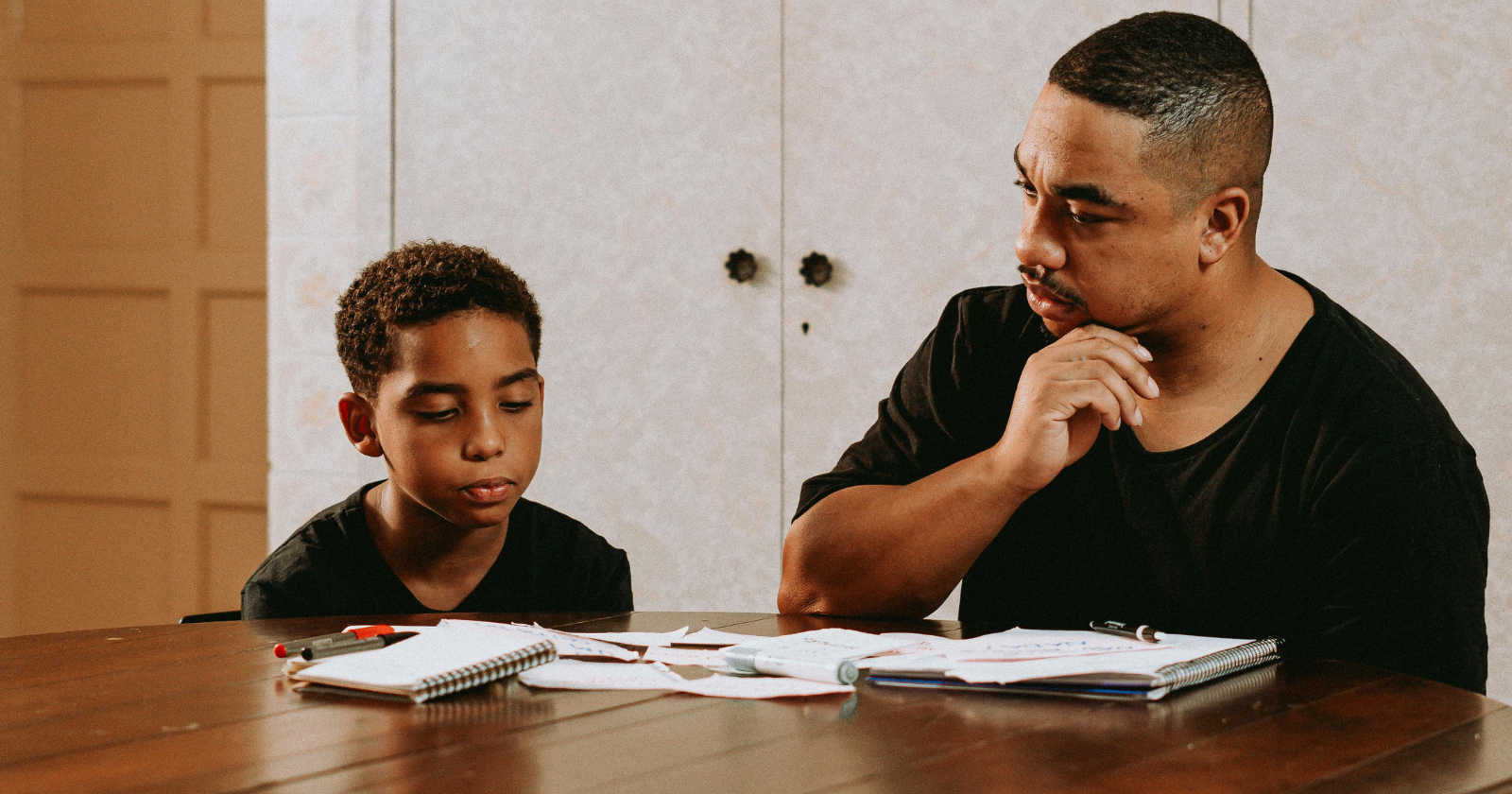
I grew up watching my dad build invisible walls. Not the kind you could see or touch, but the kind that kept him just out of reach, even when he was sitting right next to us at dinner.
He’d ask about school, sure. He’d show up to soccer games. But when it came to real conversations about feelings, fears, or failures? That door stayed locked.
For years, I thought this was just who he was. The strong, silent type.
The provider who showed love through actions, not words. It wasn’t until I studied psychology and later became a father myself that I realized something profound: my dad’s emotional distance wasn’t a personality trait at all.
It was armor he’d inherited from his own father, who’d inherited it from his, stretching back through generations of men who were taught that vulnerability was dangerous and feelings were feminine.
And here’s the kicker – we’re all still paying for it.
The myth of the “strong, silent” father
Let’s bust a myth right off the bat. That emotionally distant father figure we’ve normalized in our culture? He’s not naturally that way. No baby boy is born with an aversion to emotional expression. This distance is learned, practiced, and perfected over years of subtle (and not-so-subtle) messaging.
Think about the phrases boys hear growing up: “Man up.” “Boys don’t cry.” “Don’t be so sensitive.” Each one is a brick in that emotional wall, teaching young boys that their feelings are something to be conquered, not expressed.
Personal Development Coaching puts it bluntly: “When fathers are emotionally unavailable, physically absent, or disengaged, individuals experience what is called the ‘father wound.'”
This wound doesn’t just affect the child. It perpetuates a cycle where emotionally wounded sons grow up to become emotionally distant fathers themselves. They’re not trying to hurt their kids – they’re using the only emotional toolkit they were ever given.
Why men learned to shut down
Here’s something that might surprise you: emotional distance was once a survival strategy that actually made sense.
Related Stories from The Artful Parent
- The loneliness many boomers feel isn’t a personal failure — it’s the predictable result of a culture that valued them for their productivity and caregiving, then offered no roadmap for building an identity or community once those roles ended
- Psychology says children who were allowed to argue with their parents — respectfully — become adults who can advocate for themselves in rooms full of people who outrank them
- The reason millennial adult children don’t call as much isn’t that they don’t love their parents — it’s that their generation was raised to prioritize independence and self-sufficiency to a degree that accidentally taught them that needing people, even parents, was a form of failure
For generations, men worked dangerous jobs, fought in wars, and faced brutal physical challenges. Shutting down emotions helped them survive coal mines, battlefields, and factory floors.
If you’re sending your 14-year-old son to work in a steel mill (as was common a century ago), teaching him to suppress fear and pain wasn’t cruel – it was practical.
The problem? The world changed, but the programming didn’t.
We’re no longer sending boys into coal mines, but we’re still raising them with emotional strategies designed for that world. Modern life requires emotional intelligence, vulnerability in relationships, and the ability to process complex feelings. Yet many men are still operating with software from 1920.
I see this in my own family history. My grandfather returned from war and never spoke about it. My dad grew up watching a man who buried his trauma so deep that it leaked out in other ways – anger, distance, silence. By the time I came along, this pattern was so normalized that questioning it felt like betrayal.
The hidden cost our children pay
When we talk about generational trauma, we often think of obvious abuse or neglect. But emotional absence leaves its own kind of scar, one that’s harder to see but just as real.
- The toughest generation in history isn’t millennials navigating burnout or gen X surviving neglect — it’s the boomers who were handed a definition of resilience that meant you could break every bone in your body and still weren’t allowed to say it hurt - Global English Editing
- The loneliest moment in a long marriage isn’t a fight or a silence. It’s when you say something that matters to you and the other person responds with a subject change so smooth you almost don’t notice they never acknowledged what you said. - Global English Editing
- Psychology says the reason some people seem fine on the surface but are deeply unhappy underneath isn’t repression — it’s that they genuinely believe their feelings don’t matter compared to everyone else’s stability - Global English Editing
Children of emotionally distant fathers often grow up feeling fundamentally flawed. They wonder: Why doesn’t dad want to know the real me? What’s wrong with me that he keeps pulling away?
Saint Augustine’s University explains that “Children of emotionally distant parents internalize a limiting identity: ‘I’m too much, not enough, or irrelevant.'”
These beliefs don’t stay in childhood. They follow us into every relationship, every job interview, every moment of self-doubt. We become adults who struggle with intimacy, who sabotage success, who repeat the very patterns we swore we’d break.
I’ve seen this play out in my own life. In my twenties, I’d end relationships the moment they got “too real.” I’d achieve something great at work, then immediately downplay it.
It took years of work (and writing my book “Hidden Secrets of Buddhism: How To Live With Maximum Impact and Minimum Ego”) to understand that I was protecting myself from a vulnerability I’d learned was dangerous.
Breaking the cycle starts with awareness
Here’s the good news: unlike our grandfathers and fathers, we have access to information and tools they never did. We understand trauma, emotional intelligence, and the neuroscience of connection in ways previous generations couldn’t imagine.
The first step to breaking this cycle? Recognizing it exists.
When I became a father to my daughter, I made a conscious choice. I wasn’t going to be the dad who loved from a distance. I was going to be present, vulnerable, and emotionally available, even when every instinct told me to retreat into the familiar fortress of masculine stoicism.
Is it uncomfortable? Absolutely. Do I sometimes catch myself repeating my dad’s patterns? All the time. But each moment of awareness is a chance to choose differently.
Rewriting the script for future generations
If you’re a father reading this, know that your emotional availability isn’t just nice to have – it’s essential for your child’s development. And if you’re someone who grew up with an emotionally distant father, understand that his distance likely had nothing to do with you and everything to do with his own unhealed wounds.
The beautiful thing about recognizing these patterns is that we can change them. We can be the generation that stops passing down emotional distance as an inheritance. We can teach our sons that strength includes vulnerability, that real men feel deeply, and that emotional intelligence is as important as any other kind.
Start small. Share one feeling with your child today. Tell them about a time you were scared, sad, or unsure. Let them see you as human, not just as “dad.” These moments might feel insignificant, but they’re actually revolutionary acts that rewrite centuries of programming.
Remember, emotional distance isn’t written in our DNA. It’s learned behavior, which means it can be unlearned. Every time a father chooses connection over distance, vulnerability over stoicism, presence over absence, he’s not just healing his own family – he’s contributing to a larger cultural shift.
Final words
That invisible wall I watched my dad build? I’ve spent years trying to understand it, and even more years trying not to build one myself. Some days I succeed, others I fail. But I keep trying because I know the stakes.
Our children deserve fathers who are fully present, emotionally available, and unafraid of their own humanity. They deserve to grow up knowing they’re enough, that their feelings matter, and that love doesn’t require distance to be strong.
The emotional distance many fathers maintain isn’t their fault – they’re products of generations of conditioning. But once we know better, we have a responsibility to do better. The cycle of emotional inheritance can stop with us.
We can be the fathers who finally pay off that generational debt, not with distance, but with presence. Not with silence, but with words. Not with walls, but with bridges.
And maybe, just maybe, our children won’t have to write articles like this one. They’ll simply know what it feels like to be truly seen and loved by their fathers, no inheritance tax required.