
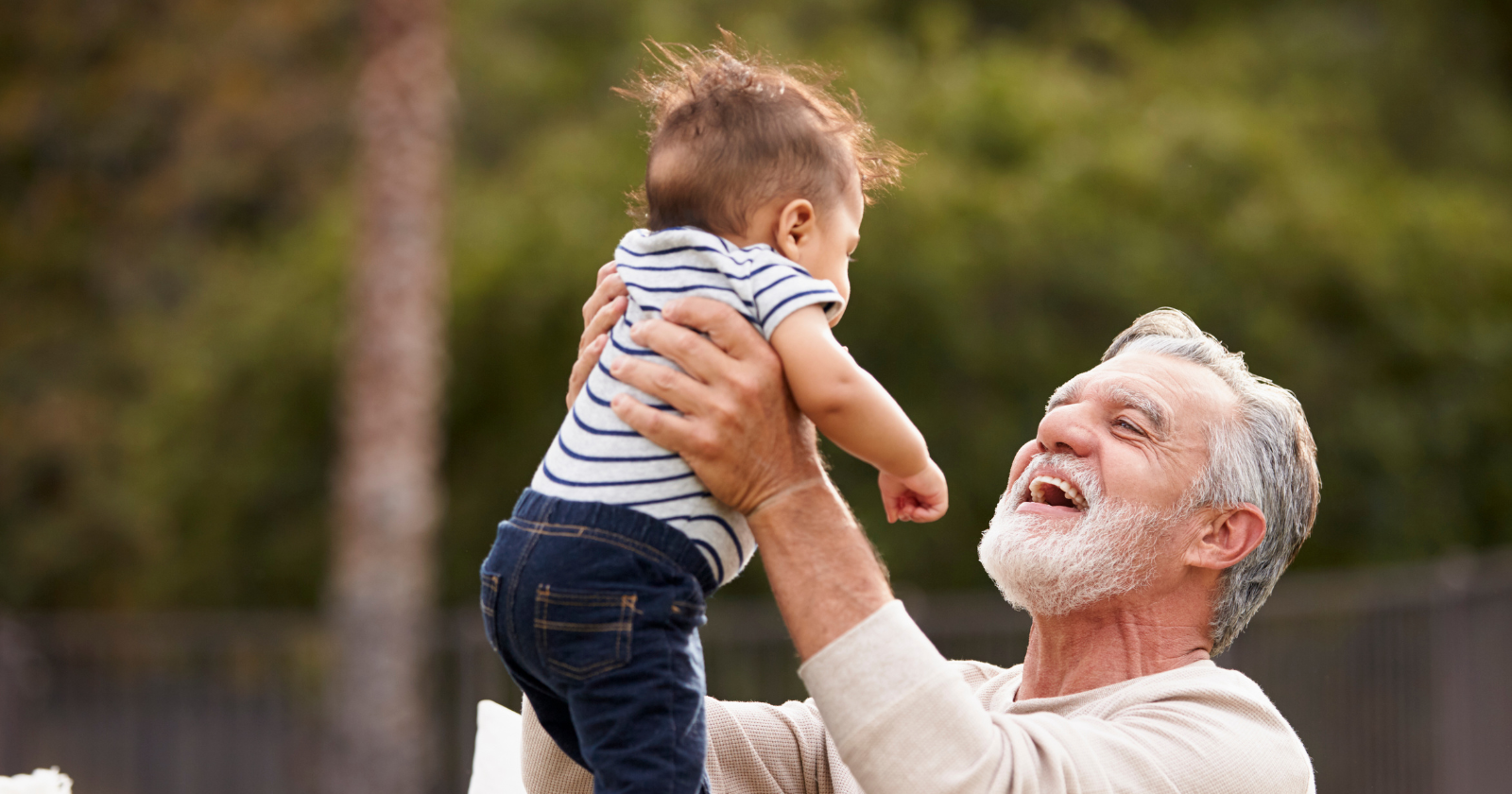
There is a particular psychological experience that arrives in the lives of many grandparents, often unexpectedly, that the broader culture has very little language for. The experience is not the love of the grandchild, which is widely described and frequently sentimentalized. It is something more specific. It is the experience of watching the person you raised, the small child you knew across forty or fifty years, doing the work of being a parent to their own small child, and seeing in that work the visible record of what they absorbed from how you raised them.
The experience is harder to name precisely than ordinary descriptions of grandparenting allow for. It is not the same as pride. It is not the same as relief. It is not the same as nostalgia, though all three are mixed into it. It is, more accurately, the sustained simultaneous perception of someone as both the child they were and the parent they have become, and the perception is, for many grandparents, one of the more substantial experiences of late life.
We are writers and parents, not developmental psychologists or family researchers. What follows is a reading of the research on generativity in late life and the related literature on grandparenthood, alongside the observational pattern the title points at. The article describes an experience documented in qualitative and clinical writing; it does not prescribe how anyone should feel about late-life family relationships.
The Artful Parent
Family-life ideas and sharp reads, in your inbox.
What the experience actually involves
The experience involves a particular kind of double vision.
The grandparent is, in the same moment, watching their adult child manage a difficult bedtime, settle a sibling dispute, calm a tantrum, or quietly comfort a child who has just been disappointed by something small. They are seeing, in real time, the adult competence the child has developed. They are also seeing, often without intending to, the specific moments in their own parenting that the adult child has either absorbed or revised. The way their adult child speaks to the grandchild. The patience they show. The choices they make. The patterns from the household the grandparent ran are visible, modified, in the household the adult child is now running.
What makes the experience unusual is the simultaneity. The grandparent is not, in that moment, primarily remembering the past. They are not, in that moment, primarily planning the future. They are looking at one specific person in front of them who is, in the same body, the child they raised and the adult who has become someone new. The two perceptions hold each other in tension. The tension is the experience the title is pointing at.
Why the culture has so little language for it
The cultural conversation about grandparenting tends to focus on the relationship between grandparent and grandchild. The popular accounts are warm, often nostalgic, sometimes sentimental, and almost always organized around the youngest generation. The grandparent appears as a supporting character in someone else’s story.
The experience the title describes is, structurally, in a different register. It is not, primarily, about the grandparent’s relationship with the grandchild. It is about the grandparent’s relationship with their own adult child, now mediated through watching that adult child parent. The relationship has new content, much of which the grandparent did not know was coming.
There is, in the available research, comparatively little empirical work on this specific experience. The research on grandparenthood has focused on the practical roles, including caregiving, financial support, and the transmission of values; the relational dimensions, including closeness with grandchildren and contact patterns; and the well-being outcomes, including life satisfaction and sense of purpose. The particular emotional experience of watching the adult child parent, separate from any of these, has not been mapped in the same level of detail. The cultural language for it has, accordingly, not developed.
What the research does say
The framework most relevant to this experience is the developmental psychologist Erik Erikson’s concept of generativity, originally proposed in his 1950 book Childhood and Society as the central developmental task of midlife. The basic idea was that adults in middle adulthood face a choice between generativity, the active care for the next generation, and stagnation, the failure to invest in it. Erikson later extended the concept, particularly in his 1982 book The Life Cycle Completed, to include what he called grand generativity, the late-life form of caring for the generations that follow the next one.
The contemporary empirical work on generativity, including Dan McAdams’ foundational research on operationalizing the construct and a substantial subsequent literature, has documented that generativity in late life is associated with multiple measures of psychological well-being. In a 2017 paper drawing on data from the Harvard Study of Adult Development, the longest-running longitudinal study of adult development in the world, the researchers found that strong Eriksonian generativity at midlife predicted measurably better cognitive and emotional functioning decades later. Subsequent work on generativity specifically in later life has shown that the construct continues to function as a meaningful predictor of well-being into the seventies and beyond.
What this work does not yet capture in detail is the specific emotional experience the title points at. It captures the structural fact that the desire to contribute to future generations matters for well-being. It does not, in the empirical literature so far, capture the specific quality of seeing the adult child as both the child and the parent at once. That specific experience has, in most cases, been left to memoirists rather than researchers.
Why naming the experience matters
The reason for naming the experience precisely is that, in the absence of language, the grandparent often does not know what to do with it.
The experience can produce moments of unexpected intensity. The grandparent watching their adult daughter or son comfort a crying grandchild may, in that moment, feel something they did not have a name for. It is not strictly happiness. It is not strictly sadness. It is the recognition that the child they raised has, in fact, grown up, and the recognition arrives not in the abstract but in the embodied evidence of competence that the adult child is producing in real time.
Many grandparents, in the qualitative accounts that do exist, report that they did not expect this experience and did not know what to call it when it arrived. Some describe it as a private joy that they have not found a way to share with anyone. Others describe a more complicated mix that includes some grief, particularly grief for the years the child has now left behind. The mix is, in the available accounts, individual. The basic structure of the experience is consistent enough across people to suggest it is a recognizable feature of late-life family experience rather than a personal peculiarity.
The cultural conversation about late-life family experience still tends to focus on what is being lost. The research on generativity, and the qualitative accounts that have begun to map this territory, suggest there is also something being given, and something being received, that the cultural conversation has not yet learned to describe. For the grandparents living the experience, the absence of language has not, in most cases, made it less real. It has only made it harder to share.