
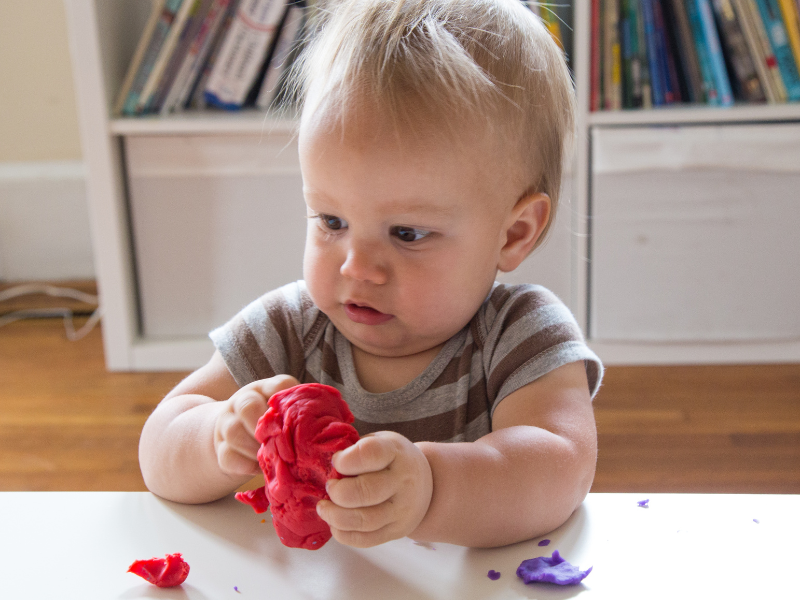
I watched my grandson last weekend as he opened a new building set. The box promised a detailed spaceship if you followed the 47-step instructions carefully. He glanced at the manual for maybe three seconds, then pushed it aside and started constructing something that looked nothing like the picture on the box.
His mother sighed. I smiled. Because I’ve seen this before, many times over the years, and I’ve come to recognize it for what it really is.
That urge to create rather than replicate, to build rather than follow, often signals something quite special happening in a young mind. If your child does the same thing, you might be witnessing uncommon intelligence at work.
1) They trust their own thinking over external authority
When a child pushes aside instructions and decides to figure things out themselves, they’re demonstrating something psychologists call internal locus of control. They believe their own abilities can shape outcomes, rather than depending entirely on outside guidance.
This matters more than many parents realize. Research from the American Psychological Association has shown that children with a strong internal locus of control tend to be more motivated, resilient, and successful in problem-solving throughout their lives.
Think about what your child is really saying when they bypass the manual. They’re saying, “I can work this out. I trust my brain to find a solution.” That kind of confidence in one’s own cognitive abilities is actually quite rare, and it forms the foundation for independent thinking that serves people well into adulthood.
Does your child often want to try things their way first? That’s not stubbornness. That’s a mind that believes in itself.
2) They learn through doing, not just watching or reading
Some children absorb information best by reading. Others prefer listening. But a certain type of learner needs to get their hands on something, manipulate it, feel how the pieces connect, and discover through direct experience.
Educational researchers call this kinesthetic learning, and it’s often misunderstood in traditional classroom settings. These children might struggle to sit still during lectures, but hand them materials and a problem to solve, and suddenly they come alive.
I’ve mentioned this before, but my own son was exactly this way. Teachers sometimes labeled him as distracted or unfocused. Yet give him a broken radio or a pile of wood scraps, and he’d work for hours with intense concentration. He wasn’t lacking focus. He just needed a different kind of engagement.
If your child gravitates toward hands-on creation, they’re showing you how their brain works best. And that self-awareness about learning style is itself a form of intelligence that many adults never develop.
Related Stories from The Artful Parent
- 8 signs you’re raising an emotionally secure child even when it doesn’t feel like you know what you’re doing
- 9 things creative kids do that look like misbehavior but are actually signs their mind is working overtime
- The 8 messiest childhood activities are actually the ones building your child’s brain in ways screens never will
3) They see possibilities where others see limitations
Instructions tell you what something is supposed to become. A child who ignores them is essentially saying, “But what else could this be?”
This is divergent thinking in action. While convergent thinking narrows down to one correct answer, divergent thinking expands outward into multiple possibilities. Both are valuable, but divergent thinking is particularly associated with creativity and innovation.
Watch closely next time your child builds something unexpected. They’re not failing to follow directions. They’re succeeding at imagining alternatives. That LEGO set designed to be a castle? In their hands, it becomes a robot, or a bridge, or something that doesn’t have a name yet because they just invented it.
As noted by creativity researcher Sir Ken Robinson, “Creativity is as important as literacy, and we should treat it with the same status.” Children who naturally think in possibilities rather than prescribed outcomes are exercising exactly this kind of creative muscle.
4) They’re comfortable with uncertainty and experimentation
Following instructions provides a safety net. You know what the end result should look like, and each step brings you closer to that guaranteed outcome. There’s comfort in that predictability.
Choosing to build without instructions means accepting uncertainty. Will this work? Will the pieces hold together? Will it look like anything recognizable? A child who embraces this uncertainty is showing remarkable comfort with ambiguity.
- Boomers are statistically the last generation to buy homes in their 20s, raise families on one income, and retire with pensions — and economic historians say these 9 survival skills they developed are completely foreign to younger generations - Global English Editing
- 3 tools that promised to supercharge content strategy and what they actually revealed about publisher dependency - The Blog Herald
- There’s a specific kind of shame that arrives in your seventies that has nothing to do with wrinkles or grey hair or any of the things the beauty industry wants you to worry about – it’s the shame of becoming irrelevant in a world you helped build, and it sits in your chest like a stone nobody can see - Global English Editing
This tolerance for not knowing, for experimenting and adjusting along the way, is a hallmark of scientific thinking. Real scientists don’t follow instruction manuals. They hypothesize, test, fail, adjust, and try again. Your child tinkering with blocks or craft supplies is engaging in the same fundamental process.
I find this quality particularly valuable in our current world. So much of modern life involves navigating situations without clear instructions. Children who practice this early, who learn that uncertainty can be exciting rather than frightening, develop resilience that serves them throughout life.
5) They understand that failure is just information
Here’s something I’ve noticed over many years of watching children build and create. The ones who ignore instructions also tend to have a healthier relationship with failure.
When you follow a manual and something goes wrong, it feels like you made a mistake. You deviated from the correct path. But when you’re creating your own path, a collapse or a design flaw is just useful data. It tells you something about how the materials work, about physics, about what to try differently next time.
Research published in the National Institutes of Health has explored how children who view intelligence as malleable rather than fixed tend to embrace challenges more readily. They see setbacks as opportunities to grow rather than evidence of inadequacy.
Does your child shrug when their tower falls and immediately start rebuilding? Do they seem more curious than upset when something doesn’t work? That emotional response to failure, that ability to extract lessons rather than defeat, indicates a growth mindset that correlates strongly with long-term success.
6) They’re driven by intrinsic motivation
Instructions come with a built-in reward: the finished product that matches the picture on the box. You complete the steps, you get the predetermined result, satisfaction achieved.
But a child who creates their own design is motivated by something internal. They’re not working toward an external image of success. They’re driven by curiosity, by the joy of making, by an inner vision they want to bring into existence.
This intrinsic motivation is powerful stuff. Studies consistently show that people who are internally motivated tend to be more persistent, more creative, and ultimately more satisfied with their work than those who rely primarily on external rewards.
Think about what drives your child when they’re building something original. Nobody told them what the finished product should look like. Nobody promised them a gold star for completing it. They’re doing it because something inside them wants to see what they can create. That internal engine is worth more than any external validation.
7) They’re developing executive function through self-directed play
Executive function refers to the mental skills that help us plan, focus attention, remember instructions, and juggle multiple tasks. These skills are crucial for success in school and life, and they develop significantly during childhood.
Here’s what fascinates me: when a child follows instructions, they’re practicing executive function in one way. But when they create their own project, they’re exercising these skills even more intensively.
Think about what self-directed building requires. The child must hold a mental image of what they want to create. They need to plan steps, even if unconsciously. They must monitor their progress, adjust when things don’t work, and persist through frustration. All of this happens without external structure guiding them.
Harvard’s Center on the Developing Child emphasizes that executive function skills are built through practice, particularly through activities that require children to exercise self-control and creative problem-solving. Self-directed building projects provide exactly this kind of practice.
So when your child ignores the instruction booklet and starts creating something from their imagination, they’re actually giving their brain a more intensive workout than if they’d followed the steps as written.
What this means for you as a parent
I want to be clear about something. Following instructions is also a valuable skill. There are times in life when we need to follow procedures carefully, when the established method exists for good reason. I’m not suggesting you should discourage your child from ever using a manual.
But if your child naturally gravitates toward hands-on creation over step-by-step replication, recognize what you’re seeing. Don’t mistake independence for defiance. Don’t confuse creativity with an inability to follow directions.
Provide materials. Give them space to experiment. Resist the urge to show them the “right” way. Ask questions about what they’re making and why. Celebrate the process, not just the product.
My grandson’s creation that day looked nothing like the spaceship on the box. It was lumpy and asymmetrical and honestly a bit strange. But when I asked him about it, he explained an elaborate story about what it was and what it could do. His eyes were bright. His mind was fully engaged.
That, to me, is what uncommon intelligence looks like in action. Not the ability to follow someone else’s blueprint perfectly, but the courage and creativity to imagine something new and bring it into being.
What has your child built lately that surprised you?