
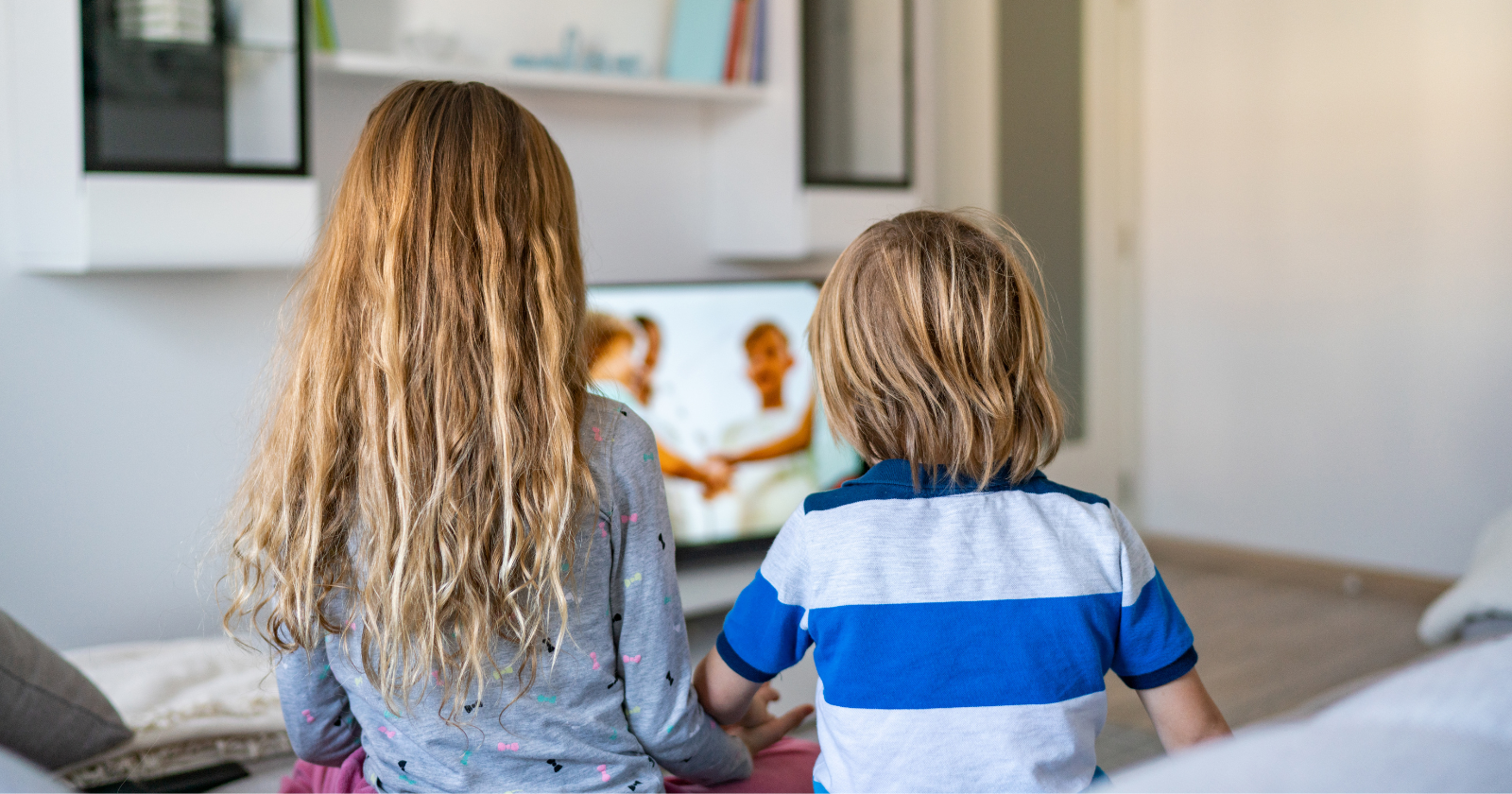
There’s a particular kind of quiet in my house these days. My wife and I noticed it years ago when the grandchildren would visit. They’d walk through our front door and almost immediately ask, “Why is it so quiet in here?”
We never really thought about it until then. We simply weren’t TV people. But their question got me thinking about what constant background noise does to developing minds.
And after chatting with a few teacher friends over the years, I’ve learned something fascinating. They can identify children who grew up with perpetual television noise within days of meeting them.
Not because these kids are less intelligent or less capable. But because their attention works differently in ways that show up clearly in a classroom setting.
1) They struggle to filter out irrelevant sounds
Picture a child trying to read a book while someone nearby is having a conversation. Most kids learn to tune out that chatter and focus on the words in front of them. But children raised with constant TV background noise often find this surprisingly difficult.
Their brains essentially learned that all sounds deserve equal attention. The television taught them that background noise might suddenly become important, that a jingle or dramatic moment could demand their focus at any second. So they developed a habit of monitoring everything instead of filtering anything out.
Teachers notice this during independent work time. These children’s heads pop up at every locker slam, every whispered conversation, every announcement over the intercom. As noted by researchers at the University of Iowa, background television significantly disrupts children’s ability to sustain attention on tasks, even when they aren’t actively watching the screen.
The classroom becomes overwhelming because every sound competes for their attention equally. They haven’t built that mental filter that says, “This matters, this doesn’t.”
2) They need constant stimulation to stay engaged
Have you ever watched a children’s television program lately? I sat through one with my youngest grandchild last summer, and I was exhausted within ten minutes. The colors, the sounds, the rapid scene changes. It’s designed to capture attention through constant novelty.
Children who grow up marinating in this learn to expect that level of stimulation. Their baseline for “interesting” gets calibrated to something that real life, and certainly a classroom, simply cannot match.
A teacher explaining long division cannot compete with animated characters and sound effects. A chapter book cannot compete with the visual fireworks of a cartoon.
Related Stories from The Artful Parent
- 8 signs you’re raising an emotionally secure child even when it doesn’t feel like you know what you’re doing
- 9 things creative kids do that look like misbehavior but are actually signs their mind is working overtime
- The 8 messiest childhood activities are actually the ones building your child’s brain in ways screens never will
So these children often appear bored or restless during normal instruction. They’re not being difficult. Their brains are just searching for that hit of stimulation they’ve been trained to expect.
I’ve mentioned this before, but my own father used to say that boredom was the birthplace of creativity. There’s real wisdom in that. Children need to experience quiet, unstimulating moments to develop their own internal resources for engagement.
3) They have difficulty following multi-step directions
Here’s something teachers consistently report. Children from high-TV households often struggle when given a series of instructions. “Take out your math book, turn to page forty-two, and complete the first five problems” becomes a challenge.
Why? Because television doesn’t ask you to hold information and act on it sequentially. Television does the work for you. It shows you what’s happening, tells you what to feel, and moves on before you need to remember anything.
The American Academy of Pediatrics has found that background television reduces both the quantity and quality of parent-child interaction, which is where children typically learn to process and follow verbal instructions.
In conversation, we naturally ask children to listen, hold information, and respond. But when the TV fills that conversational space, those practice opportunities disappear.
- I worked full-time while raising a one-year-old and maintaining a marriage and by month ten I was overwhelmed in the supermarket aisle because I realized I had optimized my entire life for efficiency but forgotten to leave space for joy - Global English Editing
- I’m 38 and I just realized my Boomer parents don’t call me for advice — they call me to hear their own thoughts repeated back in a younger voice because somewhere in the last 5 years they stopped trusting their own judgment and my job isn’t to have answers anymore, it’s to make their answers sound valid, and I don’t know when that shift happened but I know exactly what it cost them to need it - Global English Editing
- 9 signs you’ve quietly become the most self-aware person in your social circle — and why it sometimes feels lonelier, not better - Global English Editing
The result shows up years later when a teacher gives directions and watches certain children complete only the first step before looking around, confused about what comes next.
4) They interrupt frequently and struggle with conversational timing
This one surprised me when a teacher friend first mentioned it. But it makes perfect sense once you think about it.
Television doesn’t wait for you. It doesn’t pause to let you process or respond. It barrels forward whether you’re ready or not. Children who grow up with this constant companion don’t get the natural practice of conversational give-and-take that happens in a quieter home.
In homes without background TV, there’s more talking. More pausing. More waiting for someone to finish their thought before jumping in.
Children absorb these rhythms without anyone explicitly teaching them. They learn that conversations have a flow, that listening is part of talking, that silence between speakers is normal and comfortable.
Teachers see the difference immediately during class discussions. Some children wait their turn naturally. Others blurt out thoughts the moment they have them, seemingly unable to hold an idea while someone else is speaking. They’re not being rude. They simply never learned the rhythm.
5) They show reduced imaginative play skills
I spend a fair amount of time at the park with my grandchildren. And I’ve noticed something over the years. Some children can turn a stick into a magic wand, a sword, a fishing pole, a conductor’s baton. Others pick up the same stick, look at it, and toss it aside, unsure what to do without explicit direction.
Background television provides a constant stream of pre-made stories, characters, and scenarios. Children absorb these passively rather than generating their own. When playtime comes, they often default to reenacting what they’ve seen rather than inventing something new.
Teachers notice this during creative activities. Given open-ended art supplies or unstructured play time, some children dive in immediately while others seem almost paralyzed by the lack of direction.
As child development expert Nancy Carlsson-Paige has noted, children need unstructured, screen-free time to develop the creative thinking skills that form the foundation for later academic success.
Imagination is like a muscle. It needs exercise. And background television, for all its entertainment value, doesn’t give that muscle much of a workout.
6) They have trouble with sustained silent reading
This is perhaps the most academically significant habit teachers observe. Children from constant-TV homes often struggle mightily with sustained silent reading, that cornerstone of educational success.
Reading requires you to generate the images, voices, and emotions yourself. Your brain does the heavy lifting that television does for you. For children whose brains developed with that external stimulation always available, this internal work feels exhausting.
They read a paragraph and their attention drifts. They finish a page and can’t remember what happened. They look around the room, fidget, ask to use the bathroom. Not because they can’t read the words, but because sustaining that internal focus feels unnatural.
Teachers often describe these children as “capable but distractible.” They can read perfectly well when someone is listening. But alone with a book and their own thoughts? That’s where the struggle becomes apparent.
The good news is that these habits, while persistent, aren’t permanent. Brains remain remarkably adaptable, especially young ones.
Reducing background television, increasing conversation, and allowing for more unstructured quiet time can help children develop stronger attention skills even after years of constant media exposure.
I’m not suggesting that television is evil or that parents who leave it on are doing something terrible. Life is complicated. Parenting is exhausting. Sometimes that background noise provides a sanity-saving buffer during a long afternoon.
But awareness matters. Understanding how that constant hum shapes developing attention can help us make more intentional choices. Maybe the TV stays off during dinner. Maybe mornings are quiet until everyone leaves for school. Maybe weekends include stretches of genuine silence.
Small changes, made consistently, can make a real difference in how a child’s attention develops. And those differences will show up in classrooms, in relationships, and in their ability to engage deeply with the world around them.
What does the soundscape of your home look like these days?