
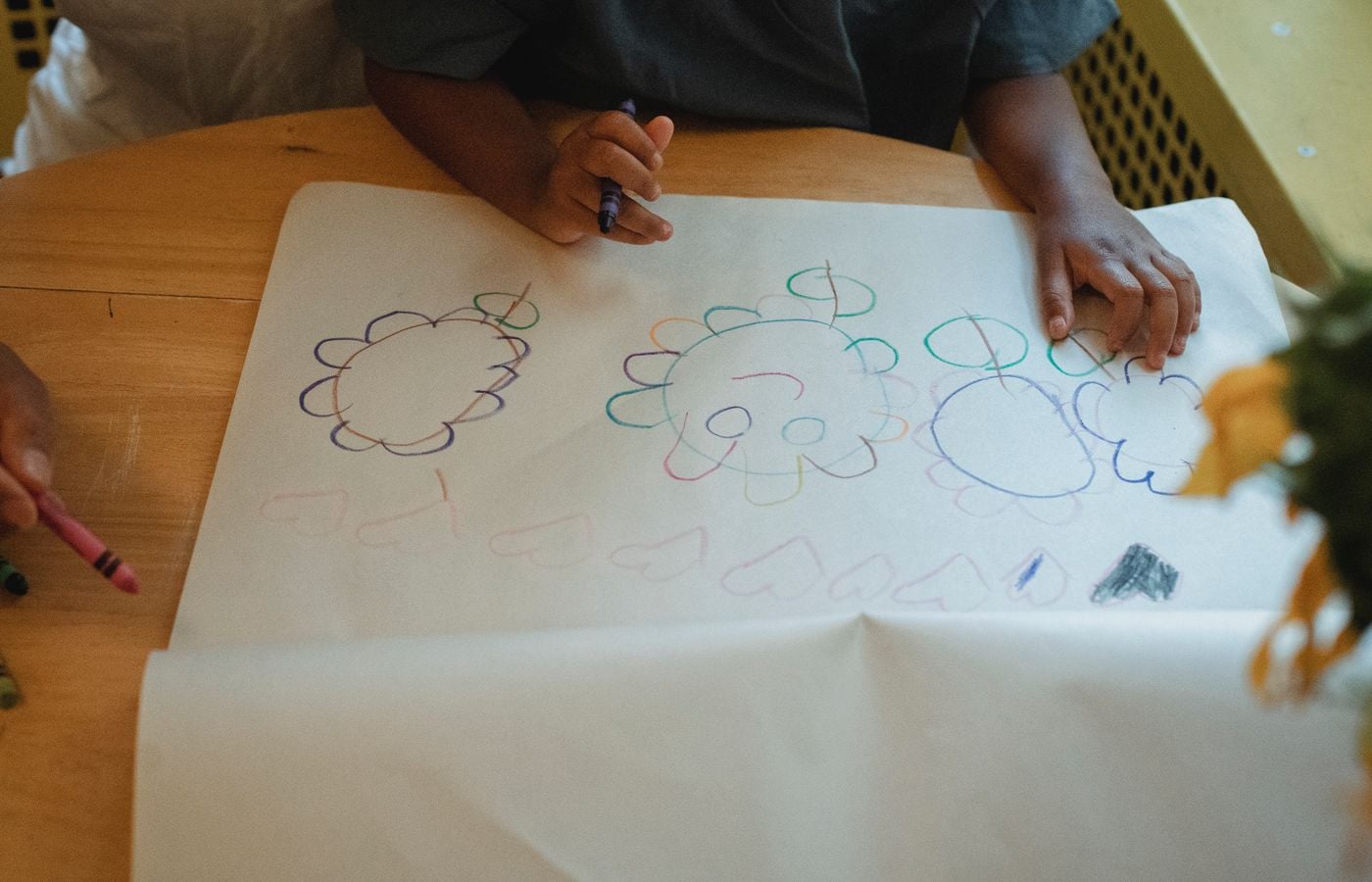
The parent who saves every drawing is not always trying to build a perfect archive of childhood. Sometimes the pile on the shelf is doing a quieter job.
It says: this happened. This child was small. This hand really was that size. We were here.
That does not mean every saved worksheet has a hidden psychological meaning, or that parents who recycle more are less attached. Families vary, storage space varies, and some people are simply better at letting paper go. But for many parents, the pull to keep children’s drawings, report cards, notes, handprints, birthday cards, and lopsided cardboard creations is not just sweetness. It can be a way of making the blur of family life feel real after the fact.
The Artful Parent
Family-life ideas and sharp reads, in your inbox.
The box is not really about paper
Parents often talk about keepsakes as if they are saving the object itself: the drawing of a person with one giant arm, the preschool name-writing sheet, the handprint turkey, the report card with a teacher’s small comment in the margin. But the object is usually carrying more than its own materials.
Psychologist and consumer researcher Russell Belk argued in Journal of Consumer Research that possessions can become part of the “extended self,” reflecting identity, memory, and relationship. That paper was not about parenting keepsake boxes specifically, so we should not stretch it too far. Still, it helps explain why a faded drawing can feel less like paper and more like a piece of family history.
A child’s artwork can hold several selves at once. It holds the child at that age, with that grip on the crayon and that way of drawing legs straight out of a head. It holds the parent who was there, even if they were wiping the table, answering an email, nursing a baby, or trying to get dinner started. It also holds the version of the family that existed for a short time and then changed.
That is why the urge to keep everything can feel so strong. The paper is ordinary. The proof is not.
Why ordinary days are so hard to remember
Most parenting days are not arranged like memories. They arrive as fragments: shoes, snacks, a spill, a missing marker cap, a child calling from another room, a form due tomorrow, a drawing placed in your hand while you are thinking about laundry. You may be physically present for all of it and still feel as if you barely registered the day while it was happening.
Autobiographical memory research gives us a useful way to think about this. In Psychological Review, Martin Conway and Christopher Pleydell-Pearce described autobiographical memory as tied to the self, not just to stored facts. We remember our lives partly by organizing moments into a story of who we are and what has happened to us.
That is hard to do in the middle of caregiving. A parent can spend a whole afternoon helping a child make something and still have almost no clear memory of the afternoon later, because their attention was spread across safety, food, siblings, timing, cleanup, and a dozen tiny decisions. The drawing becomes a handle for a day the mind did not have time to file properly.
This is one reason a keepsake can feel like evidence. It gives shape to something that otherwise disappears into the general category of “when they were little.”
The saved thing becomes a cue
In another autobiographical memory paper, Susan Bluck and colleagues described self-reported uses of memory in Social Cognition, including self, social, and directive functions. Put simply, people use memories to understand themselves, connect with others, and guide choices.
A child’s drawing can do all three. It can remind a parent, “I was the parent of a four-year-old who drew rainbows on every page.” It can become a story shared with the child later: “You made twenty maps that summer.” It can quietly guide what the parent makes room for next: more paper, fewer instructions, more time to let a child explain the picture before it vanishes into a drawer.
The object does not contain the whole memory. It opens the door to it.
That is also why writing a date or a child’s words on the back can matter more than keeping every single page. “Age 3, told me this was a family of clouds” gives the future parent more to hold than a stack of unnamed marker drawings. The note turns the paper from storage into memory.
Why handmade things feel different
There is also something particular about objects made by a child. In Journal of Consumer Psychology, Michael Norton, Daniel Mochon, and Dan Ariely found that people can value things more when they have made them themselves, a finding often called the IKEA effect. That research was about adults valuing their own completed creations, not parents saving children’s art. The boundary matters.
But it points toward a familiar truth in family life: work leaves a mark on how objects feel. A child’s drawing is not only something they produced. It is the result of time at the table, a chosen color, a decision to press harder, a moment when they said, “This is you,” and handed it over.
Parents are often saving the labor of becoming, not the polish of the result.
This is why a perfect school photo may sit in a folder while a crooked handprint gets saved. The handprint is not better art. It carries more body, more scale, more now-ness. It shows that the child was once small enough for their whole hand to fit inside yours.
When keeping everything becomes too heavy
There is a practical problem here, and it is a real one. Children make a lot. School sends home a lot. A parent can begin by saving out of love and end up with boxes that feel less like memory and more like a job waiting to be done.
It can help to separate the feeling from the storage decision. The feeling may be true: I do not want this time to vanish. The storage decision can still be limited: I do not need every worksheet to prove it happened.
A simple approach is to keep a small “anchor box” for each child or each year. Choose a few pieces that carry the clearest memory: one handprint, one self-portrait, one note in their own writing, one report card with a teacher comment that sounds like them, one piece that shows a favorite phase. Photograph the bulky or repetitive pieces before recycling them. If a child is old enough to care, ask which pieces they want saved too.
The goal is not to curate childhood into a perfect museum. It is to leave enough honest traces that the years can be found again.
A kinder way to look at the pile
If you are the parent with folders, tubs, envelopes, and a drawer you avoid opening, it may help to stop asking, “Why am I so sentimental?” and ask a plainer question: “What am I trying to remember?”
Maybe you are trying to remember the child. Maybe you are trying to remember yourself as the parent of that child. Maybe you are trying to keep hold of a season that was full of love and also too busy to fully feel while you were inside it.
That is not silly. It is human.
Keep some of it. Write the date. Add the sentence they said. Let the rest go when you need the space. The years did happen, and the proof does not have to be every piece of paper. Sometimes one drawing, kept carefully, can bring back the room.