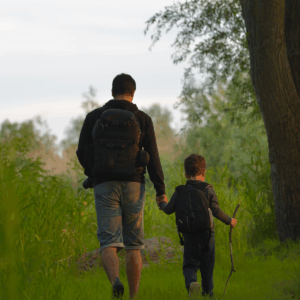

Look, I won’t pretend to have it all figured out, but here’s something I’ve been thinking about lately: the words we use to survive our own childhoods have a funny way of becoming the words we use to raise our children.
I was talking with my son the other day, and he mentioned something I used to say to him when he was growing up. The phrase stopped me cold because I suddenly heard my own father’s voice coming out of my mouth, decades after the fact. I had sworn I’d parent differently, yet there I was, passing down the same survival scripts I’d learned as a kid in the 1960s.
This isn’t a criticism of anyone. Rather, it’s an observation about how deeply these patterns run and why so many of us ended up parenting the way we were parented, even when we didn’t always plan to. Let me share eight phrases that were survival tools for our generation that somehow became our default parenting style.
1. Life isn’t fair
We heard this constantly growing up. Someone got a bigger slice of cake, a better grade despite less effort, or a new bike when yours was still working. Your complaint was met with three words: “Life isn’t fair.”
It wasn’t meant to comfort. It was meant to prepare us for disappointment.
Psychologists note that Boomers “grew up in the post World War II era marked by rapid industrialization, cultural shifts and less emotional handholding.” This phrase taught us that the world wouldn’t bend to our will and whining wouldn’t change outcomes.
The thing is, when we became parents ourselves, we reached for the same phrase. Our kids complained about something unfair, and out it came. We weren’t trying to be dismissive—we genuinely believed we were teaching resilience.
Looking back now, I wonder if there might have been room for both. Acknowledging that yes, this particular situation isn’t fair, while also teaching the larger lesson about navigating an imperfect world.
2. Stop crying or I’ll give you something to cry about
This was the ultimate warning in many boomer households. Tears were seen as inconvenient, unnecessary, or downright unacceptable.
I’m the first to admit I don’t know everything, but even back then, this one felt harsh to me. Yet I heard myself say it—or a version of it—to my own kids when emotions ran high and I didn’t know how else to restore order.
Dr. Ernesto Lira de la Rosa notes that when we suppress emotions, “they don’t go away. They often show up as stress, anxiety or even physical health issues.” We learned to bottle things up, and then we taught our children to do the same.
Related Stories from The Artful Parent
- I’m 35 and I love my parents but I also resent them — and I spent years believing those two things couldn’t both be true before I understood that love and resentment are not opposites, they are the specific combination that forms when you were raised by people who did their best and whose best had limits and whose limits became your wounds
- Psychology says when adult children avoid their parents, it’s rarely about one dramatic event — it’s about a thousand small moments where the child learned that being authentic around the parent felt more dangerous than being distant
- I finally understand why my father always backed the car into the driveway — it wasn’t about convenience, it was a man who spent his whole life making sure everyone else could leave first
The irony is that we used this phrase because we’d survived it. It worked for us, or so we thought. Only later did many of us realize that “working” and “being healthy” aren’t always the same thing.
3. Money doesn’t grow on trees
This was practically gospel in working-class and middle-class homes. You asked for something, and this phrase appeared like clockwork.
It taught us the value of money, sure. But it also taught us that wanting things was somehow wrong or that our desires were burdens on our parents.
When we had our own children, this phrase slipped out automatically. They’d ask for a toy or extra money for the movies, and there it was. We meant it as a lesson in financial responsibility, which it was. But it also carried the same subtle guilt we’d absorbed as kids.
This is well backed by research showing how specific mediators account for intergenerational continuity in particular types of parenting behavior, with practices being transmitted through both explicit teaching and implicit modeling.
4. Because I said so
The ultimate conversation ender. No explanation, no discussion, just authority.
We heard it when we questioned rules or wanted to understand the “why” behind decisions. And honestly, it usually meant our parents were tired, didn’t have a good reason, or simply expected obedience without question.
Fast forward to our own parenting years, and guess what became our go-to phrase when we were exhausted or caught off guard? Same one.
“Why can’t I stay out past 10?”
“Because I said so.”
We recycled the script without thinking about it. In the moment, it felt efficient. In hindsight, it shut down exactly the kind of thoughtful dialogue we probably should have been having with our kids.
5. Back in my day, we had to…
Oh boy, this one became our signature move, didn’t it?
We heard our parents talk about walking miles to school, making do with less, and appreciating what they had. When we became parents, we found ourselves launching into the same speeches about how we didn’t have video games or how we shared one family phone.
The intention was good—gratitude, perspective, hard work. But it often landed as dismissive of our children’s actual experiences and challenges.
Their world wasn’t our world. Housing costs, education expenses, job markets—all different. Yet we kept reaching for this phrase as if it would magically instill appreciation.
6. Children should be seen and not heard
This Victorian-era gem somehow survived well into the 1960s and 70s in many homes. Adults talked; kids stayed quiet unless directly addressed.
We learned to sit still during adult conversations, to not interrupt, to wait our turn. Sometimes that turn never came. It taught us patience and respect, but it also taught us that our thoughts and feelings weren’t particularly important.
As parents, many of us softened this one—we weren’t quite as rigid. But the underlying message often crept through in subtle ways. We’d hush our kids when adults were talking or tell them to go play while we handled “grown-up” matters.
I’ve mentioned this before, but parenting is often about unconsciously repeating what feels familiar, even when we consciously want to do things differently.
7. If your friends jumped off a bridge, would you?
The ultimate response to “But everyone else is doing it!” We heard it about everything from staying out late to wanting certain clothes or trying new things.
It was meant to teach independent thinking and not following the crowd blindly. And there’s wisdom in that, genuinely.
But when our kids came to us with the same plea, we pulled out the exact same rhetorical question. We didn’t stop to ask if maybe their friends’ parents had made a reasonable decision we should consider, or if peer connection actually mattered for this particular thing.
The phrase became a reflex rather than a moment for actual discussion about decision-making and peer pressure.
8. You’re being too sensitive
This one cuts deep because it invalidated our feelings when we were young, and then we turned around and did the same thing to our kids.
Someone hurt your feelings at school? “You’re being too sensitive.” Upset about something that happened? “Don’t be so dramatic.”
We learned that having strong emotions was a flaw that needed to be corrected. Toughen up. Get over it. Move on.
And here’s one I really don’t want you to miss: when we became parents, this phrase became our go-to whenever emotions got uncomfortable. Rather than sitting with our children’s feelings, we tried to talk them out of those feelings.
Dr. Holly Schiff points out the importance of naming and expressing feelings “in order to build deeper self-awareness and stronger relationships.” Our generation often missed that lesson entirely.
Final thoughts
These phrases weren’t just words—they were survival scripts. They helped us navigate childhoods with less emotional support, fewer safety nets, and parents who were often navigating their own unhealed wounds.
When we became parents, these scripts were so deeply embedded that they felt like truth rather than one generation’s coping mechanism. We reached for them automatically because they were familiar, not necessarily because they were best.
The good news? Recognizing these patterns is the first step toward something better. Whether you’re still raising children or now have grandchildren in your life, it’s never too late to examine these old scripts and decide which ones are worth keeping and which ones we can finally let go.
Here’s what you can do starting today:
- Notice when you’re about to say something your parents always said and pause for just a moment
- Ask yourself if this phrase serves the situation or if it’s just a reflex
- Consider having a conversation with your adult children about these patterns—you might be surprised by what you learn together
- Remember that doing better doesn’t mean your parents were wrong; it means you’re building on what they gave you
The world has changed, and that means we can change too. Our parents did the best they could with what they had. Now we have the chance to take what worked, leave what didn’t, and create something new for the next generation.