
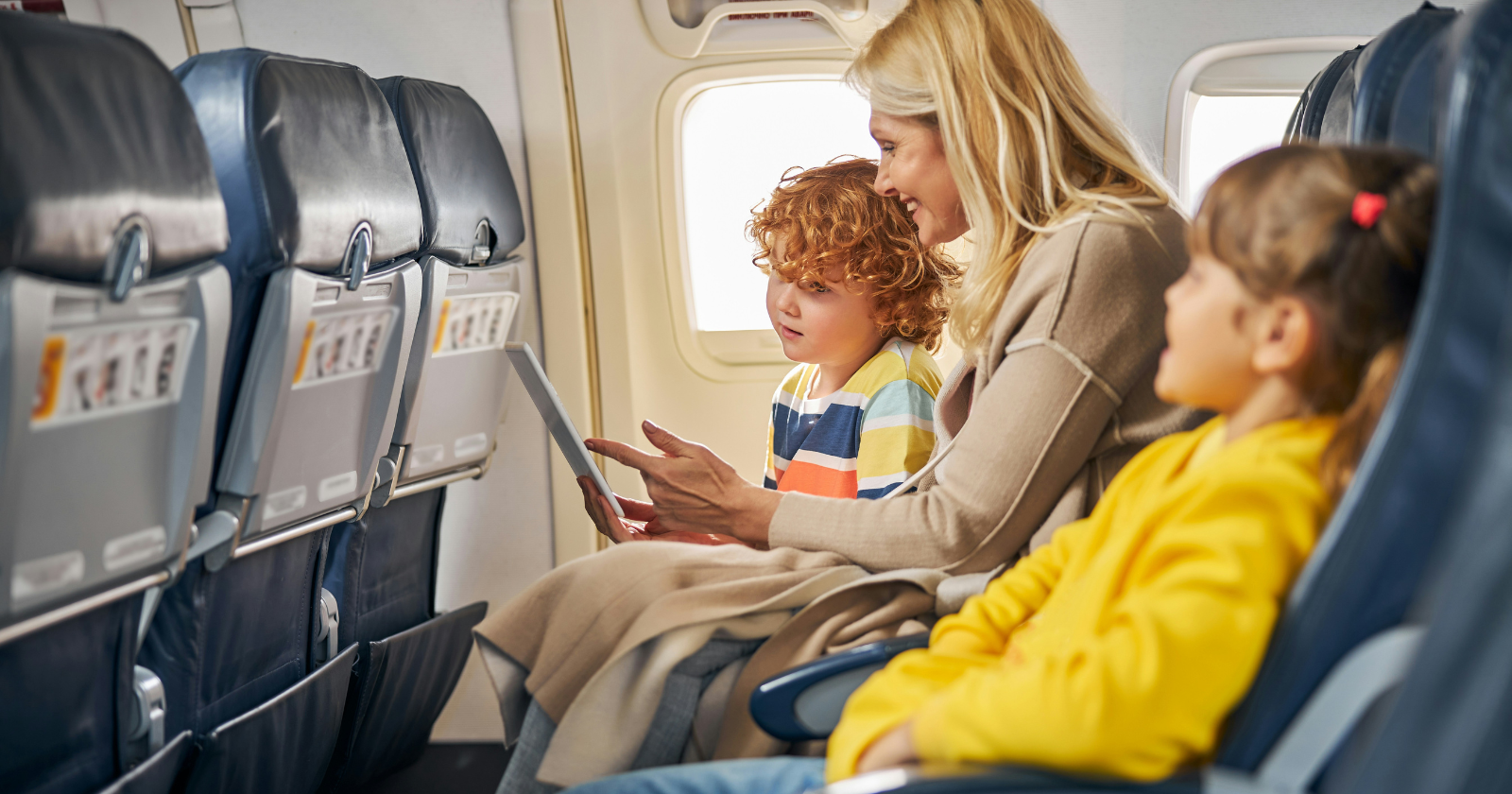

I entered a plane with my toddler. Nobody said anything to me. Nobody had to.
The slow exhale from the man in 14B, the way the woman across the aisle pulled her neck pillow a little tighter and stared at the ceiling — it was all communicated clearly enough. My daughter and I had boarded the plane, and we were already a problem before we had even found our seat.
I had done everything the parenting forums suggest. Snacks in a separate zip-lock. A new small toy she had never seen before. Headphones loaded with her favorite songs. I had mentally rehearsed the flight approximately forty times. And still, the moment I clicked her into the middle seat and she let out one loud, excited squeal at the window, I felt the familiar flush of shame rise in my chest.
The Artful Parent
Family-life ideas and sharp reads, in your inbox.
I spent the first hour of that flight in a kind of silent apology tour. Every small noise she made, I would glance around to check who was bothered. Every time she kicked the seat in front of her, I would grab her legs and mouth “sorry” to no one in particular. I was so focused on managing everyone else’s comfort that I barely registered my own daughter sitting next to me, watching clouds for the first time and pointing at them like they were the most miraculous things she had ever seen.
By the time we landed, something in me had shifted.
The invisible rule nobody agreed to
There is an unspoken contract that parents — and especially mothers — are handed the moment they enter public spaces with a small child. The contract says: keep your child invisible, keep your child quiet, and if you cannot, apologize continuously until the inconvenience is over.
I have watched this play out in restaurants, in supermarkets, in waiting rooms, and on planes. Parents hunching over strollers trying to muffle cries. Mothers leaving cafes mid-meal because a baby is fussing. Fathers carrying toddlers out of shops before they even finish what they came to do. All of it driven by the sense that a child in a shared space is a burden, and the burden is the parent’s fault.
Nobody signed this contract. Nobody asked if it was fair. It just exists, enforced through sighs and stares and the occasional pointed comment from a stranger who has temporarily forgotten that they were also, at some point, a child.
What I was actually teaching her
Somewhere over the Andes, I had a thought that stopped me. My daughter was watching me scan the rows of passengers every time she made a sound. She was watching me shrink. She was watching me perform this anxious, apologetic version of myself that I would never want her to grow into.
I think a lot about what my daughters will learn from watching me, not from what I tell them. I can tell them they are allowed to take up space all I want. But if they watch me spend an entire flight apologizing for their existence, the message they absorb is something different entirely.
I want them to move through the world with ease. To be considerate of others, yes, because that matters. But not to pre-emptively punish themselves for being present. There is a meaningful difference between being genuinely disruptive and simply existing in a way that inconveniences someone who would prefer the world to be quieter and more convenient.
Consideration is not the same as self-erasure
I want to be clear about something, because this is not a case for letting children run wild on planes or in restaurants while parents look on indifferently. There is real work involved in traveling with a toddler, and I do that work. I prepare, I redirect, I manage, I intervene when needed.
Being considerate of the people around you is something I genuinely believe in. My daughter is learning it too. She is learning to use her indoor voice, to share, to say sorry when she bumps into someone. These are good things to teach.
But consideration is a two-way street, and somewhere along the way it became entirely one-directional when children are involved. The expectation is that parents absorb all discomfort, manage all noise, and apologize for any reminder that small humans exist in the world. And the people on the receiving end of all that management offer nothing back, not patience, not a small smile, not even a neutral expression.
That is not consideration. That is social erasure, and I am no longer willing to participate in it the way I was before.
The shift that happened at 35,000 feet
About two hours into the flight, my daughter fell asleep on my shoulder. I had stopped scanning the rows. I had stopped bracing for judgment. I sat with her small, heavy head pressed into my neck and I just let the flight be what it was.
An older woman two rows ahead of us turned around at one point and smiled at me. Not a performative smile. Just a quiet, recognizing one, the kind that says “I remember this.” It meant more than she probably knew, because it reminded me that not everyone in a shared space is a critic. Most people are just people, getting through their day, mostly unbothered and mostly kind.
The handful of people who treat a child’s presence as a personal offense are loud in their body language, but they are not the majority. I had been managing my behavior around the loudest, most negative signal in the room, and in doing so had missed the rest of it.
What I stopped doing after that flight
I stopped apologizing preemptively. If my daughter does something that directly affects someone else, I address it. If she is loud in a restaurant, I redirect her. If she kicks a seat, I tell her to stop. I do the actual work of parenting in public.
What I no longer do is apologize for her presence before anything has even happened. I no longer make myself small the moment someone sighs. I no longer perform distress to signal to strangers that I am aware my child exists and am very sorry about it.
I also started noticing how often other parents do this, this constant pre-apology, this visible bracing. I see it now everywhere. And I understand it completely, because I did it too. But I do not think it is helping anyone. It does not make the child quieter. It does not make the journey easier. It just makes the parent feel worse.
Children are not a courtesy problem
We live in an increasingly child-averse public culture. There are threads online dedicated to complaining about children in restaurants, on planes, in coffee shops. There is a kind of social status attached to being unbothered, to traveling without children, to having clean, quiet, adult-only experiences.
I understand the appeal of quiet. I genuinely love quiet. But children are not a lifestyle choice that should be kept out of sight. They are people. Small, loud, unpredictable people who are doing the very hard work of learning how to exist in a world full of other people who would sometimes rather they did not.
My daughter pointing at clouds from a plane window is not a disruption. Her excitement about the world is not a problem I need to manage on behalf of strangers. And I am done treating it like it is.
Final thoughts
That flight changed something small but real in me. I did not arrive at some dramatic epiphany over the mountains. It was quieter than that. It was just a decision to stop apologizing for things that do not require an apology.
I grew up learning that keeping the peace meant making yourself smaller. And there are times when that is genuinely the kind thing to do. But there are also times when making yourself smaller just teaches everyone around you, including your own children, that your presence is negotiable.
My daughter’s presence is not negotiable. She is allowed to be here. So am I. And the next time someone exhales loudly the moment we board, I will get our bags into the overhead bin, settle her into her seat, and point out the window at the runway without scanning a single row for approval.