
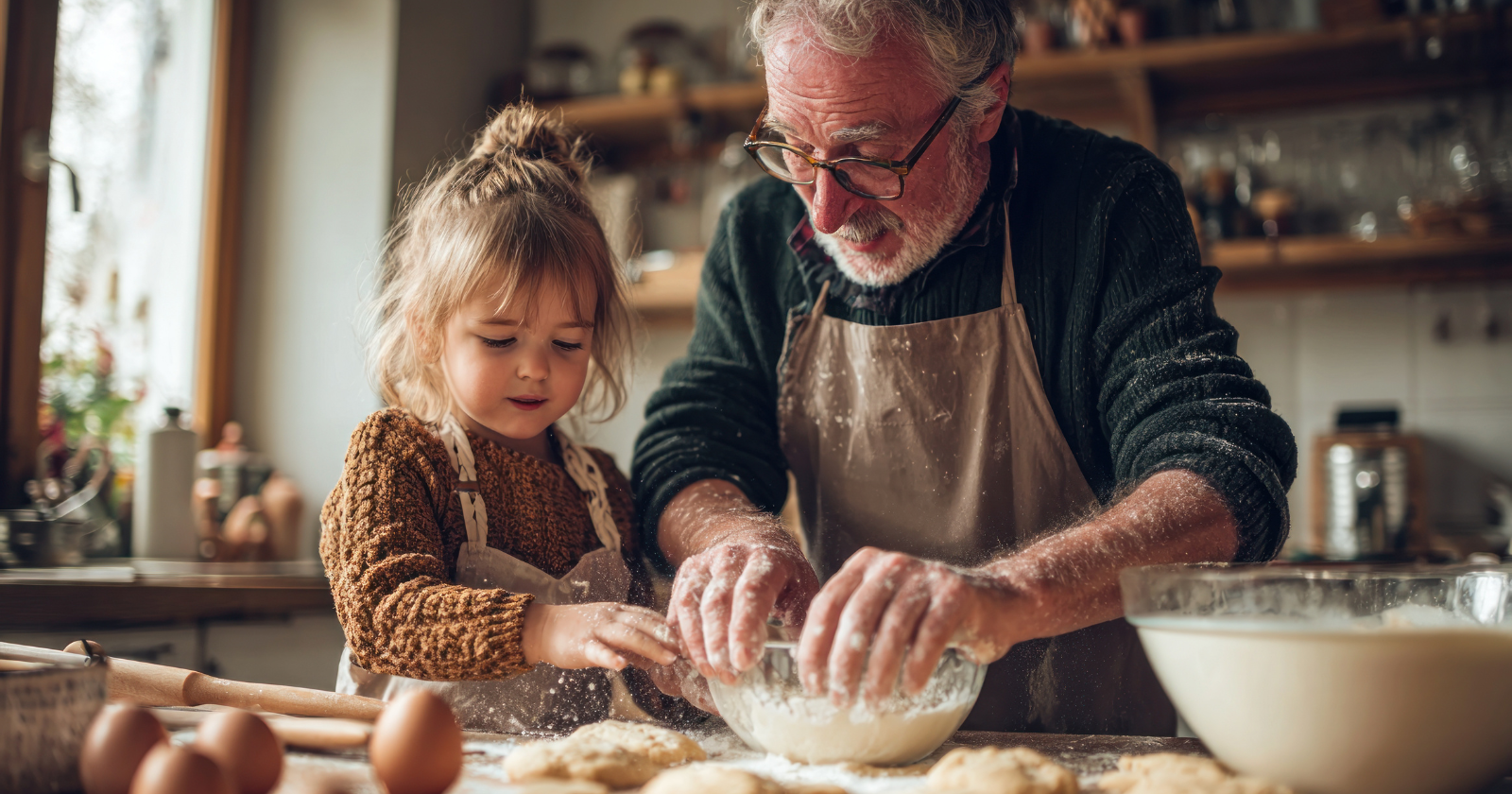

Last week I was making focaccia and Emilia, who is nineteen months old and apparently has strong opinions about baked goods, reached up both arms from the kitchen floor and made the face that means “I want in.” I lifted her onto the counter stool, handed her the wooden spoon, and pointed at the bowl. She stirred. Slowly, with total focus, the way toddlers approach everything they feel has been given to them seriously.
At some point I stopped watching the dough and started watching her. And a thought came up, the kind that arrives uninvited when you’re in a quiet moment with your kid: when Emilia is grown and someone asks her about her childhood, what will she actually remember?
Not the recipe. Not whether the focaccia turned out. But maybe the wooden spoon. Maybe the feeling of being lifted up and asked to help. Maybe just the warmth of standing close to someone who was making something and wanted her there too.
The Artful Parent
Family-life ideas and sharp reads, in your inbox.
This is what the research consistently points to, and it’s worth sitting with if you spend time making things with your kids.
The project was never the point
Research by Krystine I. Batcho, Ph.D., a professor at Le Moyne College, found something that sounds simple until you really think about it: “What activity fills the time together is less important than the fact that the time spent was spent together.” She studied childhood autobiographical memories and the pattern that kept emerging was the relationship underneath the activity, not the activity itself.
The adults in her research did not describe elaborate outings as their most meaningful memories. They described baseball games with a dad because it was “a me and Dad thing.” Hiking trips not for the scenery, but because of “feelings of togetherness and no one else to worry about or bother us.” The activity was the vehicle. The closeness was the destination.
For those of us who make things with kids, this changes what we actually need to bring to these moments. Your child is not going to remember the craft project in twenty years. But they are going to remember something about how it felt to be included in it. That’s a much lower bar than most of us hold ourselves to.
What children carry forward from these moments
Emilia won’t have explicit memories of our baking sessions for a couple more years. Children don’t typically retain narrative memories until around age three or four. But that doesn’t mean nothing is being stored. Long before the brain can turn experience into story, children form implicit memories: emotional and sensory impressions that settle in without being named.
The feeling of being wanted in a room, of being handed the spoon, of being close enough to a parent to feel their warmth: these register. They shape a child’s sense of whether the world is safe, and whether they belong in the spaces where things get made and done. That groundwork is laid earlier than most of us realize.
Dr. Dan Siegel and Dr. Tina Payne Bryson put it well in The Power of Showing Up: “Each time your kids need you and you show up, the trust in the relationship increases. You make a deposit in the relational trust fund.” A baking session is a deposit. So is the afternoon you let them help plant seeds that end up mostly on the floor. So is every time you pull them up beside you instead of waiting until they’re old enough to be useful.
The trap of getting it right
There is a version of making things with kids that looks productive and feels hollow. The parent is focused on the output: the paint staying inside the lines, the cookies being cut neatly, the finished thing looking the way it was supposed to look. The child senses the shift. You have moved from them to the project, and they feel it even if they cannot name it.
I notice this in myself when baking with Emilia. The moment I start caring too much about whether she is stirring in the right direction, the energy changes. She becomes less a person I am doing something with and more a small variable I am managing. The session stops being about us and starts being about the bread.
The cookies can be misshapen. The paint project can be chaos. What matters is whether your child felt, for that stretch of time, that they were the point of it. Because they were.
Why ordinary repetition outperforms one perfect craft day
Batcho’s research also points to something easy to miss: the power of the routine over the one-off. “The most memorable childhood experiences reflect critical qualities of the relationship formed between child and parent,” she writes. “Relationships develop over time as products of the ordinary interactions that become special by virtue of their ordinariness.”
What people remember is not the one exceptional afternoon. It’s the word “always.” We always baked on Sunday mornings. We always had a project on the go. We always made things together. That “always” is what builds the picture of who a parent was, and how welcome it felt to be near them.
One elaborate craft day is lovely, but it is not doing the same work as every Saturday morning letting your kid stand beside you while you make whatever you were already going to make. The consistent, low-key, imperfect presence is what accumulates. Special occasions are the highlight reel. The ordinary repetition is the actual relationship.
You already have what this requires
I am seven months pregnant, not moving particularly fast, and our baking sessions are usually a mess. Flour on the counter, on Emilia, occasionally on me. But I keep lifting her onto that toddler tower because of what I believe is happening underneath all of it. Not that she is learning to bake. That she is learning she belongs beside me when I make things.
You don’t need a craft haul or a complicated plan. You need a counter they can reach with help. A spoon they can hold. A task small enough that it doesn’t matter if they do it wrong.
The finished project is not the memory. The feeling of being there, beside you, wanted in the room: that is what stays. And you’re already there.