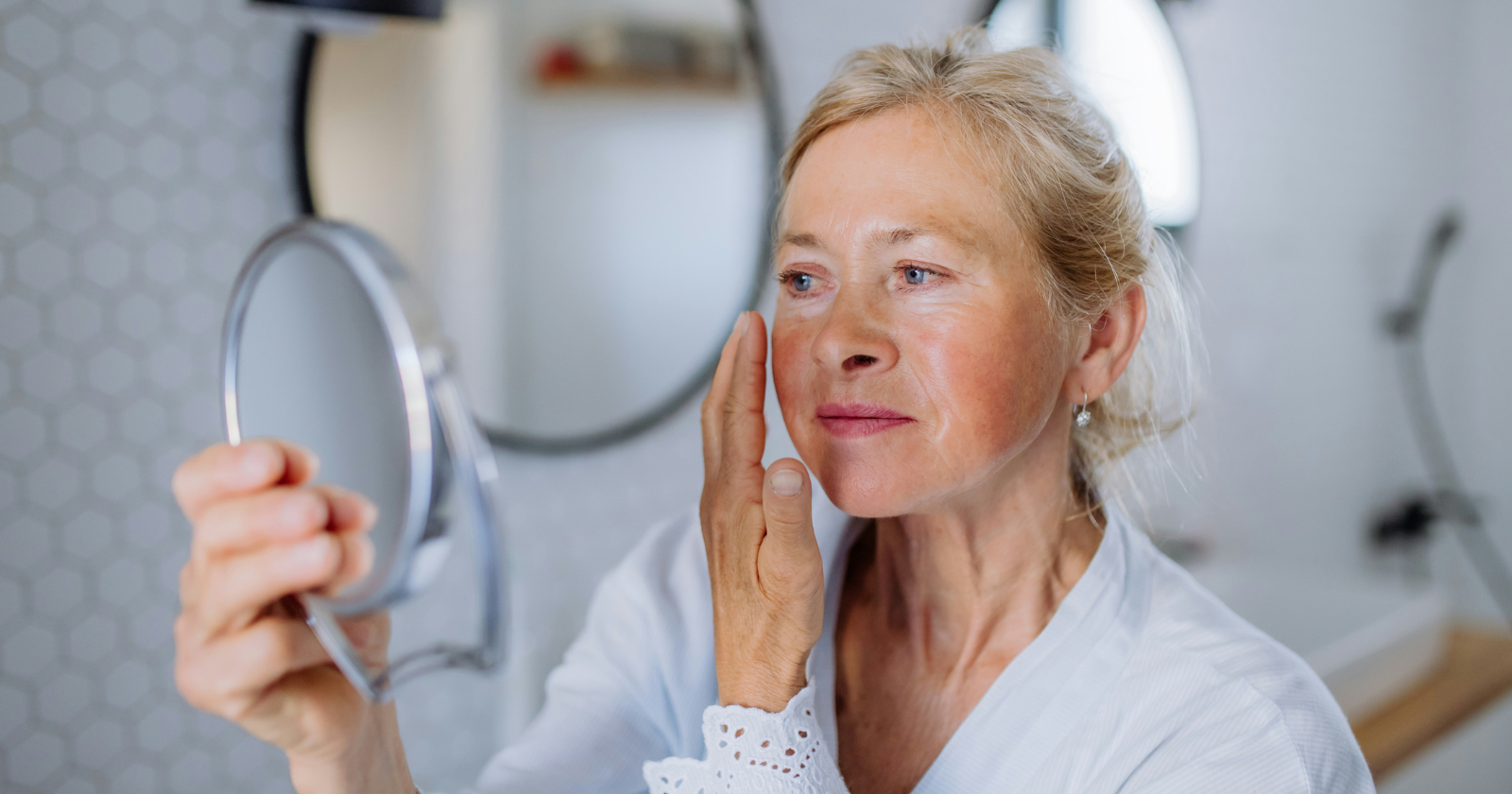
The assumption about people who dread aging is that they’re really dreading wrinkles. Fretting about grey hair, about visible decline, about the mirror becoming less cooperative. And for some people, some of the time, that’s part of it. But a significant and underappreciated portion of aging anxiety has nothing to do with appearance. It has to do with the prospect of needing help with things you currently do yourself. Of becoming, in the clinical sense, dependent on others. Of losing the autonomy that defines how you move through your days.
Calling someone vain because they’re afraid of aging is not just imprecise. It misses the point entirely for a large share of the people experiencing that fear. And misreading the fear, packaging it as something shallow when it’s actually something serious, makes it much harder to address honestly.
What aging anxiety is actually about
Research into aging anxiety has identified several distinct dimensions: worries about health, cognitive decline, financial security, loss of social connection, and, consistently, fear of dependence. The dependence dimension is not peripheral. A 2024 study by Darby Mackenstadt and Carolyn Adams-Price, published in a peer-reviewed journal on aging, found that fear of dependency was significantly associated with elevated depression and anxiety, particularly among middle-aged women and those with poorer physical health. The fear of needing others is not a mild concern in this literature. It’s one of the strongest predictors of psychological distress in the face of aging.
Separately, research by Becca Levy, PhD, a professor of public health and psychology at Yale, has documented how negative aging stereotypes, including the stereotype of the dependent, incompetent older person, get internalized by people over time and end up shaping how they relate to their own future. In other words, people aren’t just afraid of what aging looks like from the outside. They’re afraid of becoming the very figure they’ve spent their whole lives seeing described as a problem.
Why this particular fear makes sense
It’s also worth acknowledging that people rarely name this fear out loud, because it’s wrapped in things that feel embarrassing to say. You can’t easily tell someone you’re scared of needing them to help you shower, or that you lie awake thinking about what it will cost financially and emotionally when your body stops cooperating. So instead you say you’re “not ready to get old” and people assume you mean the grey hair.
Fear of dependence is not irrational. It’s a rational response to real conditions. In most Western contexts, especially in the United States, independence is not just a preference. It’s a moral value. Adults are expected to manage their own lives, contribute economically, and not place unnecessary demands on other people. Needing help, especially ongoing care, is quietly understood as a kind of failure. Not of the body exactly, but of the self.
Into this cultural backdrop, the prospect of aging into physical need lands very differently than it might in contexts where dependence is normalized as a natural part of a full life. The person who is anxious about aging is not necessarily afraid of death. They may be afraid of the extended, costly, complicated process of needing people to do things for them that they currently do themselves. And of the cost of that dependence, financial and relational, on the people they love.
There’s also an efficiency dimension worth naming. The modern world is organized around capability and output. Working adults have value partly because of what they produce. Once that production slows or stops, the cultural signals get less warm. Older adults are well aware of this. Many have watched it happen to people they know, or to their own parents. The anxiety about aging is often, at its core, an anxiety about relevance in a system that prizes function.
What this means for how we talk about it
None of this is to say that the appearance dimension of aging anxiety is trivial or not worth attending to. For some people it’s very real, and it deserves to be taken seriously on its own terms. The point is that for a significant share of people, the anxiety is not primarily there. And when we treat all aging anxiety as vanity, we leave a large and legitimate fear unaddressed.
When someone expresses anxiety about getting older, the instinct to reassure them with “but you look great!” is understandable but tends to address the wrong thing. The more useful conversation is about the fear underneath: what specifically are they afraid of? Losing the ability to drive? Needing help bathing? Becoming a financial or logistical burden on their children? These are concrete fears, and they deserve concrete responses, not aesthetic reassurance.
Some of what people fear is preventable or plannable: financial planning, long-term care decisions, conversations with family members while things are still comfortable. I’m not a financial advisor or a medical professional, and if any of this applies to your situation, talking to someone qualified to help you plan for aging concretely is worth doing sooner than you might think.
The deeper part, the fear of losing autonomy in a world that treats autonomy as the baseline of dignity, is harder to plan around. But it helps to name it for what it is. The person afraid of aging is not usually afraid of looking older. They are often afraid of becoming someone who can no longer take care of themselves. That fear deserves a direct response, not a compliment.
If aging anxiety is sitting heavily for you right now, talking to a therapist can be a useful space to work through what’s actually driving it. The fear is real and worth taking seriously. The question is whether it’s pointing at something concrete that’s worth addressing practically, or whether it’s more free-floating and needs a different kind of attention entirely. Either way, naming what you’re actually afraid of is usually the most useful place to start.