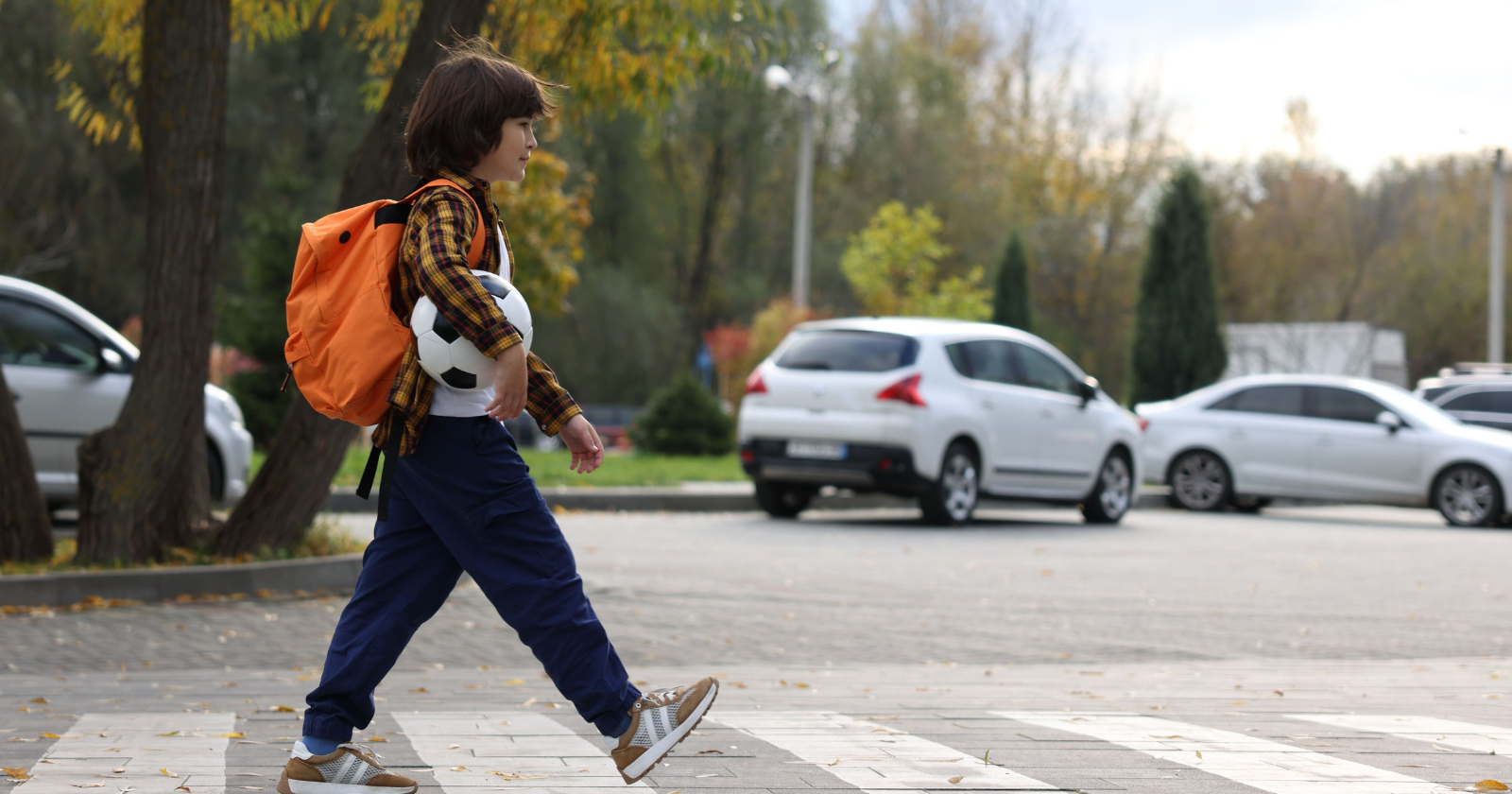
People who walked to school alone, crossed busy streets, and knew which houses to avoid often describe it not as neglect but as independence — and many are still sorting out why the same freedom now feels almost impossible to give a child
Many adults who grew up in the 1970s and 1980s carry a particular kind of childhood geography in memory: the route to school walked alone at seven or eight, the neighbor’s house known for its barking dog, the shortcut through the park, the crossing of a road they had been warned about and managed on their own. When asked about it now, most of them do not describe that experience as risky or as a failure of care. They describe it as ordinary. They describe it as theirs.
Most of their children will not have that geography. Not because the streets became more dangerous — in most places, they became safer — but because what adults consider an acceptable level of risk for a child has shifted so completely in the intervening decades that the walk once regarded as unremarkable now reads, to many parents, as something close to negligence.
What the numbers show
The shift is not a feeling. Research on children’s independent mobility, meaning children’s freedom to move through their neighborhood without adult accompaniment, has documented the change in precise terms. A series of studies by the Policy Studies Institute, the most recent supported by the Nuffield Foundation and available through the Policy Studies Institute, found that in 1971, 80 percent of seven- and eight-year-old English children were allowed to walk to school without an adult. By 1990, that figure had fallen to 9 percent. The same research traced the pattern through 2010, finding continued decline.
What makes the pattern stranger is the parallel one: over the same period, child road fatalities in Britain dropped substantially. The streets got safer in measurable terms. The permissions tightened anyway. Mayer Hillman, whose original 1971 research established the baseline for much of what came later, noted the central paradox directly: parents restricted their children’s movement primarily because of fear of traffic, at precisely the moment traffic deaths for children were falling.
The fear and the facts moved in opposite directions.
The fear that replaced the walk
The 1970s and 1980s brought significant changes in how child abduction was covered by American and British media. That coverage was not proportionate to the statistical reality. Stranger abductions of children are, and were then, rare. Data from the Office of Juvenile Justice and Delinquency Prevention indicates that around 100 children are abducted by strangers in the United States each year — a number that has not risen with the growth of parental fear.
But the feeling that it might happen — that it happened to other children, elsewhere in the country, that the neighborhood was not quite the continuous safe space it appeared — took hold in ways that outlasted the news cycles that produced it. A 2022 study in the Journal of Experimental Criminology examined how media coverage of child abduction shapes parental risk assessment. The results found that exposure to abduction coverage heightened perceived threat at the community level — though notably not always at the level of personal family risk — even when the statistical picture did not support it.”
This matters because the fear that shaped one generation’s parenting did not dissolve once the coverage died down. It became the background assumption, passed on not as an argument but as a disposition, as a form of care.
The parents who had it
There is something particular about the generation currently raising children, those born roughly between the late 1960s and mid-1980s, who themselves walked to school alone, ranged freely through neighborhoods, and whose parents often did not know where they were for hours at a time. Many of them are aware of the contradiction. They know they had that freedom. They are often not sure how to give it back.
This is not a simple story about overprotection or about the erosion of common sense. Lenore Skenazy, whose book Free-Range Kids helped frame a public conversation about independent childhood, has written about parents who genuinely want their children to have more freedom but find themselves unable to override the ambient concern: the legal uncertainty, the neighbor who might call someone, the sense that other parents would judge the decision.
That ambient concern is partly social and partly structural. In a number of American states, parents have been investigated by child protective services for allowing children to walk to school at ages their own parents would have considered entirely unexceptional. The law in many places had not kept up with any particular view of what children need, but it had absorbed a general cultural assumption that unsupervised children are children at risk.
Skenazy, who co-founded the nonprofit Let Grow, has spent years working to change state laws on this, with some success. But the legal question is only part of it. Much of what stops parents is harder to legislate: the internalized sense that something might happen, that they would be the ones who let it happen, that the walk alone is a bet made with someone else’s safety.
What the research has added
A 2023 paper by Peter Gray, David F. Lancy, and David F. Bjorklund, published in the Journal of Pediatrics, reviewed the evidence connecting the decades-long decline in children’s independent activity with broader trends in children’s reported wellbeing. The paper is careful about its framing: it is a review of existing research, not a clinical guideline, and it does not reduce the question to a clean before-and-after. Its central argument is that the shift toward adult oversight and away from children’s independent activity is worth taking seriously as one contributing factor in a larger picture.
We are not reviewing that paper here as clinical guidance. The frame for this piece is observational. But it is worth noting that researchers across multiple disciplines have been documenting this same shift for decades, not as a lifestyle complaint but as something measurable, with a consistent finding: the contraction of independent childhood has been real, rapid by historical standards, and is now long enough in duration to examine in retrospect.
What sits underneath the question
The people who crossed the road alone as children are not, mostly, nostalgic in a simple sense. They know their own childhoods were not uniformly good. They know some of the houses they learned to avoid were avoided for real reasons. What they carry is something more specific: the memory of having been trusted with ordinary risk, and the knowledge that this made the street feel like something that belonged to them.
Whether to give that back, and how, is not something a single study settles. It involves the social infrastructure around a given family, the sidewalks, the local culture, the presence of other children, the willingness of neighbors to pay attention without intervening. It involves what the law allows. It involves a form of nerve that many parents find they no longer quite have, though they are not always sure when or why they lost it.
Now Read: Psychology says truly classy men aren’t the ones performing confidence or status — they’re the ones who make everyone feel like they matter