
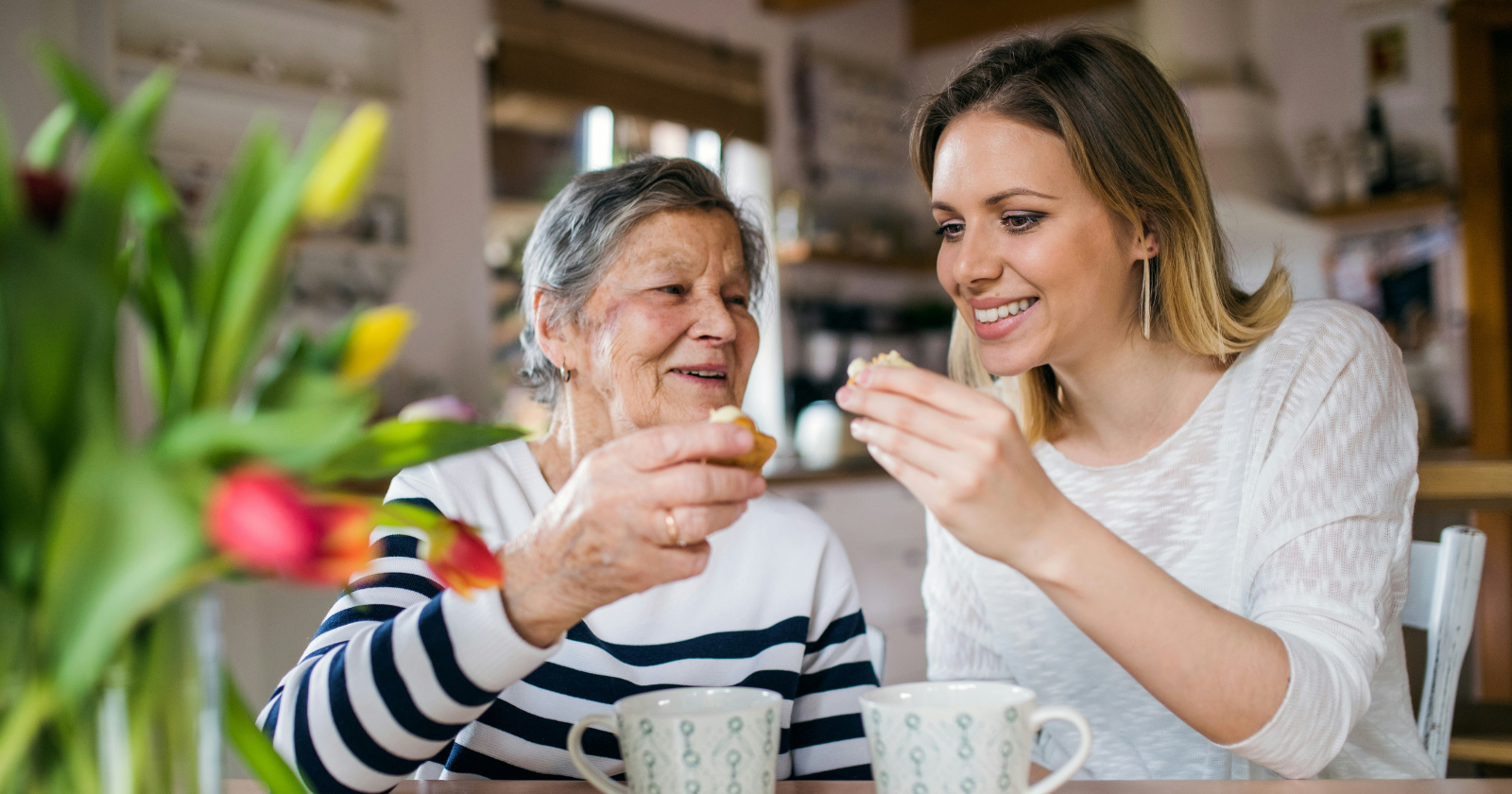
A grandmother arrives on a Tuesday with no occasion attached to it. She lets herself in, puts something on the stove, takes the baby so her daughter can sleep for an hour, and walks the older child to the corner and back. None of it is dramatic. By evening she has gone home again, and the household runs a little easier than it would have. Multiply that Tuesday by years, across most of human history, and you have something that turns out to be hard to explain — and, to one group of researchers, the key to a genuine biological riddle.
The riddle is this. Almost no animal lives long past the age when it can reproduce. A few whales aside, most species breed until close to the end. Human women are the conspicuous exception: fertility reliably ends around the late forties or early fifties, yet women routinely live decades beyond it, healthy and capable for much of that time. We are so used to this that it reads as ordinary. Looked at across the animal world, it is strange enough to demand an explanation.
The years after, and who they were for
The usual assumption was that menopause means women “stop early” — that the body shuts reproduction down ahead of everything else. But the anthropologist Kristen Hawkes and her colleagues pointed out that this gets the oddity backwards. Our reproductive span is not unusually short; it is at least as long as a chimpanzee’s. What is unusual is the long, vigorous life that follows it. The distinctly human trait isn’t an early ending. It’s the extra decades on the far side.
Their proposal, drawn partly from years of watching Hadza foragers in Tanzania, became known as the grandmother hypothesis. Among the Hadza, some of the most reliable foods are tubers buried deep in hard ground — drought-resistant staples available year-round, but difficult to dig. Young children can’t extract them efficiently. Their mothers can. And so can older women who no longer have young children of their own. When a new baby arrives and a mother’s foraging slows, it is often the grandmother whose steady digging keeps the weaned children fed.
The argument runs from that observation outward. A woman who stopped bearing her own children but kept working to feed her daughter’s could let that daughter wean sooner and have the next child faster. Over enough generations, the thinking goes, longer-lived women left more descendants — not by reproducing longer, but by helping. The years after fertility weren’t a leftover. They may have been doing real work.
We should be plain about what we are and aren’t doing here. We read this research; we don’t conduct it, and a hypothesis about deep evolutionary time is a different kind of claim from a measurement you can repeat on a Tuesday. What follows is one influential reading of the human pattern, not a settled verdict.
What the family records show
The Hadza observations suggested a mechanism. The harder question was whether longer-lived grandmothers actually leave more descendants. That needs the complete reproductive histories of several generations, which are rare. Two unusually complete sets exist: church and census registers from eighteenth- and nineteenth-century Finland, and parish records from nineteenth-century Quebec.
Working through them, Mirkka Lahdenperä and colleagues found that a woman’s lifespan after fifty tracked the number of grandchildren she ended up with. Across both countries, the figure came out remarkably similar: roughly two extra grandchildren for every ten years a woman lived beyond the age of fifty. The effect held after accounting for wealth, region, and era, and it wasn’t because longer-lived women had simply had more children themselves.
The mechanism in the records echoed the one in the field. When a living grandmother was nearby as her grown children started families, those children began having babies earlier — nearly two and a half years earlier — and, early on, spaced them more closely. Grandchildren were likelier to survive childhood when a grandmother was present, with the strongest effect while she was still under sixty. Tellingly, her presence made no difference to a baby’s survival in its first two years, when it was still nursing, and began to matter only afterward — when an extra pair of hands that could feed and mind a weaned child was exactly what helped.
Where it is still argued
This is one body of research, not a closed case, and the disagreements are real. Some researchers think the grandmother story leaves too much out. An alternative, often called the embodied-capital model, emphasizes the long human apprenticeship of learning and skill — that our slow development and long lives are tied to brains and know-how, not only to grandmothers’ provisioning. Others note that the hypothesis says little about older men, whose long lives it doesn’t obviously explain.
There is also a careful distinction worth keeping. Even researchers sympathetic to the grandmother story have argued that grandmothering alone may not account for why menopause itself exists — the shutting-off of fertility — even if it can account for the long life that follows. The deep-time version of the claim cannot be rerun in a laboratory; it rests on comparisons across species and on demographic patterns that, however suggestive, are correlations. The Finnish and Canadian families are real evidence, but they are pre-industrial farmers, not the ancestors in whom the trait supposedly evolved.
What this can and cannot tell us
What the research can offer is a change of frame. It takes the years we tend to file under “afterward” — past childbearing, past the center of the working family — and suggests they may be not a fading appendix to a life but a part the species came to depend on. The long life after the last child looks, in this light, less like decline running its course and more like a stretch with its own quiet function.
What it cannot do is hand anyone a job description. None of this says a grandmother’s worth is measured in tubers dug or grandchildren minded, or that a woman who lives far from her family, or never had one, is somehow off-script. Evolutionary accounts explain why a pattern might have spread across deep time; they are not instructions for a Tuesday, and they say nothing about what any particular life is for. A theory about ancestral foraging is a poor place to look for permission to rest, or to keep going.
Held lightly, though, the idea rearranges something. We are inclined to picture a life as a long climb to a reproductive peak and a slow descent afterward. This research sketches a different shape — one in which the descent was never quite a descent, and the woman arriving on a Tuesday with nothing on her calendar may be doing, in miniature, the very thing that gave our species its unusual length of days.
The years after fertility may not be biology’s afterthought. In our species, they might be closer to the point.
