
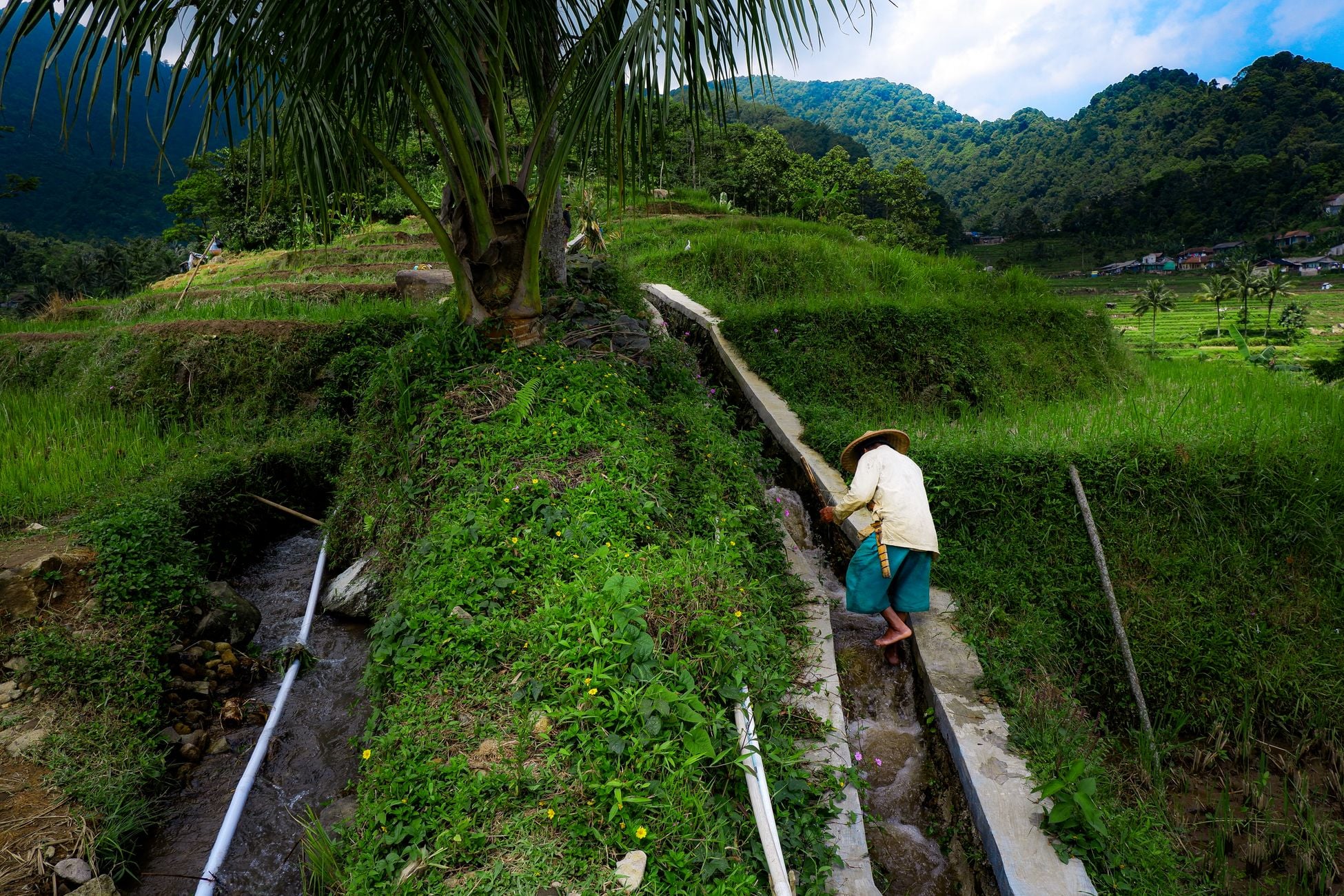
The chinampas of Xochimilco, the rectangular garden plots floating in the canals south of Mexico City, sit at high altitude — high enough that on clear winter nights the temperature can drop below freezing within a few hours of sunset. The Aztec farmers who engineered them centuries ago solved that problem without fuel, without cover, without any moving parts. They wrapped every plot in water. The canals around each chinampa absorb solar radiation through the day, hold that heat in their volume, and release it slowly through the cold hours after midnight, keeping the root zone of the crops several degrees warmer than the surrounding air. Six hundred years later, a handful of those plots are still in production, and the thermal trick still works.
UNESCO recognised the Xochimilco wetland as a World Heritage Site in 1987, citing the chinampas specifically as an agricultural system in continuous use since pre-Hispanic times. What the citation does not quite spell out is how strange the engineering is when you look at it closely. The chinampa is a piece of climate hardware disguised as a vegetable bed.
What a chinampa actually is
A chinampa is not a floating raft, despite the common translation. It is a narrow rectangular island, built up from the shallow lakebed by stacking alternating layers of aquatic vegetation, mud dredged from the canal floor, and decomposing plant matter. The edges are anchored with rows of willow trees — ahuejotes — whose roots knit the soil together and keep the plot from slumping. The surface of the chinampa sits above the waterline, with canals between plots running deep enough to provide thermal mass.
That geometry is the whole device. A long, thin strip of soil, surrounded on all four sides by a body of water that never freezes and never gets very hot. The soil never dries out because capillary action pulls moisture up from the canal through the root zone. And the air immediately above the soil is buffered, day and night, by the thermal mass of the water lapping its edges.
Why water is the right material for the job
Water has a specific heat capacity of about 4,186 joules per kilogram per degree Celsius — roughly four times that of dry soil and around five times that of air. A cubic metre of canal water can absorb the same amount of solar energy as several cubic metres of earth before its temperature changes by one degree. Through a sunny morning at high altitude, where ultraviolet and visible-light intensity is sharp, the canals warm up slowly and steadily. By late afternoon they have stored an enormous reservoir of thermal energy that the air above cannot match.
When the sun sets and the dry mountain air begins radiating heat to space, the canal water starts giving its stored heat back. It does this slowly, because water cools as slowly as it warms. The air directly above the canal stays warmer than the air a hundred metres away over open ground. The chinampa, surrounded by that warmer air column, experiences a microclimate that can sit two to four degrees Celsius above the regional minimum on a frost night.
For crops like maize, beans, squash, amaranth and chili — the staples of the Aztec diet — that buffer is the difference between a harvest and a dead field. Frost damage in maize begins at around 0 °C for mature plants and well above that for seedlings. A two-degree margin, delivered passively every night through the cold season, extends the growing window by weeks at each end.
The altitude problem the Aztecs were solving
Tenochtitlan, the Aztec capital that became Mexico City, was founded on an island in Lake Texcoco. The Basin of Mexico sits in a high-altitude bowl ringed by volcanoes. Daytime sun is intense; nighttime sky is clear; the air is thin and dry. The combination produces a steep diurnal temperature swing — often 15 to 20 degrees Celsius between afternoon high and pre-dawn low — and frequent radiative frosts from November through February.
Agriculture at that altitude, without protection, is brutal. The Aztecs needed to feed a city that had grown to a massive population, larger than any city in Spain at the time. Dry-land farming on the basin’s slopes could not support that population. The chinampa system, expanded aggressively through the 15th century in the southern freshwater zones of Xochimilco and Chalco, produced multiple crop cycles per year on the same plot — a yield density that allowed remarkably high agricultural productivity.
That productivity is partly soil fertility and partly water access. But the year-round growing season, in a basin that should have a sharply seasonal one, comes from the thermal regulation built into the layout.
How the farmers tuned the system
Chinampa farmers did not write thermodynamics treatises, but their practices show they understood the principle viscerally. Seedbeds were started in chapines — small blocks of mud cut from the canal floor, arranged in trays on the chinampa surface, where they sat closest to the warm canal edge and could be covered with reed mats on the coldest nights. Once seedlings hardened, they were transplanted into the body of the plot. Willows along the edges shaded the canal water in summer, preventing it from overheating, and dropped their leaves in winter, letting sunlight reach the water surface exactly when the heat-storage function mattered most.
The canal network itself was maintained obsessively. Silt was dredged up onto the chinampa surface, both as fertiliser and to keep the canals deep enough to hold thermal mass. A shallow, clogged canal stores less heat and offers less freeze protection. The geometry — long thin plots maximising the ratio of edge to interior — meant no part of the chinampa was more than a few metres from a thermal buffer.
What survived, and what almost didn’t
The lake system that once covered much of the Basin of Mexico is mostly gone. Spanish colonial drainage projects, followed by 20th-century groundwater pumping for Mexico City, dried out Texcoco and most of Xochimilco. The surviving chinampa zone had shrunk to a fraction of its pre-Hispanic extent, and most remaining plots had been abandoned or converted to greenhouses growing ornamental flowers with synthetic inputs.
The canals that still exist now host one of the strangest survival stories in modern conservation: the axolotl, Ambystoma mexicanum, a neotenic salamander found wild nowhere else on Earth. The same canal water that buffers the chinampas against frost is the only habitat the species has. Recent restoration projects by scientists and farmers working together in Xochimilco have been rebuilding traditional chinampas partly to feed the city and partly to give the axolotl a fighting chance against pollution and invasive carp and tilapia.
The thermal function quietly persists through all of this. A farmer working a restored chinampa today is using the same passive heating system an Aztec farmer used centuries ago. No upgrade has been necessary, because the physics of water has not changed.
A landscape that does the work of a greenhouse
Modern frost protection in commercial agriculture relies on active inputs: wind machines that mix warm upper air down to crop level, sprinklers that release latent heat as water freezes on leaves, propane heaters in vineyards, plastic row covers. All of these consume energy or materials and require labour at the exact moment — usually 3 a.m. on the coldest night of the year — when nobody wants to be in the field.
The chinampa does the same job by sitting still. The thermal mass of the canal was charged that afternoon by the sun, free of cost. The release happens automatically, governed by the temperature gradient between water and air. The willows do not need to be told to drop their leaves. The capillary rise in the soil does not need to be switched on. The whole system is, in the language of contemporary engineering, a passive thermal regulator integrated into the landscape — a phrase that would have meant nothing to the people who built it, and would have described exactly what they built.
On a January night in Xochimilco, when the dry air over the basin loses its heat to a black sky and the temperature on the surrounding hillsides falls below zero, the canals are still giving off the warmth they collected that afternoon. A thin layer of mist rises from the water. The maize and the chard and the radishes on the chinampa surface sit a few degrees warmer than they have any right to be. And somewhere in the canal below, an axolotl drifts through water held at the temperature its ancestors evolved in, in a city that has forgotten almost everything else about the lake it was built on.
