
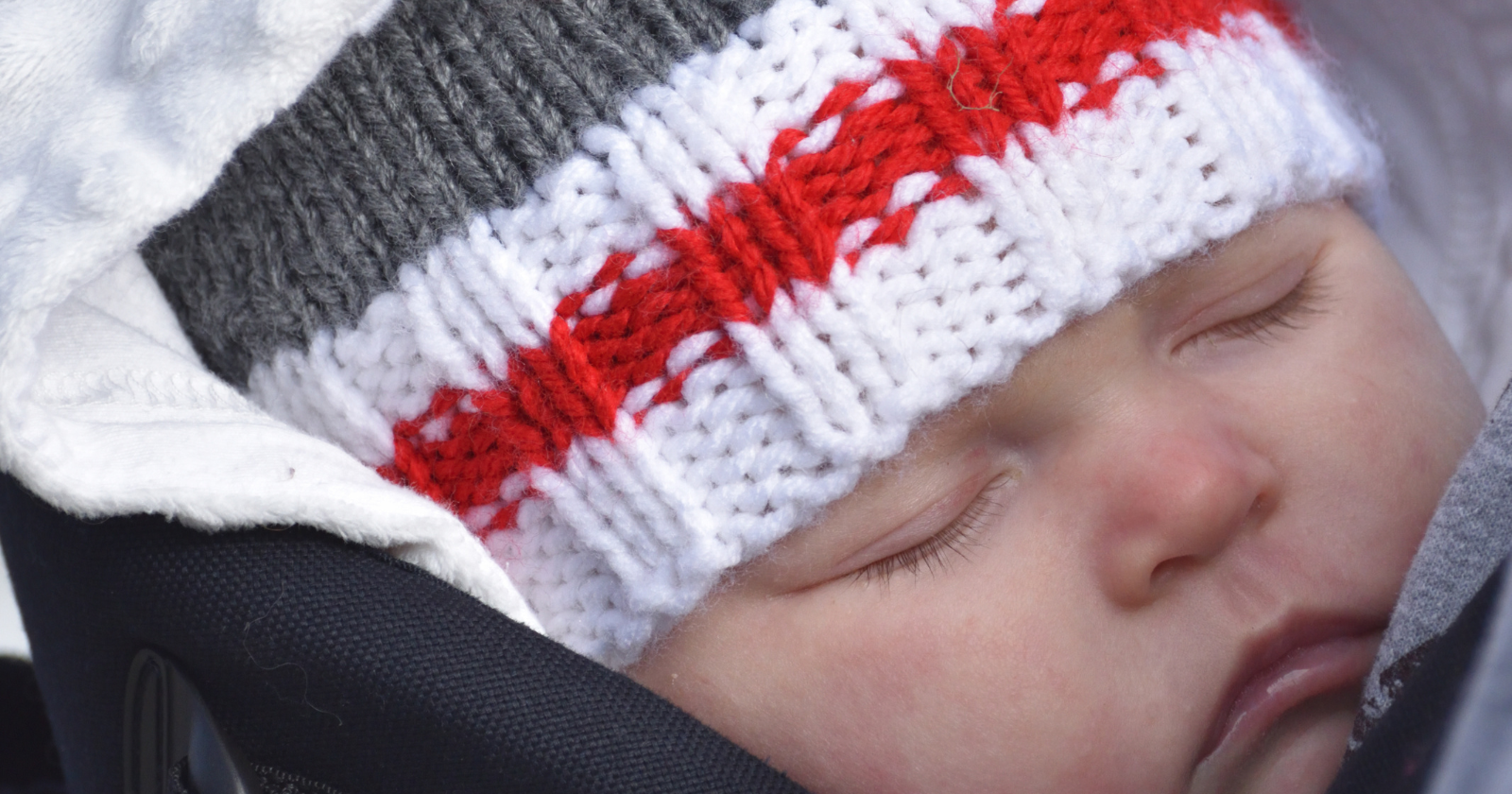
In the Finnish city of Oulu, about 95 percent of families with babies under two routinely put their infants outside to nap, in prams, in winter, sometimes in temperatures well below freezing. The finding comes from a 2008 survey by Marjo Tourula, Arja Isola, and Juhani Hassi at the University of Oulu, published in the International Journal of Circumpolar Health. The practice usually begins when the baby is around two weeks old. Parents check on the babies regularly. The temperatures reported in the study ranged from +5°C down to -27°C, with -6°C cited as the most common perceived ideal.
This is a reporting piece on what the research actually says about this. It is not a recommendation. We are writers and parents, not paediatricians, and the practice described below works within a specific cultural and infrastructural context that does not transfer cleanly to families outside it. Anyone considering changes to their infant’s sleep environment should talk to their paediatrician first.
What the research shows, and what it does not
The headline empirical finding, replicated in Tourula’s 2010 follow-up in Acta Paediatrica, which measured skin and microclimate temperatures in 67 infants, is that babies sleep significantly longer outdoors than indoors. Indoor naps in the studied families lasted between one and two hours. Outdoor naps lasted between 1.5 and 3 hours. Skin temperatures stayed within normal physiological ranges when the standard Finnish infant winter clothing system was properly assembled.
The Artful Parent
Family-life ideas and sharp reads, in your inbox.
What the research did not measure, despite the popular framing, was infection rates or illness frequency. The claim that Nordic outdoor-napping infants “show fewer illnesses,” which appears in many write-ups of this research, is not a finding from the Tourula studies. It is a parental perception reported in the survey data. The same parents who hold the belief are the ones reporting on the outcomes, and the belief has not been tested against indoor-napping comparison groups in a controlled way. The “longer sleep” finding is empirically supported. The “fewer illnesses” claim, as currently framed, is not.
The infrastructure that makes the practice work
Outdoor infant napping in the Nordic countries depends on a specific system of clothing, equipment, supervision, and cultural norms that has developed over generations. The clothing is engineered for the climate: layered insulation including wool, a windproof outer shell, and a sleeping bag rated for the relevant temperature range. The prams are designed for extended outdoor use. The babies are supervised, often through a window or a baby monitor, and the cultural norm of collective attention to a pram in public is strong. Widely shared thresholds govern when the practice is appropriate, what clothing to use at which temperature, and what signs to look for when checking on the infant.
None of this transfers automatically to a household that does not have it. The Tourula research describes a practice that works in its native environment. The image of an unattended pram in deep cold, occasionally circulated in popular coverage, is misleading: the babies are in supervised cold, with engineered equipment, in a culture that has thought carefully for generations about how to do this safely.
What the wider point actually is
The transferable insight from the Nordic research is narrower than the cultural-novelty version of the story suggests. The finding that infants sleep longer at cooler temperatures, within a properly designed clothing system, points at something the broader paediatric literature has also engaged with: that infants regulate temperature differently from adults, and that overheating is a real concern in infant sleep environments.
The American Academy of Pediatrics’ 2022 policy statement on sleep-related infant deaths, the current authoritative US guidance, addresses overheating directly but does not, as is sometimes claimed in consumer-facing summaries, specify a particular room temperature range. The statement notes that the definition of overheating varies across studies and that “it is difficult to provide specific room temperature guidelines to avoid overheating.” What the AAP recommends instead is dressing the infant in no more than one layer more than an adult would wear to be comfortable in the same environment, and watching for signs of overheating such as sweating or a hot chest.
The Nordic practice is, in a sense, a cultural expression of the broader principle that infants are more sensitive to overheating than adults often realise. The transferable element, for a family outside the Nordic system, is not the outdoor pram. It is the underlying observation that an indoor environment kept warm for adult comfort may be warmer than the infant needs for sleep, and that the question of appropriate dressing is worth raising with the child’s paediatrician rather than answering from articles.
What to do with the recognition
Any change to an infant’s sleep environment, including temperature, clothing, sleep surface, position, or location, is the kind of decision where reading an article is not a substitute for talking to a clinician. Infant sleep practices are tied to safety outcomes that are well-studied at the population level, and individual circumstances vary enough that general principles need to be applied with professional input.
The Tourula research is genuinely interesting, and the Nordic outdoor-nap practice is a real cultural phenomenon worth reporting on. What it is not is a parenting tip. The practice works in its native environment because of a long-developed infrastructure that does not exist elsewhere. The research findings within that environment are meaningful. The casual transfer of the practice to a family without the infrastructure is exactly the move the research most clearly does not support.