
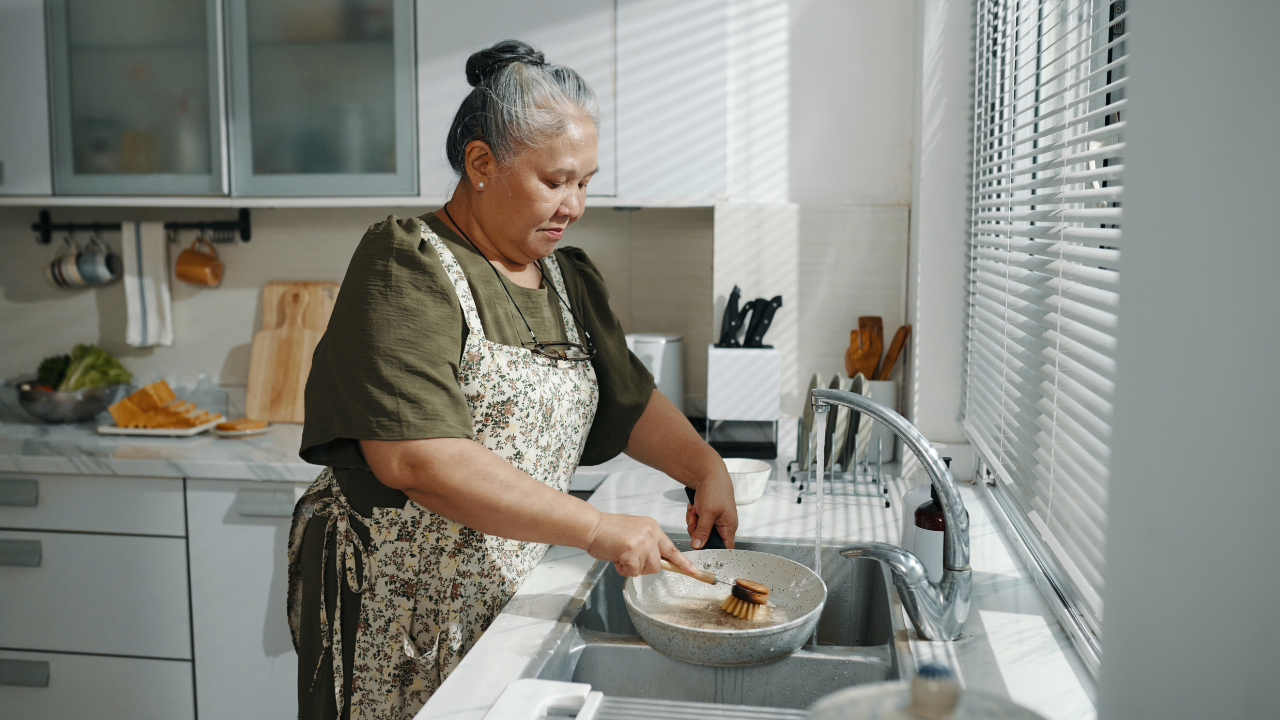
You notice it at the kitchen table. She’s sitting across from you and her hands haven’t stopped moving in twenty minutes. She’s straightened the placemat. She’s rearranged the salt and pepper. She’s picked up your empty cup, taken it to the sink, and returned before you could tell her not to bother. When she does eventually put her hands down, they land in her lap and don’t quite settle. They twitch. Her fingers trace small circles on the fabric of her skirt. She isn’t nervous. She isn’t fidgeting. She’s a woman who spent forty years taking care of other people, and her hands don’t know how to be off duty.
The hands you’re watching have done more than most people’s hands do in a lifetime. They cooked forty-three years of family dinners. They wiped fevered foreheads. They folded laundry for five children, and then, when the children grew up, for their grandchildren too. They dressed her mother-in-law for the last eleven years of that woman’s life. They held her husband’s hand through his cancer treatment. They wiped down surfaces, replaced light bulbs, sewed on buttons, made packed lunches, cut fruit into small pieces, and did most of the small daily labour of keeping a family running. Nobody kept score. The hands did the work anyway.
What the research has been noticing
The research on what happens to lifelong caregivers after their care work ends has been getting more careful about this pattern. In a 2025 qualitative study of long-term spousal caregivers, researchers found that the caregiver identity often persists well beyond the point where the caregiving officially ends. Even after the person being cared for had died or moved into long-term care, the former caregivers’ sense of themselves, their daily patterns, and the small automatic movements of their hands remained organised around care work. Their bodies were still running the programme long after the programme had anyone to run for.
Other researchers have started naming the specific stages of this transition. In a 2025 paper on post-caregiving support, the authors described what qualitative work in this area has come to call “post-caring emptiness”: a phase characterised by a specific kind of restlessness, a fatigue that doesn’t feel like tiredness, and a chronic low-grade sense that the person should be doing something for somebody. The body knows there is care work to be done. The care work isn’t there anymore. What’s left is the physical habit of doing it.
A note on what this is
We write about research here, not from a clinical chair. What follows describes patterns from the caregiver research, not any specific person’s experience. Not every lifelong caregiver carries this pattern. Some ease into the transition without difficulty. What the research points at is a common experience, particularly for those whose adult lives were substantially organised around caring for others, and whose caregiving continued for many years.
What the restlessness actually is
The restlessness at the kitchen table isn’t nervous energy. It’s the residue of forty years of being useful to people who needed her. The hands have been trained by daily practice to look for the next task. They notice when a cup is empty. They register when a table needs wiping. They know, before the person’s brain has caught up, that a grandchild’s shoelace has come undone. The knowing hasn’t gone away just because the household has emptied out. The knowing is now looking for somewhere to land.
The wider cultural conversation about lifelong caregivers still tends to celebrate what the hands did while it was happening, and treat the restlessness afterward as a small oddity of getting older. The research keeps pointing at something more specific. The restlessness isn’t oddness. It’s the body’s continued expression of a lifetime spent responding to other people’s small needs. Every twitch of the fingers is a habit built by love. Every reach across the table to move an empty cup is a movement the person made ten thousand times before, for people who couldn’t have moved the cup themselves. The story of those decades doesn’t need to be told out loud. The hands are still telling it.
