
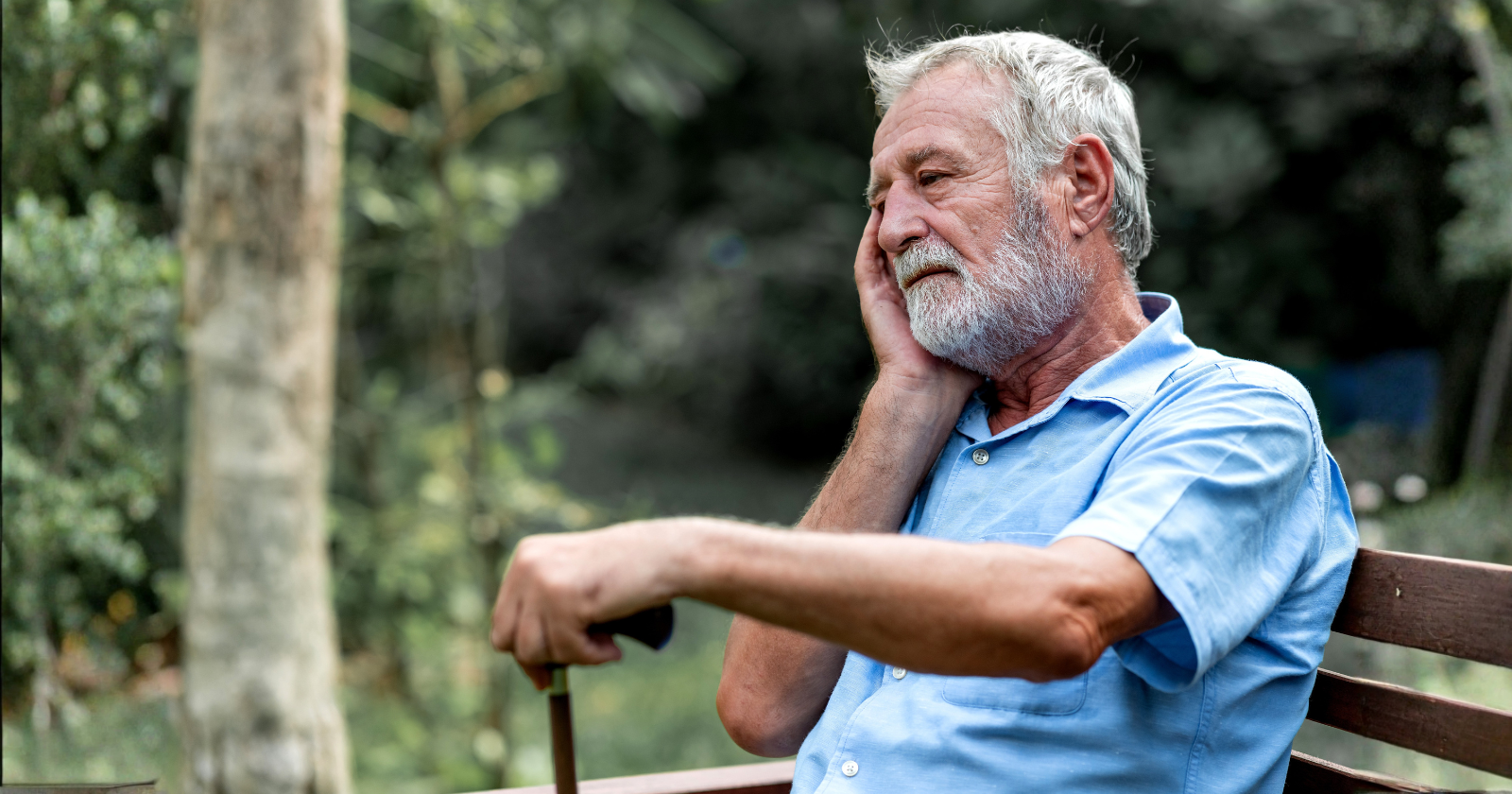
You notice it in small refusals. A parent who used to take the stairs without thinking now takes them one at a time, both hands on the rail, watching their feet. The evening walk gets declined — not tonight, the path’s uneven. The step stool disappears. An outing that involves a curb, a crowd, a slippery floor becomes a reason to stay home. Watching this, an adult child feels a familiar dread tighten: our mother is becoming frail, and the caution is just her body telling the truth.
Sometimes it is. But a large, careful study suggests the picture is more tangled than that — and that fear of falling is not simply a meter reading of how unsteady a body has become. It is partly its own thing, running on its own track, and it can shape a life, and even a fall, almost independently of how strong the legs underneath actually are.
Two different maps
A quick note on register. What follows is a reading of research, not medical guidance — falls in later life are serious, and the place to weigh any real risk is with a doctor, not an essay. What a study can offer is something narrower and still useful: a clearer picture of a thing families routinely misread.
The Artful Parent
Family-life ideas and sharp reads, in your inbox.
In 2010, Kim Delbaere and colleagues published a year-long study in The BMJ that followed 500 community-dwelling people aged seventy to ninety in Sydney. At the start, they measured each person two separate ways. One was the body’s actual, physical risk of falling — tested through balance, leg strength, reaction time, eyesight and the like. The other was the person’s own fear, how much concern they carried about falling as they went about ordinary life. Then the researchers handed out monthly diaries and waited to see who actually fell.
The first result is the one that reorders everything. The two measures — what the body could do, and what the person feared — were only loosely related to each other, and each predicted future falls on its own. The fear was not just an echo of a failing body. It was an independent forecast.
When the researchers sorted people by the gap between their real risk and their felt risk, about a third turned out to be living by the wrong map. Some — the study called them “anxious” — were physically steady but deeply afraid. Others, labelled “stoic,” carried real physical risk but were serenely unworried.
The steady and the frightened
The anxious group is the one that unsettles the tidy story. These were people whose bodies tested as low-risk, yet who were as frightened as the genuinely unsteady — and despite their sound balance, close to 40 percent of them went on to have a serious or repeated fall during the follow-up year.
The obvious explanation would be that fear made them shrink their lives — stop moving, lose strength, and fall for lack of use. But that is not what the data showed. The anxious were just as active as their fearless, equally steady peers; they had not withdrawn into their armchairs. Their raised risk tracked instead with something more internal: more symptoms of depression, a more worry-prone temperament, and poorer performance on tests of the mind’s executive control — the split-second attention that keeps a distracted foot from catching an edge. The fear, in other words, seemed to live in the same neighborhood as mood and attention, and it predicted falls from there.
The ones who weren’t worried
The stoics run the other way, and they are the quiet heart of this study. These were people whose bodies carried genuine physical risk, but who simply were not much bothered by the prospect of falling — and they fell less than the equally at-risk people who were appropriately worried.
The researchers looked hard at why, and the reason was not bravado or denial. The stoics were not reckless risk-takers. They tended to have a positive outlook on life, steadier emotions, and — crucially — they kept living: more planned exercise, more time out in the world, more ordinary participation in their community. And they were strikingly hard to frighten: of the stoics who actually fell during the year, only about one in six grew more worried about falling afterward. The rest picked themselves up and carried on much as before.
It would be easy, and wrong, to read this as stop worrying and you’ll be fine. The stoics were also, on average, a little younger and physically stronger than the frankly high-risk group, and the study cannot untangle every reason they fared better. But the pattern is hard to unsee: a fear that shrinks the world can be its own hazard, and a certain unbothered momentum — the person who keeps taking the walk — seems to protect something.
What the study cannot settle
This is one study, and its authors are careful about its edges. It is observational: it can show that fear and falling travel together, not that the fear directly causes the fall, and the psychological portraits it draws lean heavily on people describing themselves, which is never a perfect mirror. Its neat four groups were drawn with cut-points the researchers themselves call estimates, and its participants were relatively healthy community-dwellers, not the frailest older people or those with dementia, in whom the whole pattern might look different.
And nothing here argues that a genuinely unsteady person should airily ignore the risk. The researchers’ own recommendation for the physically at-risk is not less caution but more capacity: balance and strength training, the most reliably effective way to actually lower the odds of a fall. What the study reframes is not whether risk is real — it is how badly the felt version and the physical version can come apart, and how much the felt version matters on its own.
What it can offer a family
For an adult child watching a parent’s world contract, the useful shift is to stop treating every railing gripped as proof of a failing body, and to ask a second question alongside the first. There is the physical question — is the balance actually going? — which belongs with a doctor or a physiotherapist, who can measure it and, if needed, build it back. And there is the quieter question of whether fear itself has begun to run the household, declining the walk, cancelling the outing, closing the day down early. Because a fear that is steadily emptying a life is not a small thing to be waved away; the study points toward exactly the help that works for it — the kind of structured support and graded, confidence-building activity that eases the fear while it rebuilds the strength, rather than either one alone.
The two maps a person carries — what the body can bear and what the mind believes it can — are never quite the same map. A life in later years can be lost to the first, to a genuine fall on a genuine stair. But it can also be quietly lost to the second, to a caution so complete that nothing risky, which is to say almost nothing, ever gets done again.