
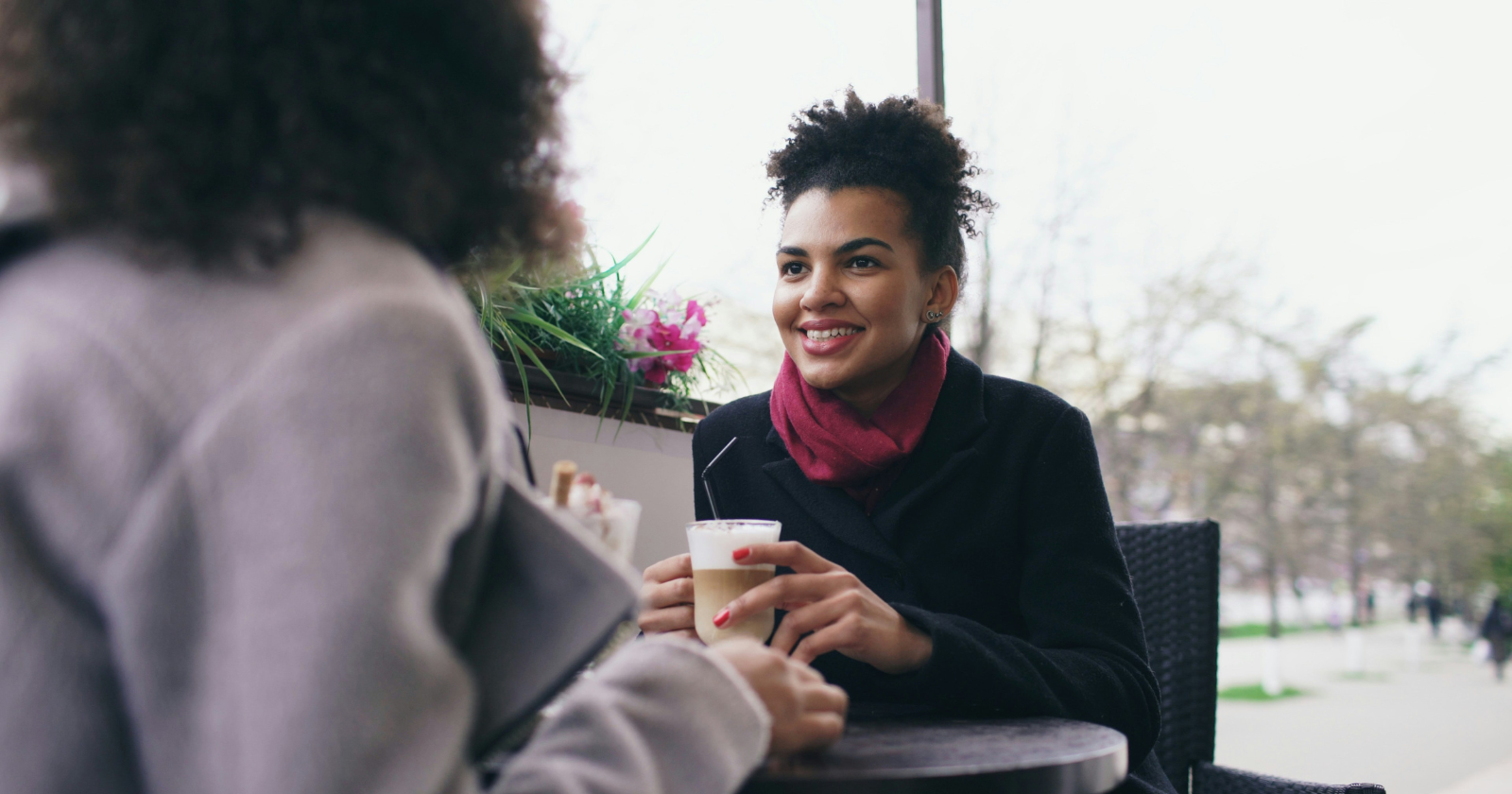

It happened at a café a few months ago. The server brought over two coffees, set them down, and was about to turn away. I said thank you and used his name, reading it from the small badge on his shirt. He paused for a half second, nodded, and left. My daughter was in a high chair across the table, watching with the focused, unblinking attention that very small children bring to everything adults do.
It wasn’t a lesson. I hadn’t planned it. I do it without thinking, the way I did it before I had a daughter to observe me. And it occurred to me, sitting there, that I learned it the same way she is learning it now: by watching, across years of ordinary meals and errands, without anyone ever explaining why it mattered.
My mother thanked people by name. She shook hands firmly and looked people in the eye while she did it. She held the door for strangers and didn’t glance back to see if anyone had noticed. None of this was accompanied by instruction. It was simply what she did, and at some point, without realizing it, it became what I do. What I notice, too: the person who says the server’s name when ordering, the one who holds the elevator a few seconds past convenient, the colleague who thanks the person who refills the coffee, not just the one who leads the meeting.
The Artful Parent
Family-life ideas and sharp reads, in your inbox.
The things we pick up from watching a parent are often smaller than we realize and more durable than almost anything we were explicitly taught.
What children are actually doing when they watch
Children are not passive observers. When a child watches an adult interact with the world, they are absorbing patterns in a way that will outlast anything they could learn from being told.
Albert Bandura, the psychologist whose work on social learning transformed how developmental psychology understood child behavior, demonstrated in the 1960s that children learn by watching others without needing direct reinforcement to do so. His research showed that “individuals can acquire new behaviors not only through direct experience but also by watching others and seeing the consequences of their actions.” This was a significant shift in thinking: you don’t need to reward or correct a child for them to absorb a behavior. You just need to perform it in front of them.
What makes this particularly striking is how indiscriminate the process is. A 2016 study published in Psychological Science found that children engage in what researchers call “over-imitation”: they copy everything an adult performs, including steps that seem unnecessary or irrelevant to any visible outcome. Psychologist Mark Nielsen, of the University of Queensland, who led the research, described what drives this: “From the mind of a child, perhaps there’s a reason why I’m doing this.” Children assume that adult behavior carries purpose, even when that purpose isn’t visible to them. They copy the handshake, the pause at the door, the eye contact with a stranger because they have no reason to assume those things are arbitrary. They see an adult doing them, and they conclude that this is how it is done.
The deliberate lessons, the ones that come with explanations, the “always say please” and “look people in the eye when they’re talking to you,” tend to produce compliance in the moment and patchy results over time. The observed behaviors, the ones that were simply there, enacted without comment, day after day, tend to become part of the person.
Why the small moments carry more than the explicit ones
There is a difference between a parent who says “be polite to service workers” and a parent who is visibly glad when a waiter arrives, who asks how the person’s day is going and means it. The first produces instruction. The second produces a model.
The behaviors described in the title of this article, shaking a hand properly, thanking a server by name, holding a door without looking for acknowledgment, share a common quality: they extend consideration to people who aren’t in a position to reward or evaluate the person extending it. There is no social advantage in thanking someone whose opinion carries no weight. There is no calculation in holding a door for a stranger you’ll never see again. These behaviors, when a child observes them, communicate something that no lesson could articulate as cleanly: this is how we treat people. All of them. Without an audience.
Children pick this up with startling accuracy. They notice what a parent does when there is nothing to gain. A parent who is warm to the people they need and clipped with the people they don’t leaves a different trace than one whose manner doesn’t shift depending on status. Adults who grew up in households where this consistency was modeled tend to describe it in the same way: they can’t remember being told to pay attention to how people treat service workers or strangers, but they do pay attention to it, and they always have.
What it means to be watched the way I once watched
My daughter is too young to remember any of this. She won’t carry a specific memory of the café, or of my hands around a coffee cup, or of the small exchange with the server whose name I used. But she is watching. At a year and a half, she watches everything, with an attention that is absolute and merciless and completely without judgment. She is building her picture of how adults move through the world, and right now I am most of that picture.
This is more weight than any explicit instruction I’ll ever give her. When she is thirty and someone observes that she is unusually gracious to people in service roles, she probably won’t know why. She won’t trace it to a specific lesson, because there won’t be one to trace. She will just know, in the way that absorbed knowledge sits, that this is how it is done. The same way I know it. The same way my mother, presumably, knew it from watching whoever she once watched.
What gets transmitted across generations in a family isn’t always what parents intend to pass on. It often isn’t the formal lessons or the deliberate conversations. It tends to be the texture of ordinary behavior: how someone’s face changes when a stranger holds a door for them, the pause before responding when something frustrating happens, the way a hand is offered. The behaviors that are simply there, day after day, without an audience and without expectation of credit.
It turns out that children notice all of it. They are noticing right now, in households everywhere, storing away the small moments that will surface years later as their own instincts, their own standards, their own sense of what it looks like to move through the world with consideration for the people in it. Nobody will remember where those instincts came from. They’ll just be there, the way my mother’s way of treating people became, quietly and without ceremony, mine.