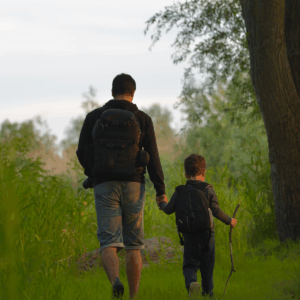

Let’s be honest: raising boys has never been simple.
Especially for those of us who grew up in an era when fathers were told to toughen up their sons, keep emotions in check, and prize achievement above all else.
Many boomers I’ve spoken with, including a few close friends, confess to looking back and wishing they had done things differently.
And I get it. As a father and now a grandfather wandering around the park with little ones at my heels, I’ve had my fair share of quiet reflections about the way I raised my own son.
Parenting is a lifelong learning curve, and sometimes the lessons do not land until decades later.
If you’re reading this, maybe you’re carrying a few regrets too, or you’re hoping to avoid them altogether as you guide your own child. Either way, you’re in good company.
So let’s talk about the mistakes many boomers say they made, the ones whispered over coffee or admitted during those late night conversations.
Because it is never too late to grow, to reflect, and to heal.
1. Expecting toughness instead of teaching emotional literacy
One of the biggest regrets I hear is this: “I didn’t let my son feel anything.”
And I can relate. When my kids were young, phrases like “Don’t cry” or “Shake it off” were practically considered normal. We thought we were preparing boys for a hard world.
Looking back, many boomers now realize we were actually stripping them of the tools they needed to navigate that world.
Experts have been saying this for years. Emotions are not obstacles. They are information.
Related Stories from The Artful Parent
- I’m 35 and I love my parents but I also resent them — and I spent years believing those two things couldn’t both be true before I understood that love and resentment are not opposites, they are the specific combination that forms when you were raised by people who did their best and whose best had limits and whose limits became your wounds
- Psychology says when adult children avoid their parents, it’s rarely about one dramatic event — it’s about a thousand small moments where the child learned that being authentic around the parent felt more dangerous than being distant
- I finally understand why my father always backed the car into the driveway — it wasn’t about convenience, it was a man who spent his whole life making sure everyone else could leave first
And recently, when I was reading Rudá Iandê’s new book Laughing in the Face of Chaos, one line in particular struck me: “Our emotions are not barriers, but profound gateways to the soul, portals to the vast, uncharted landscapes of our inner being.”
It made me reflect on the subtle emotional habits I inherited, and how some of those may have quietly shaped my parenting style years ago.
Children who grow up without emotional permission often carry that emotional suppression into adulthood, which can create tension in their closest relationships.
If I could go back, I would listen more. I would ask more questions. I would stop assuming that a quiet son was a strong one.
And many boomers tell me they wish they had done the same.
2. Using achievement as the primary lens for value
Let me pose a question. How many of us praised our sons mainly when they scored a goal, aced a test, or won something?
I know I fell into that trap. It was not malicious. We were raised in a culture where success was measurable, visible, and rewarded.
But when achievement becomes the currency of approval, boys often internalize the idea that being good enough depends on performance.
I once overheard a friend say, “I should’ve celebrated the small moments more.” It stuck with me because it is something so many of us regret.
When success is overemphasized, sons may hide mistakes, fear failure, or burn themselves out trying to stay worthy.
When adult children feel pressured during times of struggle, it negatively affects their well-being and the relationship with their parents.
As Dr. Jeffrey Bernstein puts it, “Pressuring a struggling adult child negatively impacts their well-being and the relationship with them.”
That does not start in adulthood. It starts way back when boys begin tying their worth to gold stars and applause.
There is a quieter and deeper kind of love our sons need. The kind that says, “You are valued simply because you are.” Not because you are winning.
If more of us had said that earlier, some regrets might not sting so sharply today.
3. Confusing discipline with control
This point deserves its own spotlight because it is one many boomers still carry guilt over.
Growing up, discipline meant control. Yelling was normal. Threats were common. And many of us repeated what we saw without realizing the emotional cost.
I remember an afternoon when my son was about twelve. I can still see the look on his face after I raised my voice at him for something small. Something I forgot just hours later, but that he remembered for years.
That is the thing about fear based discipline. The lesson fades, but the imprint does not.
Environments dominated by fear often make communication difficult and erode trust.
Sons raised this way may become men who either avoid conflict entirely or mirror the same controlling behaviors in their own families.
And while discipline is necessary, control is not.
Discipline guides.
Control stifles.
One quiet regret boomers often admit is this: “I didn’t realize how much my anger shaped him.”
Trust me. Anger teaches lessons we never intended.
4. Not modeling emotional self care
This one is tough because most of us did not even have the language for self care back then.
The adults I grew up with pushed through exhaustion, ignored anxiety, and believed that stress was simply part of life.
But sons watch closely. More closely than we ever realize.
If a boy grows up seeing his father bury emotions, neglect rest, or carry burdens alone, he learns that manhood means self abandonment. He inherits the silence.
Many boomers regret pretending to be invincible.
They regret what that invisibility taught their sons.
And honestly, I get it. When we do not model emotional grounding, boys grow up thinking they should hide their struggles too.
5. Letting conflict overshadow connection
Here is something I wish more parents talked about openly. How unresolved conflict in the home affects children long after they are grown.
The research supports this. “Children of divorced or separated parents will fare worse if the breakup is high conflict, as compared to low conflict.”
And even though that quote refers specifically to divorce, the principle applies broadly. Any home filled with tension, sharp tones, and unresolved fights creates emotional instability for kids.
I had a conversation recently with another grandfather who said, “I didn’t realize he thought our arguments were about him.” That is a regret I have heard too many times.
Kids do not need perfect parents. They need emotionally safe parents.
They need to see disagreements handled with humility, repair, and respect.
If I could redo anything, it would be the way I navigated conflict. Not to eliminate it, but to make it less frightening and more human.
6. Forgetting that sons need gentleness just as much as guidance
Here is the quietest regret of all and maybe the most universal. Many boomers now realize they did not nurture enough.
They provided. They protected. They guided.
But they were not gentle.
I have seen this come up again and again in conversations with men my age. We were so focused on shaping our sons into capable adults that we forgot boys need warmth and softness too.
Gentleness does not weaken boys. It strengthens them.
It gives them permission to be whole humans, not just stoic versions of strength.
If more of us had known that sooner, maybe fewer men today would struggle with vulnerability and connection.
Closing thoughts
If you are a parent wrestling with regret, here is something I have learned. Regret is simply insight that arrived a little late.
And insight is still a gift.
We can reconnect with our sons.
We can open conversations we once avoided.
We can soften the edges we used to sharpen.
We can model the emotional freedom we never had ourselves.
I am still learning every day. And if I can leave you with one last question, it is this:
What is one small shift you can make today that your future self and your son will thank you for?
Because it is never too late to rewrite the quiet parts of our story.