
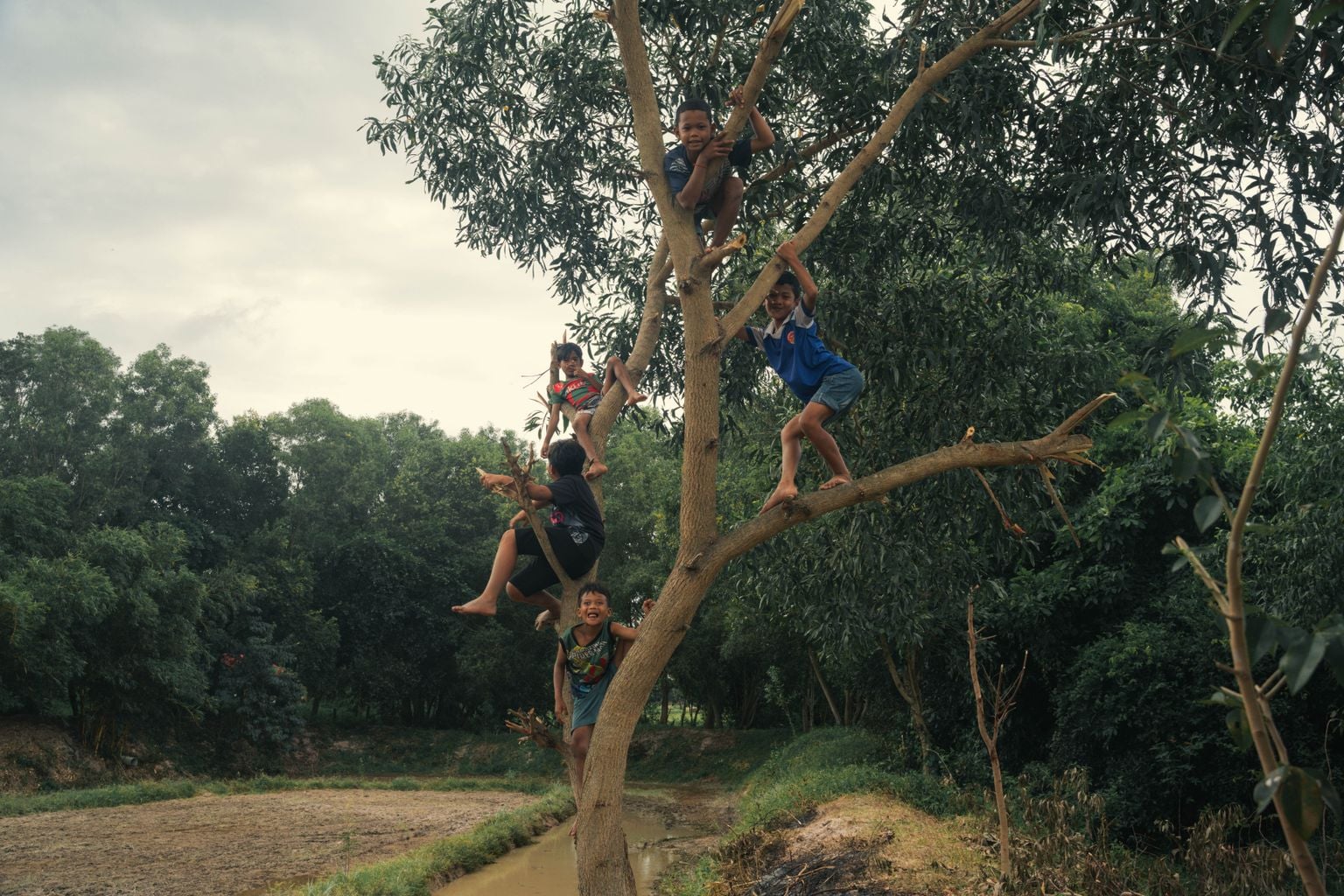
The stories are familiar by now: leaving the house after breakfast and not coming back until the streetlights came on, climbing trees without a helmet, riding bikes across town alone at eight years old. Measured against how most children spend their time today, it sounds almost reckless. A specific line of developmental research suggests that same “reckless” freedom may have been doing real psychological work.
The clearest evidence comes from a 2011 paper by Ellen Beate Hansen Sandseter and Leif Edward Ottesen Kennair, published in Evolutionary Psychology. Reviewing developmental and evolutionary research on what they call risky play, activities like climbing to real heights, playing at real speed, exploring away from adult supervision, and rough-and-tumble play, the researchers argue these experiences serve a specific function: exposing children to a controlled, manageable dose of genuine fear. Encountering that fear in a low-stakes setting, and coming through it safely, appears to help extinguish natural, evolutionarily built-in fears rather than reinforce them. The authors argue this has what they call an anti-phobic effect, essentially rehearsing the nervous system’s fear response in a way that teaches a child the sensation is survivable and manageable, rather than something to avoid entirely. Their broader argument is that the steady rise in overprotective, closely supervised parenting may be removing exactly the kind of exposure that once helped inoculate children against anxiety and phobias later on.
A separate, more data-driven review helps put a number on how much that kind of unsupervised freedom has actually shrunk. In a 2018 review by Isabel Marzi and Anne Reimers, published in the International Journal of Environmental Research and Public Health, the researchers synthesized decades of research on children’s independent mobility, meaning how far and how freely children are allowed to travel without an adult. Among the studies they reviewed was the landmark English data first collected in 1971 and later replicated: in 1971, 55 percent of 7- and 8-year-olds were allowed to travel to places other than school completely on their own. By the time later replications were conducted, that figure had collapsed to nearly zero. The freedom to simply go somewhere alone, once close to the default experience of childhood, had become the rare exception within a couple of generations.
The Artful Parent
Family-life ideas and sharp reads, in your inbox.
Put together, these two bodies of research describe the same shift from different angles. Marzi and Reimers’s review documents just how dramatically children’s actual, everyday independence has shrunk since the boomer generation was young. Sandseter and Kennair’s research offers a specific account of what may have been lost along the way: not simply unstructured time, but a particular kind of manageable fear exposure that appears to play a real role in how children learn to regulate anxiety. The freedoms that look reckless by today’s standards, wandering alone, climbing without supervision, testing real physical risk, may have been functioning as a kind of built-in anxiety training that most children today no longer get.
It’s worth being honest about what this research doesn’t establish. Sandseter and Kennair’s paper is a theoretical synthesis of existing evolutionary and developmental literature rather than a single controlled experiment directly testing risky play against anxiety outcomes in the same group of children over time, so it’s best understood as a well-reasoned, evidence-informed argument rather than definitive proof of cause and effect. Marzi and Reimers’s review, while grounded in large surveys across multiple countries, focuses specifically on independent mobility, physically traveling without an adult, which is only one slice of what boomer childhood freedom generally looked like, and the studies it draws on vary in method and country, which limits how precisely the numbers compare across decades and places.
Within those honest limits, the research offers a more specific, useful way to think about what’s changed since the boomer generation’s childhood than simple nostalgia. It isn’t just that children used to have more unsupervised time. A real, measurable freedom to encounter manageable risk and come out the other side unsupervised may have been doing something for how children learn to handle fear, and the sharp, well-documented decline in that particular kind of freedom is worth taking seriously as more than just a shift in parenting style.