
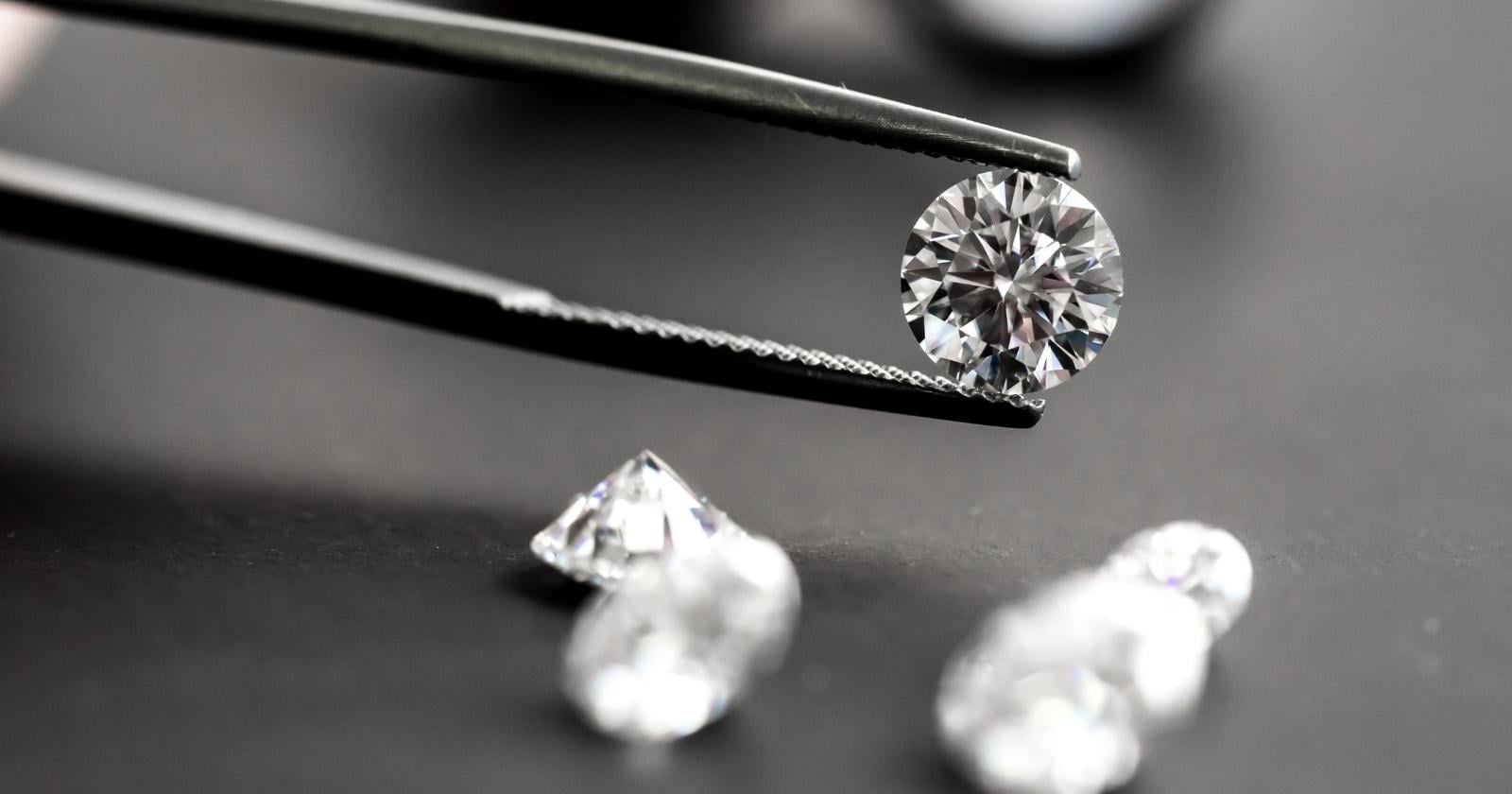
Inside a windowless industrial bay in Zhengzhou, Henan Province, a microwave plasma reactor the size of a household washing machine is glowing a faint violet, and a one-carat diamond is growing inside it at roughly the speed a fingernail grows — about 0.007 millimetres per hour. The seed at the bottom of the chamber is a thin slice of diamond crystal no bigger than a contact lens. The gas above it is methane and hydrogen, ionised by 2.45 gigahertz microwaves into a glowing ball of plasma at around 1,000 degrees Celsius. Carbon atoms peel off the methane and rain down onto the seed, one atomic layer at a time. In about two weeks, the operators will open the chamber and pull out a rough diamond chemically and optically indistinguishable from one mined a billion years ago in the Earth’s mantle. Cost to produce: a few hundred dollars.
Henan province now makes more than half the world’s lab-grown diamonds. The Chinese industry refers to the technique as CVD — chemical vapour deposition — and the older Chinese method, HPHT (high pressure, high temperature), squeezes graphite at around 5 gigapascals to mimic the conditions deep underground. Either way, the output is the same: pure crystalline carbon, lattice-perfect, often clearer than the average mined stone.
A wholesale one-carat lab-grown stone that cost about $4,000 in 2016 now trades for under $400 at the rough stage. The De Beers Group, which spent most of the twentieth century convincing the world a diamond was forever, cut its rough diamond prices by around 40 percent between 2023 and 2025 and folded its own lab-grown jewellery brand, Lightbox, in 2024.
The scarcity that wasn’t
Diamonds are not actually rare. Geologists have known this since at least the 1870s, when enormous deposits were found at Kimberley in South Africa and the global supply suddenly threatened to collapse the price. The British financier Cecil Rhodes consolidated the South African mines into De Beers Consolidated Mines in 1888 with a single strategic insight: if you control supply, you control price. For the next century, De Beers and its sightholders released only as many stones as the market could absorb at the price they wanted.
The other half of the trick was demand. In 1947, the New York copywriter Frances Gerety, working for the N.W. Ayer agency on the De Beers account, wrote the line “A Diamond Is Forever” at the end of a long evening. It ran in 1948 and has run, in some form, ever since. Advertising Age named it the slogan of the twentieth century. The line did two things at once. It tied the diamond to the permanence of marriage, and it discouraged resale — because if a diamond is forever, you don’t sell yours, which keeps second-hand supply off the market and protects the primary price.
The engagement-ring convention as a mass phenomenon is a post-war invention. Before the campaign, fewer than 10 percent of American brides received a diamond ring. By 1990, the figure was around 80 percent. The “two months’ salary” rule, often repeated as folk wisdom, was a De Beers marketing line from the 1980s. Earlier ads suggested one month.
What’s actually happening in the reactor
The CVD process was first demonstrated in the 1950s by William Eversole at Union Carbide and refined by Soviet researchers and then by teams at the Naval Research Laboratory in the 1980s. It only became commercially viable for gem-quality stones in the 2010s, once engineers worked out how to grow larger, cleaner crystals without the brownish tint that plagued early synthetics.
A modern CVD chamber is roughly a stainless-steel vacuum vessel with a quartz window. A diamond seed sits on a molybdenum stage. Hydrogen and methane flow in at low pressure — around 100 to 200 torr, about a fifth of atmospheric. The microwave generator strikes a plasma above the seed. Atomic hydrogen etches away any non-diamond carbon (graphite, amorphous soot) almost as fast as it forms, leaving only the sp³ bonded carbon — diamond — to accumulate.
Run the reactor for 10 to 15 days and you get a rough crystal of two to three carats. Run an HPHT press for about a week and you get the same. The finished stones are then cut and polished in Surat, India, the same city that cuts roughly 90 percent of the world’s mined diamonds. Under a jeweller’s loupe, a trained gemmologist cannot tell them apart. Distinguishing lab from mined requires specialised equipment — usually a DiamondView machine that examines fluorescence patterns under deep UV, looking at the growth striations the lattice records.
The price collapse, charted
In 2018, a one-carat lab-grown diamond retailed for around 20 percent less than its mined equivalent. By 2024, the discount was over 80 percent. Pandora, the Danish jewellery chain, switched its entire diamond line to lab-grown in 2022. Signet Jewelers, which owns Kay and Zales, reported that lab-grown stones accounted for roughly half of its engagement-ring sales by 2024.
The mining side has been bleeding. Anglo American announced in 2024 that it intended to divest De Beers, ending an ownership arrangement that went back to 2012. The Russian state miner Alrosa, which produced about a third of the world’s rough mined diamonds, has been under Western sanctions since 2022. Botswana, where mined diamonds generate roughly a quarter of GDP, renegotiated its sales agreement with De Beers in 2023 to take a larger share of a shrinking pie.
Why people still pay more for mined
A chemically identical product selling for one-fifth the price ought to win the market outright. It mostly has, among younger buyers. But a meaningful fraction of consumers still pay the premium for a mined stone, and the reasons are psychological rather than material.
The economics literature on luxury goods describes this as the Veblen effect: a category where higher price increases desirability rather than reducing it. Research collected in the Nature Index review of luxury consumer behaviour traces how status signalling and authenticity narratives sustain price premiums even when functional substitutes exist. A diamond pulled from the Earth, the story goes, carries something a reactor cannot replicate: time, geology, the romance of the deep mantle.
The mechanism is also one of anchoring. Three generations of brides have paid one to two months’ salary for a diamond. That anchor sets the perceived value of the object, and a $400 lab-grown stone feels insufficient to signal the same commitment — not because the carbon is different, but because the spending is. The scarcity principle, well documented in social psychology, also bites here: an object that anyone can buy for a few hundred dollars stops functioning as a status marker, regardless of its physical properties.
And then there is the strange territory of cognitive dissonance. A consumer who has already spent $8,000 on a mined ring has a strong psychological incentive to insist that lab-grown stones are not really the same — to defend the purchase against the evidence of the spectrometer. The research on belief persistence shows people will often double down on a narrative when the contradictory information becomes more, not less, compelling. A New Yorker piece tracing the history of Leon Festinger’s original 1957 work notes how the effect was first documented in groups whose prophecies failed and who responded by believing harder.
The Chinese supply chain
Henan’s dominance is not accidental. The province has been making industrial diamond — the gritty kind used in drill bits and cutting wheels — since the 1960s, when the state-owned Zhengzhou Research Institute for Abrasives and Grinding pioneered HPHT synthesis. The technical workforce, the press manufacturers, and the supply of high-purity graphite were all already in place when the gem market opened up.
Estimates from industry trackers put Chinese lab-grown production at roughly 3 million carats in 2020 and more than 15 million carats by 2024. India has scaled up rapidly as well, with CVD reactors clustered around Surat. The capital cost of a single CVD chamber is around $200,000 to $500,000. Operating costs are dominated by electricity. A reactor running continuously for a year, at Chinese industrial power rates, produces enough rough to wholesale for several times its purchase price.
What the De Beers vault looks like now
De Beers maintained a stockpile in London for decades, releasing rough stones to a select group of about 80 sightholders ten times a year at fixed prices. The system was the operational backbone of the scarcity model. In 2024 and 2025, sightholders were allowed to refuse allocations for the first time in living memory, and prices at the sights were repeatedly cut. The company has pivoted its messaging from “forever” to “natural” — emphasising the geological origin of the stone, the only thing a reactor genuinely cannot duplicate.
A mined diamond formed somewhere between one and three billion years ago, between 150 and 200 kilometres beneath the Earth’s surface, and was carried to the crust by a kimberlite volcanic eruption. A lab-grown diamond formed last month in Henan. The lattice is the same. The atoms are the same. What you are paying the premium for, in the end, is the time.
The next two weeks
Somewhere in Zhengzhou tonight, a few thousand reactors are humming in quiet violet light, each one growing a stone that, by the first week of July, will be cut in Surat, certified in Mumbai or Antwerp, and slipped into a velvet box in a shopping mall in Shanghai or Atlanta. The customer will hold it up to the light and see exactly what a customer in 1947, reading Frances Gerety’s new ad in the back of a magazine, was promised they would see. The fire. The brilliance. The forever.
The carbon doesn’t know the difference. The market, slowly, is learning.
