
Bernardino de Sahagún, a Franciscan friar who catalogued Aztec life in the sixteenth century, recorded something that startled European readers: in Tenochtitlan, a city built on a lake in the Valley of Mexico, human excrement was a commodity. Canoes worked the canals each morning collecting night soil from public latrines stationed along the causeways, and the cargo was sold to farmers who spread it across the floating gardens at the city’s edge. Nothing left the system. The lake city ate from its own waste.
By the time the Spanish arrived in the early sixteenth century, Tenochtitlan was one of the largest cities in the world, and possibly the cleanest large city on Earth. Its sanitation depended on a logic the Spanish did not at first understand: that the contents of a chamber pot were not refuse but fertilizer, and that a dense urban population sitting on a lake was a problem only if you treated its outputs as garbage. The Aztecs treated them as input.
A city built on water, fed by its own dirt
Tenochtitlan was founded on a marshy island in Lake Texcoco. To grow food for a large population, the Mexica built chinampas — long rectangular plots of mud and decaying vegetation staked into the shallow lakebed, edged with willows whose roots locked the soil in place. A single chinampa was a rectangular plot separated from its neighbors by canals just wide enough for a canoe.
The chinampa system produced multiple harvests a year of maize, beans, squash, amaranth, chilies, and tomatoes. That kind of yield demands an extraordinary input of nitrogen and phosphorus. Lake mud, dredged from the canal bottoms, supplied some of it. Aquatic plants, composted and layered onto the beds, supplied more. And the rest came from the city itself.
The canoe collectors
Public latrines, built of reeds and wood, were positioned along the main causeways and at the edges of markets. Sahagún’s informants described how full vessels were rowed out at dawn to the chinampa zones at Xochimilco and Chalco, where farmers paid for the load. Urine was collected separately in ceramic jars set out by households; it was prized as a mordant for fixing dyes in cloth, and also went onto the fields.
The chemistry was sound, even if no one in the fifteenth century was writing it in those terms. Human urine contains significant nitrogen. Feces add phosphorus and potassium along with organic carbon that improves soil structure. Modern soil scientists working on nitrogen-rich organic fertilizers from human-derived materials have shown that protein-based wastes can match or exceed conventional synthetic inputs for crops like rice and maize. The Aztecs had arrived at the same arithmetic by trial and observation, a few hundred years earlier.

Why this mattered for a lake city
Tenochtitlan had a sanitation problem most cities of its size would not solve until the nineteenth century. The Thames during the Great Stink forced Parliament to suspend sessions. Tenochtitlan, three hundred years earlier, had already removed the problem by refusing to define waste as waste.
The canal network doubled as a transit grid and a flushing system, but human excreta were never allowed to enter it. Spanish chroniclers noted with some confusion that the streets were swept daily and that there were attendants at the latrines. The collected material was carried by water, not by foot, because the city was water — every block was a few meters from a canal.
The result was a closed loop with a precision that modern circular-economy advocates spend a great deal of money trying to replicate. The shift away from take-make-waste is treated today as a recent corporate frontier. Tenochtitlan ran on it by default.
Yields that surprised the conquistadors
The chinampa system achieved remarkably high productivity — figures that compete with industrial agriculture using synthetic fertilizer. The system could support dense populations. The Xochimilco zone covered extensive areas at its peak.
Maize was the staple, but the system supported much more. Tomatoes, the wild ancestors of which were domesticated in Mesoamerica, grew on the beds. So did the chilies that would eventually transform cuisines from Sichuan to Hungary. Amaranth, harvested for both grain and leaves, provided protein. The chinampas also supplied flowers — Xochimilco means “place where flowers grow” — which were traded daily into Tenochtitlan for use in temple offerings and household altars.
None of this was possible without constant nutrient input. Take away the night soil collection and the lake mud dredging, and the chinampas would have exhausted themselves within a few growing seasons. The soil-science principle is one that contemporary research on organic fertilizers in saline soils keeps confirming: high-frequency cropping needs high-frequency nutrient return, and biological inputs work as well as chemical ones when the cycle is closed.
The role of urine in the dye trade
The separated urine collection was not just a sanitary measure. Aztec dyers used aged urine as a source of ammonia for fixing colors — a practice familiar to textile workers in other cultures. Cochineal red, indigo blue, and the yellow from the zacatlaxcalli plant all needed a mordant to bind to cotton or maguey fiber.
A household that set out a jar by the door was contributing to two industries at once: textile production and agricultural fertility. The jar was emptied, the contents sorted by use, and the household received small payment or social credit. The system was not optional or charitable — it was infrastructure, the way garbage trucks are infrastructure in a modern city.
What the Spanish did to the system
The conquest broke the loop. After the city fell, much of it was leveled. The Spanish drained sections of Lake Texcoco over the following centuries to build colonial Mexico City on dry ground, in part because they considered the canal-based sanitation system primitive — even though it worked better than anything in Madrid.
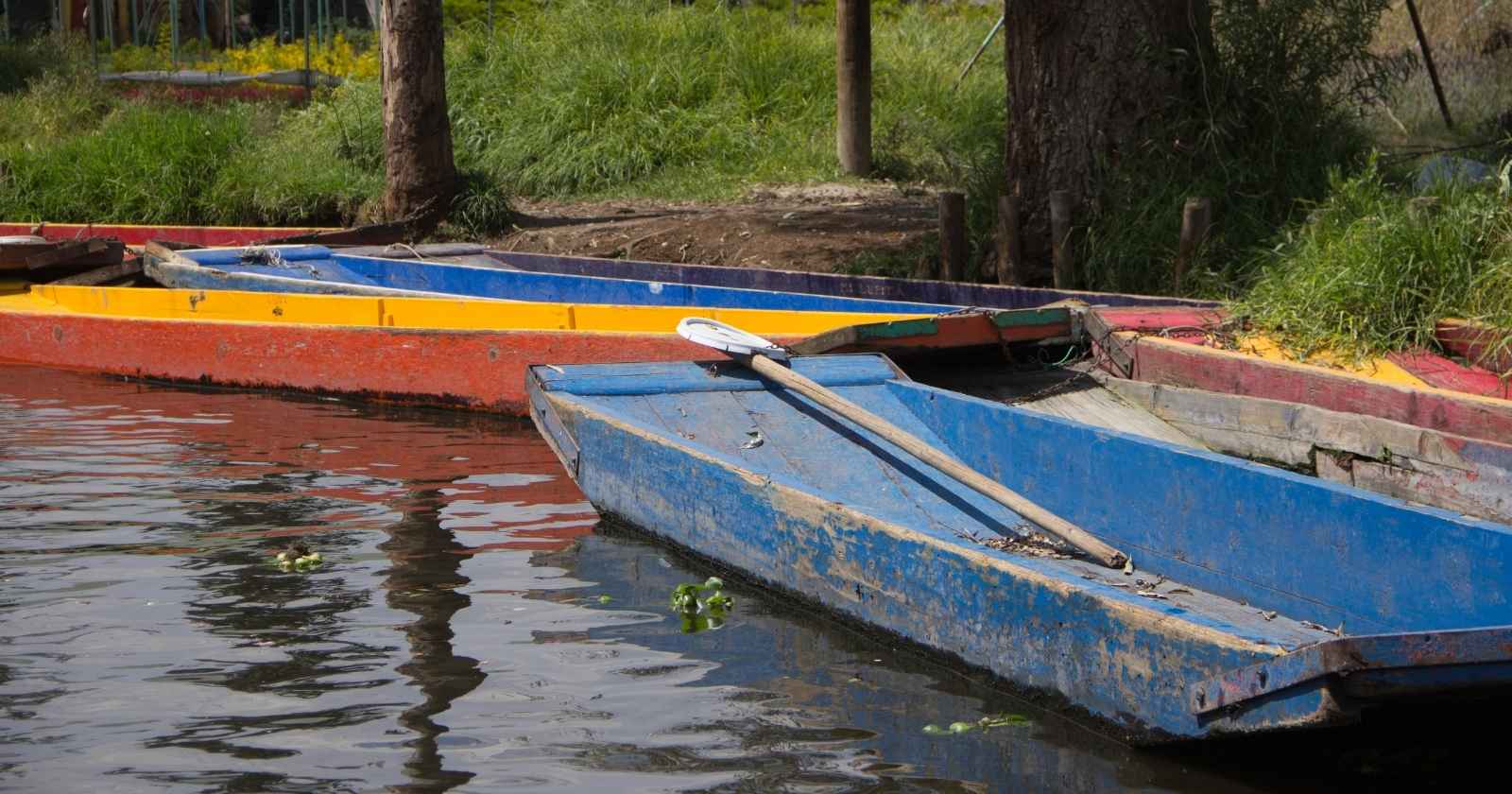
The chinampa zones at Xochimilco survived in pieces, and a small fraction still operates today, mostly as a tourist attraction with painted trajinera boats. UNESCO designated the area a World Heritage Site, citing both its agricultural ingenuity and its precarious state. Modern Mexico City sits atop the drained lakebed and is sinking significantly in some districts, a consequence of pumping out the groundwater the Aztec system had stored.
The closed nutrient loop did not survive the conquest in any meaningful form. Colonial agriculture introduced cattle, sheep, plows, and wheat, and the population of the Valley of Mexico collapsed dramatically within a century due to smallpox, measles, and forced labor. The infrastructure that had moved excrement by canoe ceased to function because the people who ran it were dead.
Why circular-economy researchers keep coming back to this
The Aztec system is cited in agricultural history because it solved a problem that synthetic-fertilizer agriculture is now beginning to face: nutrient runoff. The Haber-Bosch process made cheap nitrogen fertilizer possible and feeds a large portion of the global population. It also creates dead zones in bodies of water around the world, because nitrogen applied to fields washes into rivers.
A closed loop, by definition, has no runoff. What leaves the human body returns to the field that grew the food. The math only works at a certain density and with the right transport infrastructure, which is why Tenochtitlan’s lake-and-canoe arrangement was almost uniquely suited to it. Modern logistics research on circular supply chains often points to historical agricultural systems as proof that the model is not utopian but logistical.
Edo-period Tokyo ran a similar system, with night soil collected from the city and sold to farmers in the surrounding countryside. The price varied with the diet of the donor — waste from wealthier districts, with more protein and rice, fetched higher prices. Tenochtitlan’s market likely worked the same way, though the records are thinner.
What still grows on the old chinampas
Walk through Xochimilco at dawn today and the remaining working chinampas look almost exactly as Sahagún described them: rectangular beds of dark soil, edged with willows, separated by narrow canals. A few farming families still grow lettuce, radishes, cilantro, and flowers for the Mexico City market. They no longer use night soil — health regulations and the dilution of the canal water with urban runoff made that impossible by the mid-twentieth century — but the geometry of the beds and the rhythm of the work has not changed in seven hundred years.
The chinampa farmers harvest multiple times a year, depending on the crop. That pattern has held since the Mexica laid the first willows into the lakebed. The soil, layered with centuries of organic matter that was once carried in by canoe at dawn, is still some of the most fertile ground in the Valley of Mexico.
What the Aztecs understood, and what most cities since have forgotten, is that a city produces, every day, almost exactly the nutrients required to grow its own food. The only question is whether anyone bothers to row out and collect it.
