
A Korean mother sits down in her seventeen-year-old son’s room. He is studying for an exam, the kind of test that, in Korea, has weight Western parents often find hard to grasp. She does not check his work. She does not ask how it is going. She just sits there, in the same room, sometimes for hours. After a while she gets up, peels an apple, cuts it the way he likes, and puts the slices on the desk beside him. He eats them without looking up. Neither of them mentions any of this.
To a Western parent looking in from the doorway, the scene could be read several ways. Helicopter behaviour. Smothering. The infantilizing of a near-adult. From inside the room, it is none of these. It is what Tuesdays have looked like in this family for seventeen years.
The Western image of Korean parenting is built almost entirely on what an outside observer can see. The intense academic schedule. The high expectations. The dinner-table voice that does not soften the way many Western parents would. All of this is real. None of it is the whole picture. Running alongside it, every single day, is a second thing that the Western framework does not quite have a word for.
The Artful Parent
Family-life ideas and sharp reads, in your inbox.
The closest the research has come to naming it is “indirect parental warmth.” In a 2026 paper in Family Process, the developmental psychologist David Rudy and colleagues studied Korean American families and described the practice plainly. Korean parents, they wrote, “express warmth indirectly (e.g., through devoted attention), which can be contrasted with explicit expressions of warmth (e.g., stating love, hugging).” The phrasing matters. The Western parenting books measure warmth by the things parents say out loud and the hugs they give. Korean parents often score low on both of those, and high on a different set of behaviours the standard tests were not built to count.
What it looks like up close
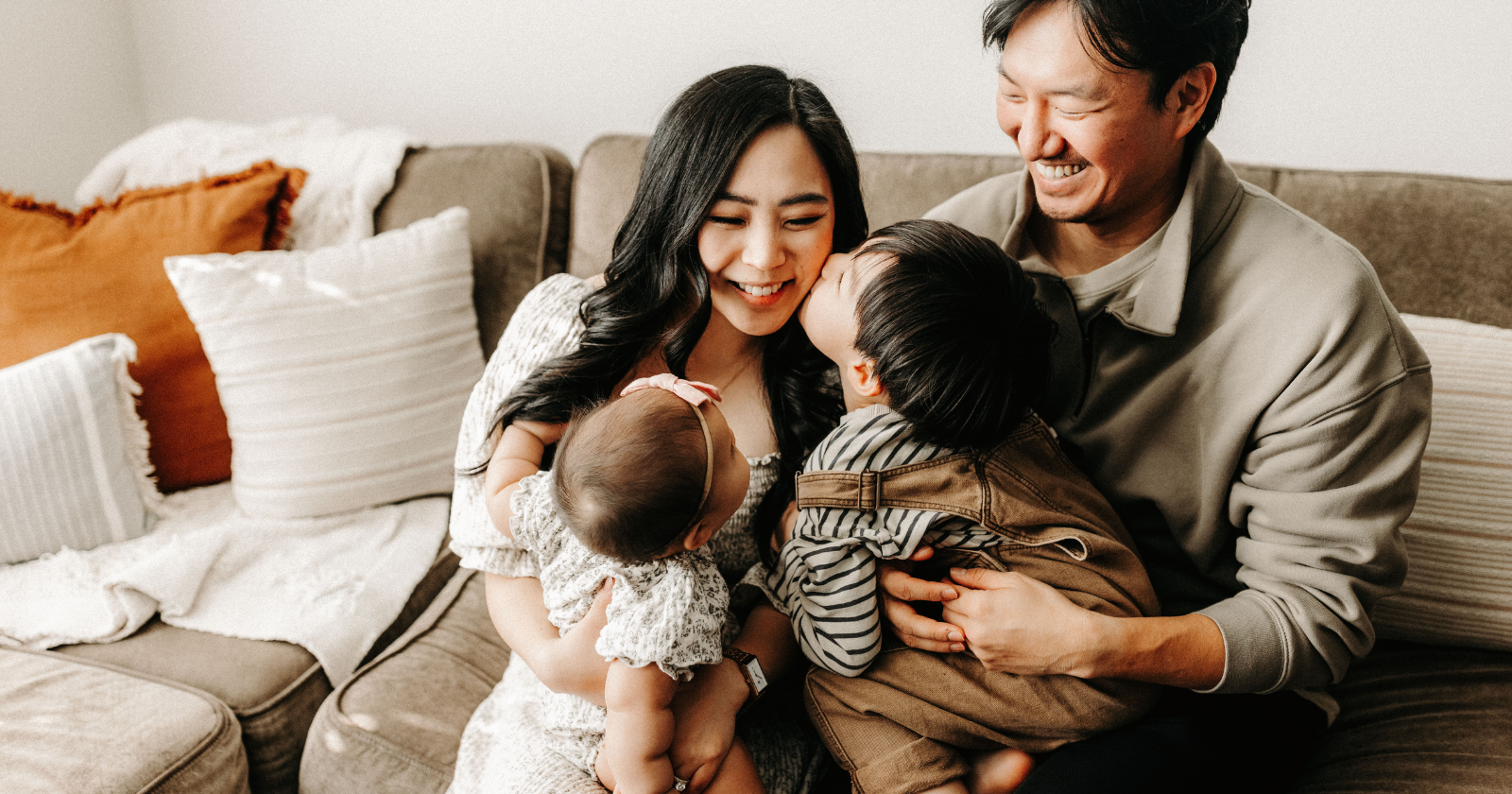
The daily texture of it goes something like this. Children sleep in the same bed as a parent until they are six, seven, eight, sometimes older. Mothers peel fruit and hand it directly to teenagers who are, by Western standards, far too old to be fed. Parents touch their children casually and often: hand on shoulder, fingers through hair, an arm around a waist, well past the age Western parents have mostly stopped. Mothers know not just their teenager’s friends but the friends’ grades, family situations, and current dating life. Fathers know which subject is going badly that week. Nobody in the house thinks any of this is unusual. It is just what being in this family means.
Korean has a word for the bond this kind of daily life produces. The word is jeong. It does not translate cleanly into English. It is something like the feeling of being deeply, accumulatedly connected to a person through years of shared physical and emotional life. The physical part of it has its own everyday word, skinship, a portmanteau of “skin” and “kinship,” used in Korea to describe the casual touch between family members that holds the bond together moment by moment.
We came across a fantastic video that explains the psychology behind how Korean parents raise brilliant kids without burning them out.
On that note – we write about research here, not from a developmental psychology lab. The patterns described come from cross-cultural studies of Korean and Korean American families, not from any one family we know. What this work can do is show that something happens consistently across a lot of Korean homes. It cannot tell us what is happening at any particular dinner table.
What the research shows
The Korean research has been getting more specific about what this combination of high expectations and high closeness actually produces. In a 2018 study of 562 Korean adults aged 19 to 34, researchers at Seoul National University looked at the relationships between parenting style, parent-child affection, and psychological wellbeing. The headline finding was simple. Yes, parents who were highly involved produced more depressive symptoms in their adult children, the same way helicopter parenting does in Western samples. But that effect was largely cancelled out by something else the researchers measured: the affection between parent and child. When the affection was strong, the involvement stopped being a problem. When the affection was weak, the involvement did its damage. The active variable, in other words, was not the strictness. It was the bond underneath it.
This is correlational work on self-reported memories, so it tells us about patterns rather than mechanisms. But the pattern has held across multiple Korean and Korean American studies over the last twenty years. What Western measures had been reading as authoritarian intrusion turned out, on closer inspection, to be running alongside an emotional bond the Western measures could not see.
What does and does not travel
None of this is a recommendation to import Korean parenting wholesale. The cultural conditions are different. In Korea, the daily physical closeness and the involvement in a child’s inner life feel normal because everyone is doing them. The child experiences them as love because the surrounding culture reads them that way. A Western parent who copies the surface practices without that wider cultural surround, particularly the physical closeness with an older child, may produce something different from what the research describes, and possibly something the child experiences as intrusion rather than care.
What might travel is the underlying principle. The kind of warmth Western parenting books measure, which is mostly verbal and explicit, is not the only way a bond gets built. There is another kind of warmth, slower and quieter, that runs through daily presence, casual touch, attention to small shifts in mood, and continued interest in the child’s life past the age most Western parents pull back. The Western framework has not had a name for this kind of warmth, which is part of why the research is only now starting to take it seriously.
The Western coverage of Korean parenting still mostly reports the surface: the strict mothers, the academic pressure, the high expectations. The research keeps pointing somewhere else for what actually produces the emotional security many Korean adults carry into the rest of their lives. The strictness is there. It is not what is doing the work. The work is being done by the parallel practice the strictness has been quietly accompanied by for decades, the thing the people inside it have almost never thought to name out loud, because in Korea it is not a practice. It is just what being in a family is.