
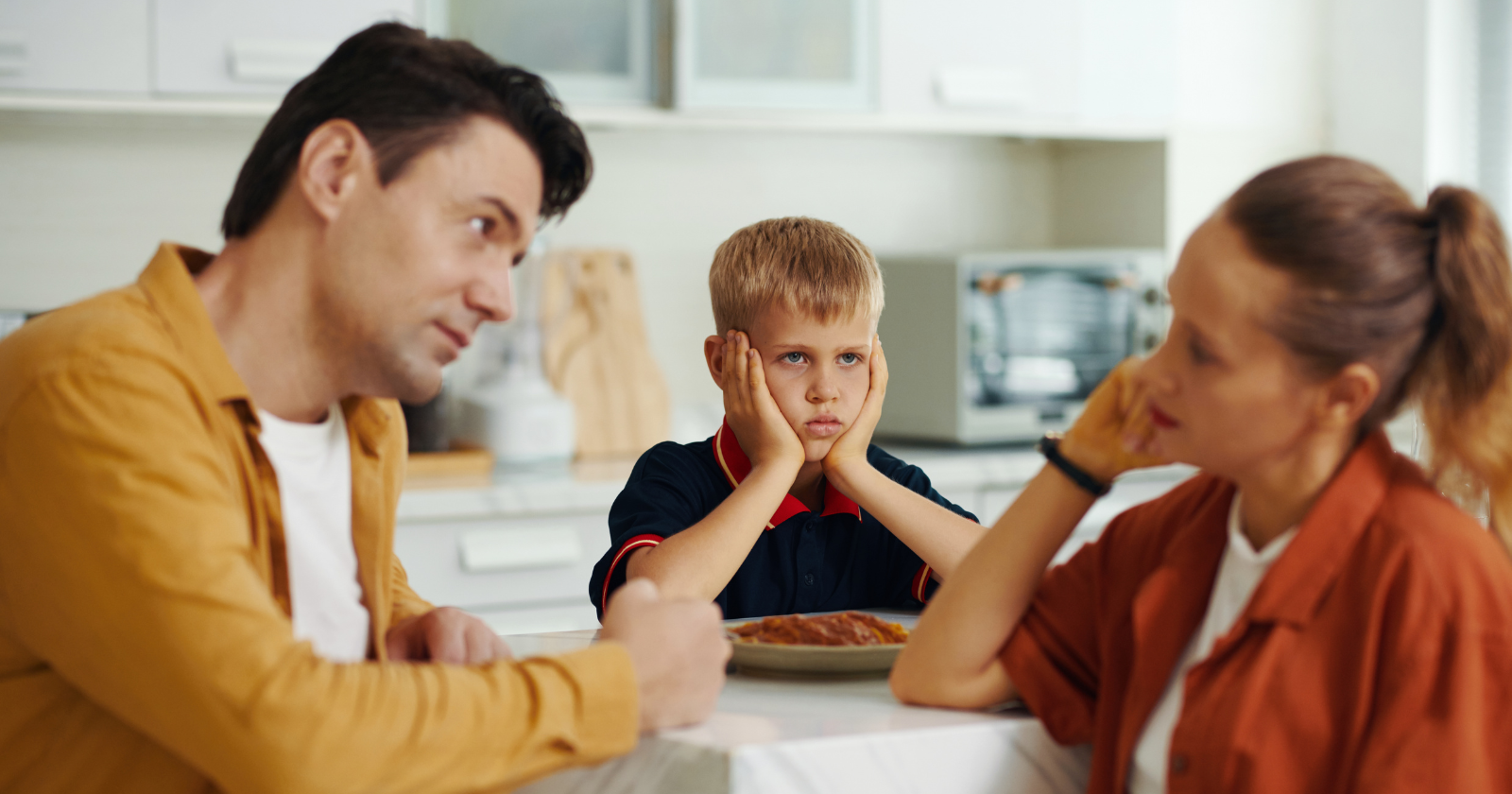
There’s a pattern I’ve been sitting with for a while now, long enough to have found the language for it, and I want to talk about it honestly because I think a lot of us are carrying some version of it without knowing.
I grew up in a small Midwest household with a father who worked long hours and an anxious mother who held everything together on the surface. We had dinner together every night. On paper, it looked like a family. And it was, in the ways that counted practically. But there was also an atmosphere to that house, a kind of low-level vigilance that I absorbed so early I didn’t think of it as anything unusual.
My mother’s mood was the weather. The rest of us dressed for it.
I didn’t know that was something to notice until I was well into adulthood and started to see the pattern playing out in my own life.
The way my stomach still tightens when someone I love seems off and I immediately start mentally scanning for what I might have done, or what I need to do now to smooth things over. The reflexive impulse to make things comfortable for everyone around me before I’ve even checked in with how I’m feeling. The deep, weirdly stubborn sense that my job in any close relationship is to hold the emotional temperature steady.
That is not a personality trait. It is a learned survival strategy. And research is increasingly specific about where it comes from.
What behavioral scientists are calling it
The technical term is emotional parentification. It describes what happens when a child takes on the role of emotional caretaker for a parent, reading the room, keeping the peace, absorbing adult tension, and managing a grown-up’s feelings before their own needs are even on the table.
Psychologists differentiate this from the more visible kind of parentification, where a child takes on physical household responsibilities. Emotional parentification is quieter and harder to see from the outside. The child looks fine, often more than fine. They’re often described as mature and perceptive. Teachers like them. Adults find them easy. And underneath all of that, they are doing an enormous amount of unpaid emotional labor in a household that should never have put it on their shoulders.
A 2026 study published in BMC Psychology examined nearly 450 young adults and found that parent-focused parentification was directly associated with both anxiety and depression in adulthood, and, crucially, that those outcomes were shaped largely by the interpersonal relationship styles the experience produced. In other words, the damage doesn’t stop at childhood. It becomes the blueprint for how a person moves through every close relationship afterward.
The child who learned to regulate a parent’s emotions grows into the adult who monitors a partner’s mood from across a room. Who interprets a friend’s quietness as their fault. Who finds it genuinely difficult to identify what they want or need in any situation, because so many years were spent attending to everyone else’s emotional state first.
The parenting styles that create the conditions
Emotional parentification doesn’t usually happen because a parent is deliberately unkind. It most commonly grows in households where something else is going wrong, often something the parent is struggling with and doesn’t have the resources to handle on their own.
It can develop in authoritarian homes, where a child learns very early that the adult’s emotional state is the one that sets the rules, and that the safest thing to do is read the room and comply before anything is even asked of them. It grows in households with an uninvolved or emotionally absent parent, where the child fills the gap because nobody else does. And it appears, sometimes, in households that look from the outside like they’re functioning perfectly normally.
It’s worth taking a moment with those two styles specifically. A video our team recently made on the five recognized parenting styles puts it plainly: authoritarian and uninvolved parenting are the two researchers flag most consistently as harmful, not because they represent the same problem, but because both, in very different ways, leave a child alone with feelings they weren’t designed to carry. In one case the child suppresses their own feelings to stay safe. In the other, the child becomes the emotional anchor because the parent has effectively vacated that role. Both can produce a version of the same outcome: a child who learns that their feelings are secondary and that the emotional state of the adults around them is their responsibility.
“Role reversal is a hallmark of emotionally immature parenting,” writes Dr. Lindsay C. Gibson in Adult Children of Emotionally Immature Parents. Her work on this dynamic is some of the most precise and widely recognized in the field, and it names something that many people don’t have language for until they read it: the loneliness of growing up feeling more like a parent’s emotional support system than their child.
There’s one truth about you that explains almost everything. Take the free quiz to find out what it is.
What it looks like in a child’s daily life
It doesn’t always look dramatic. In fact, that’s part of why it goes unnoticed for so long.
A child who is emotionally parentified doesn’t necessarily look distressed. They look capable. They track the adults in the room with a precision that can seem like emotional intelligence, and in some ways it is, but it is emotional intelligence born of necessity rather than healthy development. They’ve learned to notice the tiny shift in a parent’s tone that signals trouble. The way silence sounds different depending on what’s underneath it. Which version of the walk down the hall means things are fine versus which version means to stay small and quiet.
They learn to suppress their own needs, not because anyone explicitly told them to, but because they absorbed very early that there wasn’t space for those needs. A child who notices their parent is struggling and quietly puts their own feelings away to accommodate that. A child who comes home from school having had a genuinely hard day and immediately starts scanning the household atmosphere to decide whether it’s safe to say so. A child who becomes very good at cheerfulness on demand.
From the outside, this often looks like a particularly considerate and emotionally aware child. Inside, it is a child whose nervous system has been placed on permanent alert.
The adult who comes out the other side
Here is what tends to be true of those children as adults, and I’m drawing on both the research and a fair amount of personal recognition here.
They are often excellent in a crisis. Calm, competent, and resourceful, because chaos is a familiar environment and they know exactly what to do in it. They are frequently described by others as perceptive and easy to be around. They are good listeners, often the person everyone turns to.
And they find it very hard to let anyone take care of them. They feel guilty asking for things. They misread ordinary expressions of emotion in people they love, interpreting a partner’s tired silence as something they need to fix, or a friend’s irritability as something they caused. They carry an exhausting and largely unconscious belief that their job in any close relationship is to stabilize the other person’s feelings before they attend to their own.
The research in BMC Psychology puts this precisely: the psychological effects of emotional parentification are shaped primarily through the interpersonal relationship dynamics it produces. The anxiety and depression aren’t only direct. They are the downstream consequence of a relational blueprint that says: you are safe when others are regulated, and their feelings are your responsibility.
That blueprint can run very deep. But it is not permanent. And recognizing it is, genuinely, where the shift starts.
The family culture we’re building instead
One of the reasons this pattern matters so much to me as a parent is that I understand how easily it replicates. Not through cruelty, not through dramatic failure, but through ordinary tired moments when a parent’s emotional weather becomes the whole household’s to manage.
I catch myself sometimes, in the evenings when the day has been genuinely hard, letting something into my expression or my tone that my children don’t need to carry. And I try to catch it. Not to fake cheerfulness, because modeling false emotion is its own kind of harm, but to keep my adult feelings in adult territory where they belong.
The commitment in our house is that the children’s feelings are always allowed at the table first. When Ellie comes to me upset, my default is “tell me more,” not a redirect to how I’m feeling or a hurry toward resolution. When Milo has a big feeling, we sit with it rather than rushing him back to fine. Not because I get this right every time, but because I know what it costs a child to be the one who keeps the emotional temperature stable for the adults around them. I’ve been doing that calculation my whole life, and I’d like Ellie and Milo to never learn the math.
That’s not about being a perfect parent. It is about being a parent who is working through their own patterns with enough honesty to stop them from becoming the next generation’s inheritance.
The most important thing to understand
If any of this lands close to home, I want to say something clearly: recognizing this pattern in your childhood is not the same as blaming the people who raised you. Most parents who create these dynamics are not doing it deliberately. They are struggling with their own unmet needs, their own inherited patterns, their own limits. They are doing what they know.
But that understanding, compassionate as it is, doesn’t have to stop you from also acknowledging what it cost you. Both things can be true. Your parents did their best, and the role you were placed in was too heavy for a child.
What you do with that now, in your own close relationships and in your own parenting, is the part that belongs to you. And the moment you can see the pattern clearly enough to name it, you are already doing something different.
For a deeper dive into the different parenting styles, I highly recommend the video I mentioned earlier.
You can watch it here.
