
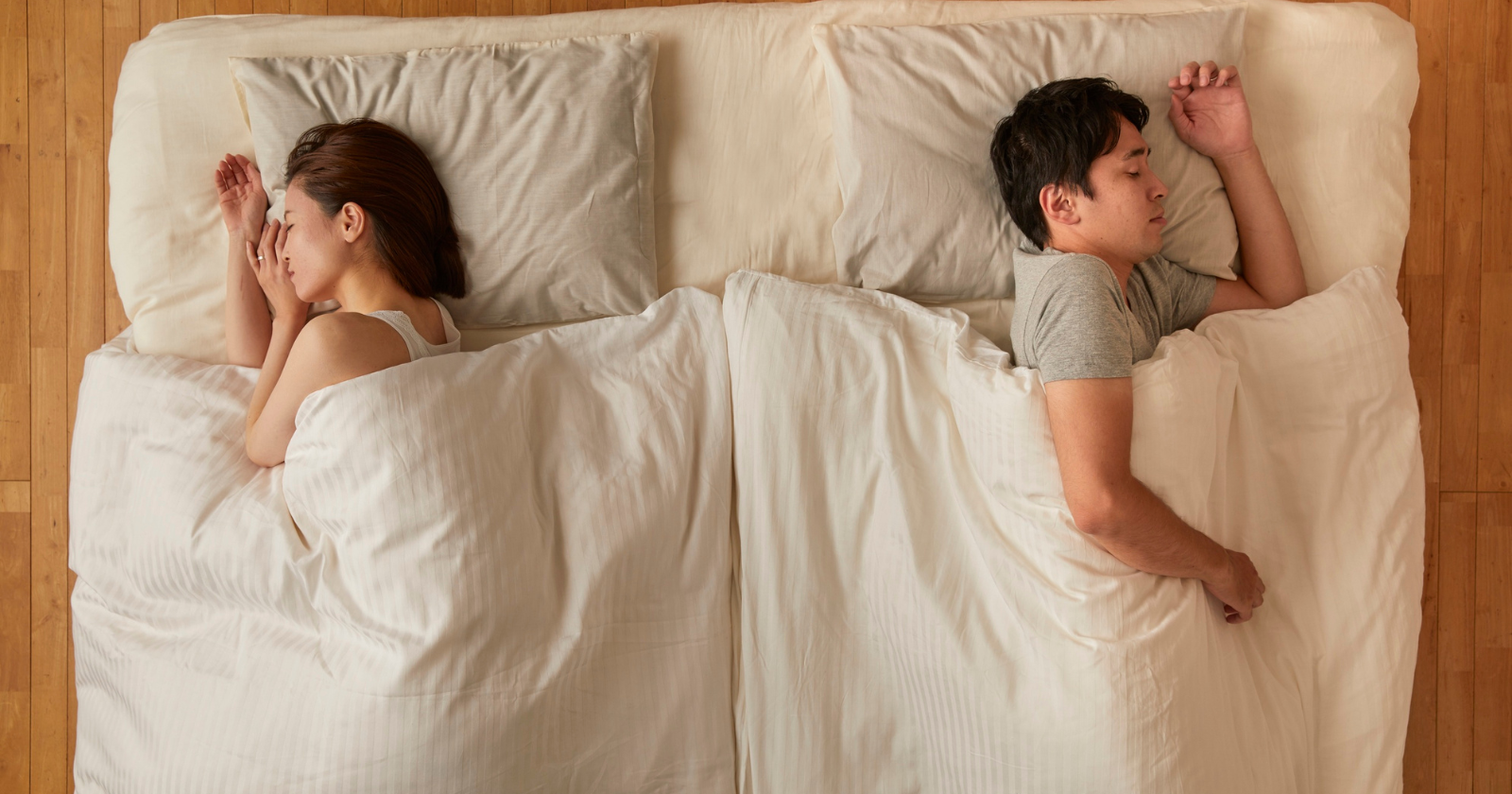
A paper published in Frontiers in Psychiatry in 2020 measured what actually happens when couples sleep next to each other, rather than relying on how they feel about it in the morning. The lead author, Dr. Henning Johannes Drews of the Center for Integrative Psychiatry in Kiel, Germany, recruited twelve young, healthy, heterosexual couples and had them spend four nights in a sleep laboratory: two nights sharing a bed, two nights apart. Then the researchers compared the data.
We are writers and parents, not clinicians. What follows is a careful reading of the research, not medical or sleep advice.
The study is small and exploratory. It is one paper, not a settled area of research, and the authors say so directly.
The Artful Parent
Family-life ideas and sharp reads, in your inbox.
What the lab actually measured
The measurement method was dual simultaneous polysomnography, which captures sleep across multiple channels at once: brain-wave activity, respiration, muscle tension, body movements, and heart rate. Dr. Drews described it in the Frontiers press summary as “a very exact, detailed and comprehensive method to capture sleep on many levels, from brain waves to movements, respiration, muscle tension, movements, heart activity.” This distinguishes the study from most research in this area, which has relied either on accelerometer-based movement data or self-reported sleep quality. By recording EEG, the researchers could track not just how much participants moved, but which stage of sleep they were in at each moment of the night.
That methodological difference matters for interpreting the findings.
The REM finding, and what it actually says
Rapid eye movement sleep, the stage most associated with vivid dreaming, increased by around ten percent when couples shared the bed, according to the paper in Frontiers in Psychiatry. It was also less fragmented. Participants sleeping alongside their partners moved through REM more continuously than when sleeping alone.
A clarification on the phrase “deepest sleep” in the title of this article: REM is not the deepest stage of sleep. The deepest stage is slow-wave sleep, also known as NREM stage 3, in which the brain produces slow delta waves and the body is most difficult to rouse. REM is, in some respects, a lighter stage, during which the brain is highly active and most muscles are temporarily paralyzed. What makes it significant is what it is associated with: emotion regulation, memory consolidation, creative processing, and social cognition. Its consistency and length appear to matter for those functions. So “the deepest sleep” is the popular shorthand; the more precise finding is that a particular stage of sleep became more stable and more plentiful when partners were present.
Similarly, “the deepest sleep happening only when the other person was there” overstates the result. The finding was that REM increased and stabilized with a partner present, not that it occurred exclusively under those conditions.
What the synchronization finding actually means
Beyond REM quantity and stability, the researchers found that couples tended to move through the same sleep stages at the same time when sharing a bed. When one partner was in REM, the other tended to be in REM too. This synchronization of sleep architecture was not simply explained by mutual disturbance: the researchers examined this possibility and found the synchrony held up independently of one partner waking or moving the other.
The degree of synchronization was positively associated with how participants rated the centrality of the relationship to their lives. Couples who said the relationship was more significant to them showed stronger alignment in their sleep stages. The researchers did not establish a causal direction. It is a correlation from a small sample, not a mechanism.
Describing this as “synchronized their brains” is loose. What synchronized was sleep staging as recorded through brain-wave data. That is not quite the same as saying the brains themselves were in direct communication, which the study did not claim and did not test.
What the study cannot tell us
The sample was twelve couples. They were young, healthy, and heterosexual. They were sleeping in a laboratory rather than their own beds, under conditions that are not typical of an ordinary night. The researchers name these constraints in the paper and call for replication in more diverse samples, including older adults and couples where one partner has a health condition.
Some of the analyses were described as exploratory. The finding on synchronization and relationship depth, in particular, is a preliminary observation from a small dataset.
The researchers proposed a positive feedback loop in which co-sleeping improves REM sleep, which in turn improves social and emotional functioning, which supports the relationship, which then supports sleep. This is a reasonable hypothesis. It has not been tested as a causal chain.
A broader pattern in survey data
A separate study, based on survey responses from more than 1,000 working-age adults in the US, found that people who shared a bed with a partner reported falling asleep faster, sleeping longer, and feeling less fatigued upon waking than those who slept alone. That research was presented at the 2022 annual meeting of the Associated Professional Sleep Societies and reported by ScienceAlert. The group who slept with partners also reported lower levels of depression, anxiety, and stress. Whether those differences owe something to the sleep itself, to the health of the relationship more broadly, or to some combination of both, the survey data cannot say.
Self-reported sleep quality and laboratory polysomnography are measuring different things. One captures how people feel about their sleep. The other records what appears to be happening neurologically. Both show something. Neither gives the full picture on its own.
An earlier study, published in the journal Sleep, found that couples sleeping together increase their body movements at night and do so in rough synchrony with each other. The Drews paper adds a neurological layer to that observation, suggesting the alignment runs deeper than physical movement.
What the finding adds up to
The popular version of this study, including the title of this article, reaches a little further than the data. The brain synchronization framing is imprecise. The “only when the other person was there” phrasing is too absolute. REM is not the deepest sleep.
Strip those simplifications away and what remains is still genuinely interesting: when couples share a bed, a meaningful stage of sleep tends to become more stable and more consistent, and their sleep stages drift into alignment with each other in ways that appear connected to how much the relationship means to them. That is a specific, careful finding from a small study. It is not the final word on why sharing a bed matters, or whether it does for everyone. But it is a more precise question than the ones the sleep-advice industry usually asks.