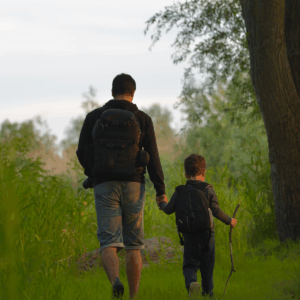

Growing up in the ’70s, I can still smell the metallic tang of my bike chain after riding through puddles, feel the rough bark of the tree we’d climb without a second thought, and hear the screen door slam as we raced outside after breakfast, not to return until the streetlights came on.
Back then, nobody called it “free-range parenting,” because it was just childhood.
What we had was time, freedom, and a whole lot of unsupervised adventures that would probably horrify today’s parents.
Now, decades later, psychologists are connecting the dots between how we grew up and how my generation approaches relationships today.
Some of it’s good, some not so much, but all of it shaped us in ways we’re only beginning to understand.
I’ve been thinking about this a lot lately, especially watching my two sons navigate their own relationships and raise their kids.
The contrast between their childhoods in the ’90s and mine in the ’70s is stark.
Honestly? I think we might have had something special, even if it wasn’t perfect.
1) Playing outside until dark without supervision
Remember when “be home by dinner” was the only rule? We’d disappear for hours, building forts, exploring creeks, and even getting into minor scrapes.
Psychologists now say this taught us self-reliance in relationships.
We learned to solve problems without immediately calling for backup.
Related Stories from The Artful Parent
- Psychology says the parents whose adult children gradually stop visiting aren’t usually the ones who were cruel or absent — they’re often the ones so focused on providing and protecting that they never learned to simply be company, and children grow up moving towards the people they feel easy with rather than the people they owe the most to
- There are three stages to calling your aging parent. First you call because you want to. Then you call because you should. Then you call because you’re running out of calls and you’ve started counting without meaning to. Most people are in the second stage and pretending they’re still in the first.
- Psychology says adult children who love their parents but avoid visiting them aren’t selfish — they’re protecting themselves from a role reversal their nervous system registers as existential threat
When conflicts arose with neighborhood kids, we had to work it out ourselves or walk home alone.
The downside? Some of us struggle to ask for help when we genuinely need it.
We’re so used to figuring things out solo that we sometimes forget relationships are about partnership.
2) Getting picked last for teams (and dealing with it)
Every recess, we’d line up while two kids picked teams and someone always got picked last.
Sometimes it was me, especially in basketball.
There was no participation trophy waiting, no adult stepping in to make it fair.
Was it harsh? Sure, but we learned to bounce back, to try harder, or to find our strengths elsewhere.
In adult relationships, this translates to resilience when facing conflict or disappointment.
Though I’ll admit, some of us took this too far.
We became so good at shrugging off hurt that we struggle to be vulnerable with partners.
If you never learned it’s okay to admit something hurts, how do you open up in intimate relationships?
3) Having dinner together every single night
At 6 PM sharp, we sat down for dinner.
No exceptions, no eating in front of the TV, and no grabbing something quick between activities; we talked, we argued, and we shared our days.
This ritual taught us that relationships require consistent, dedicated time.
Psychologists say this regular face-to-face interaction developed our ability to read social cues, navigate family dynamics, and understand that showing up matters.
I tried to maintain this with my own sons when they were young, though work made it harder during their teen years.
Looking back, I wish I’d protected that dinner hour more fiercely.
4) Fighting with siblings without parental intervention
My brother and I would wrestle, argue, and occasionally throw punches.
Unless someone was bleeding or something got broken, our parents stayed out of it.
“Work it out yourselves,” they’d say.
This taught us conflict resolution the hard way.
We learned that relationships can survive fights, that you can be furious with someone and still love them, and that sometimes you need to be the one who apologizes first.
This gave us thicker skin in relationships but also sometimes made us too accepting of conflict.
Some of us normalized fighting as just part of relationships instead of learning healthier communication methods.
5) Being bored (really, truly bored)
Summer afternoons stretched endlessly.
We learned to entertain ourselves, to daydream, to initiate activities.
In relationships, this translates to not expecting partners to be our constant entertainment.
We’re comfortable with silence, with parallel activities, with just being together without constant stimulation.
The challenge? Some of us became so self-sufficient in our entertainment that we forget to actively engage with partners.
We might be in the same room but worlds apart.
6) Walking or biking everywhere alone
At eight years old, I’d bike two miles to the store for candy.
At ten, I’d walk to friends’ houses across town.
Nobody thought twice about it.
This independence shaped how we approach relationships as adults.
We don’t expect partners to accompany us everywhere.
We maintain individual friendships and interests.
This created healthier boundaries and less codependency, but it also meant some of us struggle with interdependence.
We’re so used to doing things alone that we forget to include partners in decisions or adventures.
7) Playing without safety gear
No helmets, no knee pads, no cushioned playground surfaces.
We learned through scraped knees and occasional broken bones that taking risks had real consequences.
This taught us to assess danger for ourselves, to understand our limits, and to accept that sometimes you get hurt.
In relationships, we’re often willing to take emotional risks, understanding that vulnerability might lead to pain but also to deeper connections.
The flip side? Some of us became too comfortable with emotional danger, staying in unhealthy relationships because we’d normalized a certain level of harm.
8) Experiencing real consequences
Failed a test? That grade stuck.
Forgot your lunch? You went hungry.
Broke something? You worked to pay for it.
We learned that actions have consequences, that nobody was going to swoop in and fix our mistakes.
In relationships, this made us accountable partners who understood that trust, once broken, takes real work to rebuild.
Yet, sometimes, we’re too hard on ourselves and others, forgetting that compassion and second chances are also part of healthy relationships.
Closing thoughts
Watching my sons raise their kids with scheduled playdates and constant supervision, I sometimes wonder if we’ve overcorrected.
Yes, the ’70s approach had flaws.
We probably could have used more emotional support and definitely more safety awareness, but that independence, resilience, and ability to be comfortable with ourselves? Those were gifts, even if imperfectly wrapped.
The key is to recognize what shaped us, both good and bad.
Understanding why we approach relationships the way we do is the first step to keeping what serves us and changing what doesn’t.
What parts of your childhood still influence how you connect with others today?