
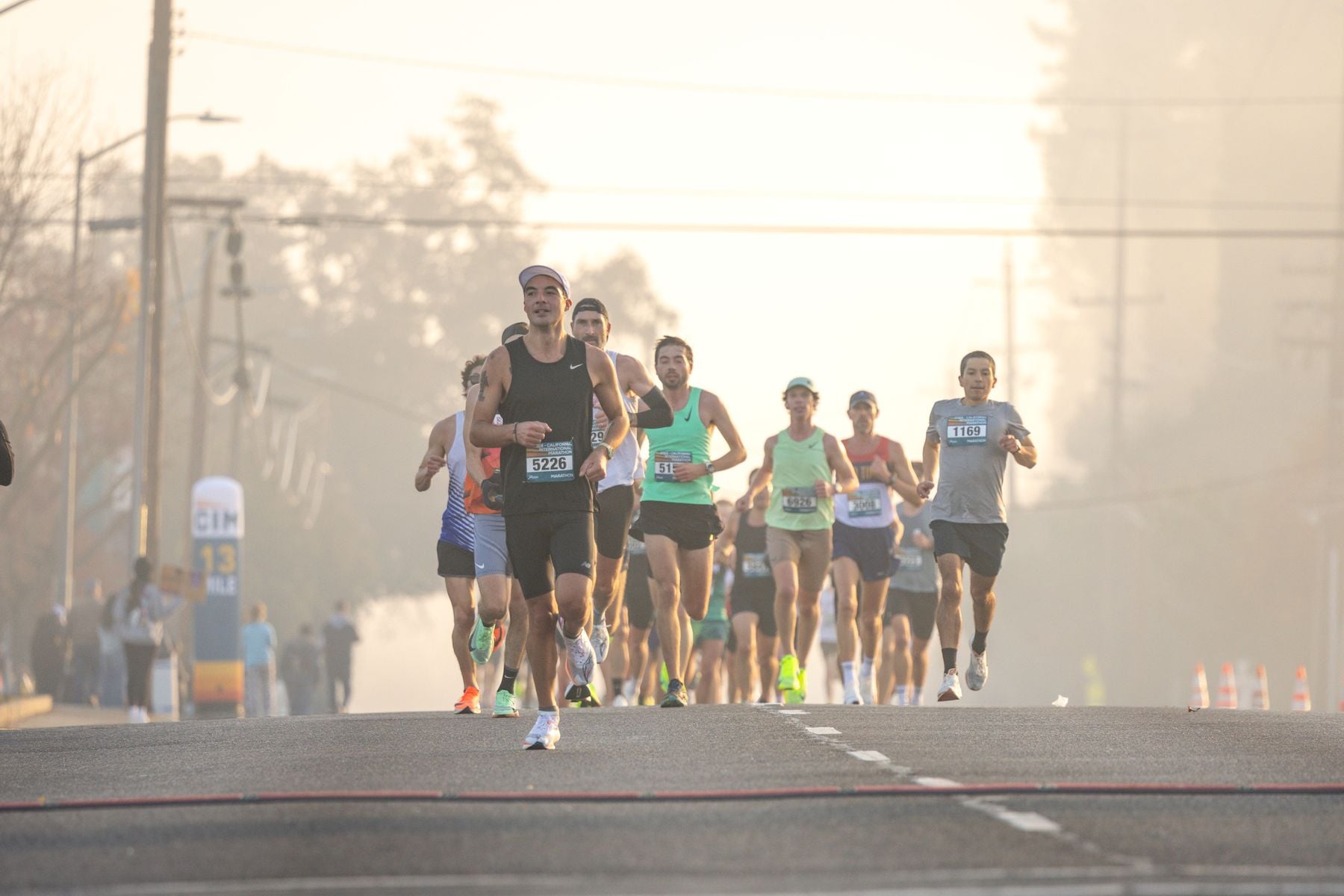
The usual story about marathon runners is that they are gluttons for punishment: people who have decided that 26.2 miles of joint pain is a reasonable way to spend a Sunday, and who must therefore be running from something. William Morgan’s research suggested a different picture. Morgan directed the Sport Psychology Laboratory at the University of Wisconsin-Madison, and starting in the early 1970s he gave a standard psychological questionnaire called the Profile of Mood States, or POMS, to Olympic-caliber wrestlers, milers, oarsmen, and marathoners, work later published with Michael Pollock in the Annals of the New York Academy of Sciences. The POMS measures six mood states: tension, depression, anger, fatigue, confusion, and vigor. Morgan found that his elite athletes, marathoners included, scored below the general population average on the five negative states and above average on vigor. Plotted on a graph, the five low scores sit below a baseline like the submerged bulk of an iceberg, with vigor rising above it as the visible tip. Morgan named it the iceberg profile, and the label stuck.
The finding held up reasonably well over time, at least as a description. A 2024 narrative review in EXCLI Journal by Lorin Braschler and colleagues, including the veteran ultramarathon researcher Beat Knechtle, surveyed more recent personality and mood research on marathoners and reported the same shape: runners tend to score high on vigor, self-sufficiency, and measures of intelligence, and low on anger, fatigue, tension, and depression, compared with population norms. The review also noted that the pattern is not identical across every runner. It shifts somewhat by sex, age, and performance level, so “marathon runner” is not one personality but a cluster of related ones.
Where the story gets more careful is in what the iceberg profile can and cannot tell you. Morgan’s original work, and much of what followed, was read for years as suggesting that this mood pattern was a marker of athletic talent, something that separated the athletes who would podium from the ones who wouldn’t. A 1995 meta-analysis in the Journal of Sport and Exercise Psychology, led by Allan Rowley, tested that idea directly across 33 studies and found the iceberg profile’s ability to predict who actually performs better was weak: the measured effect explained less than one percent of the variance in performance outcomes. The same review found the iceberg pattern showing up among successful and unsuccessful athletes alike, and among athletes in general, not marathoners specifically. So the honest version of the finding is narrower than the popular one. The iceberg profile looks like a common feature of people who train seriously at any endurance or competitive sport, not a secret psychological ingredient unique to people who finish marathons, and not a reliable predictor of who wins.
There’s also a real question of cause and effect that the mood-state research on its own cannot settle. It could be that marathon training lowers tension and fatigue and raises vigor over time. It could equally be that people who already run lower on anxiety and higher on vigor are the ones who stick with marathon training long enough to be recruited into a study, while people who find the training miserable quietly drop out beforehand. Most of the studies behind the iceberg profile are cross-sectional snapshots of people already deep into a training cycle, which cannot distinguish those two explanations from each other.
What the mood-state research doesn’t capture is what many runners actually report during the race itself, which is not vigor but a specific kind of collapse. A 2008 study in Psychology of Sport and Exercise by Matthew Buman, Britton Brewer, Allen Cornelius, and colleagues surveyed 315 recreational marathoners, 218 men and 97 women, across three marathons on the U.S. Eastern Seaboard. Forty-three percent reported “hitting the wall” at some point in the race, describing it consistently as a cluster of sudden fatigue, an unplanned slowing of pace, an urge to walk, and a narrowing of focus down to simple survival to the finish line. Runners who expected to hit the wall beforehand were more likely to report that they did, which suggests expectation plays some role alongside physiology. The wall is a real, commonly reported experience for a large share of marathoners, and it sits alongside the calmer baseline mood picture rather than contradicting it. A runner can plausibly score low on everyday anxiety and still spend the last six miles of a marathon in genuine distress.
The broader context is that endurance exercise in general, not just marathon training specifically, has a well-documented relationship with mood. A 2026 umbrella review in the British Journal of Sports Medicine, led by Neil Munro, pooled 63 prior reviews covering more than 1,000 individual studies and nearly 80,000 participants, and found that exercise, aerobic activity especially, reduced symptoms of depression and anxiety by an amount comparable to psychological therapy or medication in many of the studies reviewed. That doesn’t prove marathon training specifically builds the iceberg profile in any one person. It does mean the general association between sustained aerobic exercise and lower everyday anxiety and depression is one of the more consistently replicated findings in exercise science, which makes Morgan’s original observation about elite distance runners look less like an isolated curiosity and more like one visible instance of a broader pattern.
Put together, the honest summary is this: marathon runners as a group do tend to report calmer, more vigorous mood profiles than population norms, a finding that has replicated across decades of research. But the profile does not identify who will become a great runner, and the evidence cannot tell us how much of it was created by training and how much was already present in the people willing to train.
That makes the stereotype of the psychologically troubled marathoner difficult to defend. The average committed runner does not appear unusually angry, depressed, or anxious. If anything, the pattern points in the opposite direction. Marathoners tend to look psychologically steady in ordinary life, even though the event they have chosen deliberately exposes them to exhaustion, discomfort, and moments when continuing feels almost impossible.
Perhaps that is the more interesting explanation for why people run marathons. They are not necessarily seeking pain, and they are not immune to it. They are repeatedly practising the ability to experience discomfort without treating it as an emergency. The race can be brutal while the runner remains, outside it, comparatively calm.
The iceberg profile was never proof that marathoners are happier, tougher, or more mentally healthy than everyone else. It was a statistical shape found in groups of serious athletes. But the shape does overturn one familiar assumption: the person running for hours every Sunday may not be running away from something. They may simply have learned that temporary suffering and a troubled mind are not the same thing.
